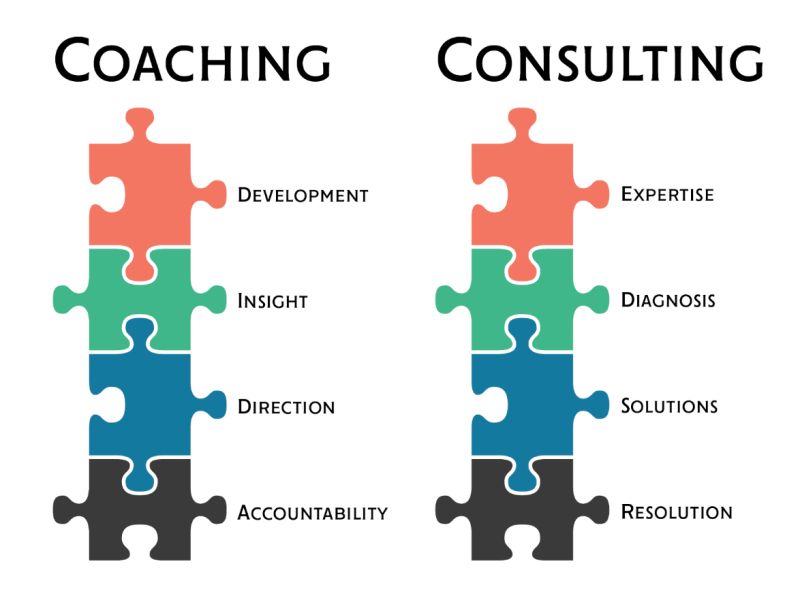

Many business owners consider outside support when they want to grow, improve performance, or solve challenges. However, confusion often arises between consulting and coaching, as both services appear similar at first glance. That is why Business Consulting vs Coaching What’s the Difference is an important question for companies seeking the right type of support. While both approaches aim to improve business outcomes, they differ significantly in structure, execution, and results. Additionally, choosing the wrong approach can lead to frustration and limited progress. When understood correctly, Business Consulting vs Coaching What’s the Difference becomes clear through how each method supports growth and decision-making.
Understanding Business Consulting
Business consulting focuses on providing expert advice, strategies, and solutions to improve a company’s performance. Consultants analyze the business, identify problems, and recommend specific actions. Therefore, consulting is typically more directive and results-oriented.
Consultants often bring specialized expertise in areas such as strategy, marketing, operations, or finance. They work closely with businesses to implement solutions that drive measurable results. Additionally, consultants may assist with execution to ensure that strategies are applied effectively.
Key characteristics of business consulting include:
• Providing specific recommendations and solutions
• Analyzing data and identifying inefficiencies
• Implementing strategies to improve performance
• Delivering measurable results
This approach is ideal for businesses that need clear direction and actionable solutions.
Understanding Business Coaching
Business coaching focuses on guiding business owners and leaders to develop their own solutions. Instead of providing direct answers, coaches ask questions that encourage self-reflection and growth. Therefore, coaching is more focused on personal development and leadership.
Coaches help individuals improve decision-making, communication, and leadership skills. Additionally, they support goal-setting and accountability. However, they typically do not provide detailed strategies or direct implementation support.
Key characteristics of business coaching include:
• Guiding individuals through questioning and reflection
• Focusing on personal and leadership development
• Encouraging self-generated solutions
• Providing accountability and support
This approach is ideal for business owners who want to improve their mindset and leadership abilities.
Key Differences Between Consulting and Coaching
While both consulting and coaching aim to improve business outcomes, they differ in several important ways. Understanding these differences helps businesses choose the right approach.
The main differences include:
• Consulting provides direct solutions, while coaching guides self-discovery
• Consultants focus on business systems, while coaches focus on individuals
• Consulting is often short-term and project-based, while coaching can be ongoing
• Consultants implement strategies, while coaches support personal growth
These differences highlight the unique value each approach offers. Therefore, businesses must choose based on their specific needs and goals.
When to Choose Business Consulting
Business consulting is the right choice when a company needs clear direction and expert solutions. It is particularly valuable when businesses face complex challenges that require specialized knowledge.
Situations where consulting is most effective include:
• When revenue growth has stalled
• When operations are inefficient
• When marketing and sales performance is weak
• When scaling requires new systems and processes
In these cases, consultants provide actionable strategies that lead to measurable improvements. Additionally, they help implement changes that drive results.
When to Choose Business Coaching
Business coaching is most effective when the focus is on personal development and leadership improvement. It is ideal for business owners who want to enhance their skills and mindset.
Situations where coaching is beneficial include:
• When leaders want to improve decision-making
• When communication and team management need improvement
• When accountability and goal-setting are priorities
• When personal growth is a key focus
Coaching helps individuals become better leaders, which can positively impact the entire organization.
Combining Consulting and Coaching for Maximum Impact
In many cases, businesses benefit from combining consulting and coaching. While consulting provides strategies and solutions, coaching supports leadership development and execution. Therefore, using both approaches can create a more comprehensive growth strategy.
For example, a consultant may develop a growth strategy, while a coach helps the business owner implement it effectively. This combination ensures that both the business and the individual are aligned.
Benefits of combining both approaches include:
• Improved strategy and execution
• Stronger leadership and decision-making
• Increased accountability
• Better long-term results
By leveraging both consulting and coaching, businesses can achieve more balanced and sustainable growth.
Avoiding Common Mistakes When Choosing
Choosing between consulting and coaching requires careful consideration. Many businesses make the mistake of selecting the wrong approach, which can limit results. Therefore, understanding common pitfalls is important.
Common mistakes include:
• Choosing coaching when specific solutions are needed
• Hiring consultants without clear goals
• Expecting coaches to provide direct strategies
• Failing to align services with business needs
Avoiding these mistakes ensures that businesses get the most value from their investment.
Q&A
| Question | Answer |
|---|---|
| What is the main difference between consulting and coaching? | Consulting provides direct solutions, while coaching focuses on guiding individuals to find their own answers. |
| Which is better for business growth? | Consulting is better for immediate business improvements, while coaching supports long-term leadership development. |
| Can a business use both consulting and coaching? | Yes, combining both approaches can provide strategy and personal development. |
| Is coaching enough to solve business problems? | Coaching helps with leadership but may not provide the technical solutions needed for complex challenges. |
| When should a business hire a consultant instead of a coach? | A business should hire a consultant when it needs clear strategies and expert solutions. |
Choosing the Right Approach for Your Business
Business Consulting vs Coaching What’s the Difference ultimately comes down to understanding what your business needs most. Consulting provides direct solutions and measurable results, while coaching supports personal and leadership development. Businesses that choose the right approach can accelerate growth, improve performance, and achieve long-term success. By aligning support with specific goals, companies can make more effective decisions and maximize their potential.