
Many businesses invest heavily in marketing, advertising, and lead generation without understanding how much potential revenue disappears before a sale is completed. They generate inquiries, schedule meetings, prepare proposals, and pursue prospective customers, yet their sales performance remains inconsistent. When this happens, business owners frequently assume that increasing marketing spending is the solution, even though weaknesses within the existing sales process may be responsible for a significant portion of their lost opportunities.
These weaknesses create revenue leaks in your sales pipeline, allowing prospective customers to disappear because of delayed responses, inconsistent follow-up, poor qualification, disconnected technology, or ineffective sales procedures. Some lost opportunities are unavoidable, but others result from operational problems that can be identified and corrected. Over time, recurring inefficiencies can undermine profitability, increase customer acquisition costs, and prevent a company from achieving predictable revenue growth.
Identifying revenue leakage requires more than reviewing monthly sales totals. Companies need to understand how prospects enter the sales pipeline, how they progress through each stage, where opportunities stall, and which improvements are most likely to increase conversion rates. A structured approach to sales pipeline analysis helps management distinguish genuine demand problems from weaknesses in customer acquisition, communication, and operational execution.
This guide explains how to identify revenue leaks, calculate their financial impact, diagnose common causes, and implement practical improvements that strengthen sales performance without unnecessarily increasing marketing expenditures.
What Are Revenue Leaks in a Sales Pipeline?
Revenue leakage occurs when a business loses potential income because of preventable weaknesses in its sales processes, customer communication, technology, or operational management. These problems can arise at any stage of the customer acquisition journey, from the initial inquiry to final negotiations and contract approval. In some cases, prospective customers never receive a response. In others, qualified opportunities remain inactive because the sales team fails to maintain communication or provide the information required for a purchasing decision.
Not every lost sale represents preventable revenue leakage. Prospects may lack sufficient budgets, select competitors for legitimate reasons, or determine that a particular product or service does not meet their needs. These outcomes are normal parts of business development. Revenue leakage becomes an operational concern when opportunities could reasonably have progressed further through better execution, clearer communication, or more reliable business systems.
Consider a professional services company that receives 150 inquiries each month. If 20 inquiries are never assigned to a salesperson, another 25 receive delayed responses, and several qualified prospects never receive appropriate proposal follow-up, the company may be losing valuable opportunities before its sales team has a reasonable chance to compete. The financial consequences depend on lead quality, conversion probability, average deal value, and delivery costs, but the operational weaknesses can be measured and improved.
Businesses seeking stronger customer acquisition and conversion processes can explore BCA’s Revenue & Lead Generation consulting services, which address lead management, conversion optimization, and scalable revenue systems.
Why Sales Pipeline Revenue Leakage Often Goes Unnoticed
Revenue leakage frequently remains undetected because businesses focus on completed transactions rather than the entire process that produces them. Monthly revenue reports reveal what the company earned, but they do not necessarily explain how many qualified opportunities were lost, why prospects disengaged, or whether operational failures contributed to disappointing results.
Another common problem is fragmented customer information. Marketing teams may track inquiries in one application, sales representatives may maintain separate records, and customer service employees may rely on email conversations that are not connected to the CRM. Without a consistent record of customer interactions, management cannot accurately determine how opportunities progress or where they disappear.
Sales performance can also appear healthy when overall revenue increases, even while conversion efficiency deteriorates. A company might generate more sales simply because advertising spending has increased, masking declining lead quality or weaker follow-up performance. Evaluating revenue alongside conversion rates, sales cycle length, acquisition costs, and contribution margins provides a more complete understanding of business performance.
Map Your Sales Pipeline to Identify Conversion Gaps
Before calculating lost revenue, companies must establish a clearly defined sales pipeline. Every stage should have a consistent meaning, an accountable owner, and measurable conditions for progression. Without these definitions, employees may record similar opportunities differently, making conversion analysis unreliable and preventing management from identifying meaningful patterns.
A typical business-to-business sales pipeline includes the following stages:
- Lead capture: A prospective customer enters the system through a website inquiry, telephone call, referral, email, or marketing campaign.
- Initial contact: A representative establishes communication and confirms the prospect’s requirements.
- Lead qualification: The company evaluates suitability, purchasing authority, budget, timing, and business needs.
- Discovery: The sales team develops a detailed understanding of the customer’s problem and potential solutions.
- Proposal: Pricing, deliverables, timelines, and commercial terms are presented.
- Evaluation and negotiation: The prospect reviews the offer, requests clarification, and considers alternatives.
- Closed won or lost: The opportunity reaches a documented outcome.
These stages should be adapted to the company’s actual sales model. A manufacturer selling complex equipment will have different qualification requirements and purchasing cycles from a business providing recurring professional services. What matters is that opportunities are tracked consistently and that management can identify the reasons they advance, stall, or close unsuccessfully.
Salesforce’s guide to sales pipeline management similarly emphasizes defining stages, establishing progression criteria, and measuring conversion performance. These principles provide a useful foundation for businesses developing more disciplined sales processes.
Seven Common Causes of Sales Pipeline Revenue Leakage
Revenue leakage rarely originates from a single issue. More often, several operational weaknesses combine to reduce conversion rates, increase sales cycle length, and create inconsistent customer experiences. Identifying these problems individually allows businesses to prioritize corrective actions according to financial impact rather than relying on assumptions.
Missed Inquiries and Unrecorded Leads
The earliest revenue leak occurs when a prospective customer contacts a business but the inquiry is never properly captured or assigned. Website forms may malfunction, telephone messages may remain unanswered, or emails may arrive in inboxes that employees monitor inconsistently. In organizations using multiple marketing platforms, leads can also disappear when integrations fail or customer information is entered incorrectly.
These problems are especially costly because marketing has already succeeded in generating interest. Businesses should test every inquiry channel regularly and confirm that each legitimate lead produces an accurate CRM record, an assigned owner, and a documented next action. A daily exception report identifying unassigned or unanswered inquiries can help management detect problems before opportunities are permanently lost.
Slow Lead Response Times
Prospective customers frequently compare several providers before making a purchasing decision. When a company takes too long to respond, buyers may begin evaluating competitors, lose interest, or conclude that the business cannot provide the level of service they expect. Although appropriate response times vary by industry and sales complexity, organizations should establish internal standards and measure actual performance against them.
Lead response time should be calculated from the moment an inquiry arrives until the first meaningful response occurs. Automated confirmation emails can reassure customers that their request was received, but they should not be confused with substantive sales engagement. Companies should evaluate response times by lead source, department, business hours, and assigned representative to determine whether delays result from staffing, routing, or workflow problems.
Inconsistent Lead Qualification
Poor qualification creates revenue leakage by directing sales resources toward unsuitable prospects while higher-value opportunities receive insufficient attention. Representatives may spend considerable time preparing proposals for prospects without the necessary budget, purchasing authority, or business requirements. Meanwhile, genuinely qualified buyers may experience delays because the sales team is overloaded with low-probability opportunities.
An effective qualification framework should reflect the company’s products, services, and customer characteristics. A consulting business may prioritize company size, project urgency, operational needs, and decision-making authority, while a manufacturer may evaluate order volume, technical requirements, and delivery schedules. Qualification criteria should also be reviewed against actual sales outcomes to ensure that the system identifies commercially valuable opportunities rather than simply producing arbitrary scores.
Weak Follow-Up and Abandoned Opportunities
Many potentially valuable opportunities become inactive after an initial conversation or proposal because the company lacks a consistent follow-up process. Prospects may need internal approval, additional information, or time to compare alternatives, but the sales representative may fail to establish a clear next action. When follow-up depends entirely on individual memory, opportunities can remain unresolved until the customer disengages.
Effective follow-up should provide relevant information and help customers move toward an informed decision. Representatives might clarify implementation requirements, answer outstanding questions, provide appropriate examples, or arrange a proposal review. CRM reminders and automated task creation can improve consistency, but the underlying communication should remain appropriate to the customer’s needs and purchasing timeline.
Ineffective Proposals and Unclear Commercial Value
Proposal-stage revenue leakage occurs when qualified prospects receive offers that do not clearly explain the recommended solution, expected outcomes, responsibilities, or commercial terms. A proposal may contain extensive descriptions of services while failing to connect those deliverables to the customer’s actual problem. Pricing may also appear difficult to justify when the proposal does not communicate business value or address implementation concerns.
Companies should review proposals as part of the sales process rather than treating them as administrative documents. Strong proposals explain the customer’s requirements, recommended solution, project scope, timeline, pricing, and next steps. Proposal win rates should be evaluated alongside average deal size, qualification quality, competitive conditions, and sales cycle length, since declining conversion does not always indicate poor proposal quality.
Disconnected CRM and Business Systems
Revenue leakage frequently develops when marketing, sales, scheduling, accounting, and customer service applications operate independently. Employees may work with incomplete records, duplicate communications, or overlook important information because systems do not exchange data reliably. These problems create administrative inefficiencies and can damage customer confidence when prospects receive inconsistent or inappropriate communication.
Improving the situation requires clearly defined data flows, reliable integrations, consistent customer records, and procedures for identifying system failures. Businesses considering broader modernization can explore BCA’s AI Operations & Infrastructure services to understand how connected workflows and operational systems can support more reliable business execution.
Poor Visibility Into Lost Opportunities
Companies that record only completed sales often lack the information needed to understand why other opportunities failed. A CRM record marked simply as “lost” provides limited intelligence when the same designation is used for pricing objections, inadequate qualification, delayed decisions, and competitor selection. Without more specific information, management cannot distinguish normal competitive losses from preventable operational failures.
A more useful approach involves establishing consistent lost-deal categories and requiring brief explanations for meaningful opportunities that close unsuccessfully. Managers can then examine patterns across products, customer segments, acquisition channels, and representatives. Repeated losses attributed to implementation uncertainty may indicate a need for clearer proposals, while recurring communication failures may reveal weaknesses in follow-up procedures.
How to Calculate Revenue Leakage in Your Sales Pipeline
Once the sales process is mapped, businesses can estimate the financial consequences of conversion gaps. This requires reliable information about the number of opportunities entering each stage, the percentage advancing, average deal value, and contribution margin associated with additional sales. The objective is not to assume that every lost opportunity could have been recovered, but to identify realistic improvements supported by operational evidence.
The starting point is the conversion rate between pipeline stages:
Stage Conversion Rate = (Opportunities Advancing ÷ Opportunities Entering the Stage) × 100
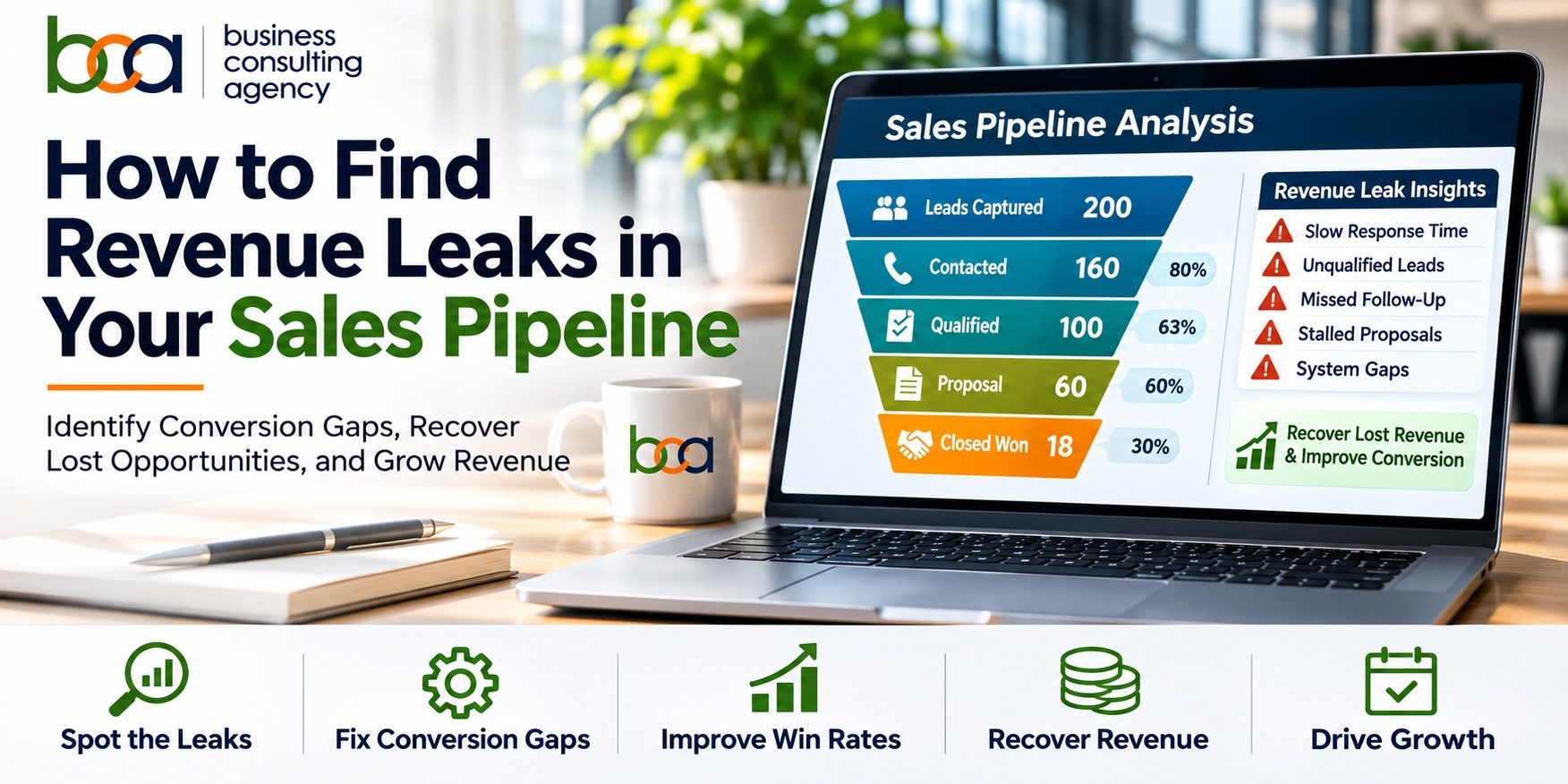
Consider a professional services company that records 200 qualified inquiries during a quarter. Of those inquiries, 160 progress to initial conversations, 100 complete discovery, 60 receive proposals, and 18 become customers. These figures establish a baseline for evaluating where opportunities decline and which stages may warrant further investigation.
| Sales pipeline stage | Opportunities | Conversion from previous stage |
|---|---|---|
| Qualified inquiries | 200 | — |
| Initial conversations | 160 | 80% |
| Discovery completed | 100 | 62.5% |
| Proposals delivered | 60 | 60% |
| Closed-won customers | 18 | 30% |
The company’s overall qualified-inquiry-to-customer conversion rate is 9%. However, that percentage does not establish how much revenue has been lost unnecessarily. Some prospects will not be suitable customers, and some competitive losses are unavoidable. Management must compare results with historical performance, realistic improvement targets, and documented reasons for unsuccessful opportunities.
Estimating the Financial Impact of Conversion Improvements
Assume the company delivers 60 proposals per quarter and wins 18, producing a 30% proposal win rate. If stronger qualification, proposal quality, and follow-up increased the win rate to 35%, the business would secure approximately three additional customers per quarter, assuming proposal volume and customer characteristics remained consistent.
At an average contract value of $5,000, those three additional customers would represent $15,000 in additional quarterly contract revenue. If the improvement continued across four quarters, the illustrative annual increase would be $60,000. This example demonstrates why modest conversion improvements can have meaningful financial consequences when applied consistently across an established sales pipeline.
However, additional revenue is not equivalent to additional profit. Businesses must account for the incremental costs of delivering new sales, including labor, materials, technology, and other variable expenses. If the company generates a 40% contribution margin, the additional $60,000 in annual revenue would produce approximately $24,000 in contribution before the costs of implementing the improvements.
These figures are illustrative rather than actual BCA client results. Companies should use their own CRM records, financial data, and reasonable assumptions when evaluating potential revenue recovery.
Build a Sales Pipeline Dashboard That Reveals Revenue Loss
A useful dashboard should provide more than total pipeline value and projected closing dates. It should reveal how opportunities enter the business, how effectively they progress, and where operational problems require management attention. The most valuable performance indicators are those connected to decisions the company can make and improvements it can measure.
Businesses should begin with a manageable set of metrics rather than creating an elaborate reporting environment that employees struggle to maintain.
| Performance indicator | What it measures | Business significance |
|---|---|---|
| Lead capture accuracy | Percentage of verified inquiries recorded correctly | Identifies missing opportunities |
| First-response time | Time from inquiry to meaningful contact | Reveals communication delays |
| Lead contact rate | Percentage of leads successfully contacted | Measures initial engagement |
| Qualification rate | Percentage of contacted prospects meeting defined criteria | Evaluates lead suitability |
| Discovery-to-proposal rate | Percentage progressing to formal offers | Reveals discovery and fit problems |
| Proposal win rate | Percentage of proposals accepted | Measures closing effectiveness |
| Average sales cycle | Time required to close an opportunity | Identifies delays |
| Pipeline aging | Number and value of stalled opportunities | Highlights inactive deals |
| Lost-deal reasons | Documented causes of unsuccessful opportunities | Supports corrective action |
These metrics should be segmented by lead source, customer type, product category, and deal size when sufficient data is available. A company may discover that one marketing channel produces substantial inquiry volume but relatively few qualified customers, while another generates fewer leads that convert more profitably. This information can improve both sales management and future marketing investment decisions.
For an additional perspective on reporting, Salesforce’s Sales Stage Analysis documentation explains how stage progression and conversion analysis can reveal bottlenecks and at-risk opportunities.
How to Fix Revenue Leaks Without Increasing Marketing Spending
After identifying the primary sources of revenue leakage, businesses should prioritize corrective actions according to financial impact, frequency, implementation effort, and confidence in the proposed solution. Attempting to resolve every weakness simultaneously can create unnecessary complexity and make it difficult to determine which improvements actually influence sales performance.
Establish Clear Accountability and Sales Procedures
Every active opportunity should have an assigned owner and a documented next action. Representatives should understand when CRM records must be updated, how follow-up activities are scheduled, and what information is required before an opportunity progresses. These procedures reduce dependence on individual memory and create greater consistency across the sales organization.
Standard operating procedures do not need to be excessively complicated. A concise framework covering lead assignment, qualification requirements, proposal preparation, follow-up expectations, and lost-deal documentation can eliminate many common operational failures. Managers should review exceptions regularly and provide coaching when patterns indicate that employees need additional support.
Improve Lead Routing and Response Workflows
Lead routing should ensure that inquiries reach the appropriate representative promptly and that unassigned opportunities are identified before they become neglected. Depending on the business, routing rules may consider geographic territory, service requirements, customer type, or employee availability. Escalation procedures should also address situations where an assigned representative is unavailable or fails to respond within the established timeframe.
Automation can support these workflows by creating CRM records, generating notifications, assigning tasks, and monitoring overdue activities. However, companies should test automated processes carefully and establish clear procedures for handling exceptions. A system that incorrectly assigns leads or produces inappropriate customer messages can create new problems rather than resolving existing ones.
Strengthen Proposal Development and Follow-Up
Sales proposals should help customers make informed purchasing decisions by clearly connecting the recommended solution to their requirements. This includes explaining deliverables, pricing, timelines, responsibilities, and relevant implementation considerations. Proposal templates can improve consistency, but they should allow enough customization to address the specific needs of each prospect.
Representatives should also establish the next communication milestone before delivering a proposal whenever practical. A scheduled review conversation can help resolve questions and reduce uncertainty, particularly for complex services or higher-value purchases. Monitoring proposal outcomes and customer feedback provides additional insight into opportunities for improvement.
Integrate CRM, Marketing, and Operational Systems
Disconnected technology can undermine otherwise effective sales procedures. Companies should evaluate how inquiries move from marketing channels into the CRM, how meetings and communications are recorded, and whether customer information remains accessible after a purchase. The goal is to create reliable information flows that support both customer experience and management visibility.
Integration projects should begin with clearly defined business requirements rather than technology selection alone. Companies may already possess applications capable of performing the required functions, making configuration and process improvements more economical than purchasing additional platforms. Where appropriate, AI Business Systems consulting can help organizations evaluate AI-assisted lead classification, follow-up preparation, workflow integration, and operational reporting.
Prioritize Revenue Recovery Opportunities by Financial Return
Not every operational weakness deserves the same level of attention. A business may identify delayed responses, inconsistent qualification, weak proposal follow-up, and unreliable reporting during the same audit. Attempting to address all four issues simultaneously can increase costs and make performance measurement more difficult.
A practical prioritization framework considers four factors:
- Financial impact: How much additional contribution profit could the improvement realistically generate?
- Frequency: How often does the problem occur across the existing sales pipeline?
- Implementation effort: What technology, training, time, and financial resources are required?
- Confidence: How strong is the evidence that the proposed change will improve performance?
For example, correcting a malfunctioning inquiry form may deserve attention before implementing advanced AI sales forecasting. Similarly, establishing a consistent follow-up procedure may produce faster results than replacing an entire CRM platform. The strongest initiatives address measurable problems, have manageable implementation requirements, and can be evaluated against clearly defined baseline metrics.
How AI and Automation Can Reduce Sales Pipeline Revenue Leakage
Artificial intelligence can support sales pipeline management by reducing repetitive administrative work, improving information visibility, and helping employees respond more consistently to prospective customers. Potential applications include classifying inbound inquiries, summarizing sales conversations, preparing follow-up drafts, identifying overdue opportunities, and highlighting incomplete CRM records.
These capabilities can create operational value, but AI should not be treated as a substitute for a well-designed sales process. If the company lacks consistent qualification standards, accurate customer information, or clearly defined responsibilities, introducing automation may accelerate existing inefficiencies rather than resolve them. Businesses should first establish reliable workflows and data quality before investing in more advanced systems.
Human oversight remains important when technology influences pricing, contractual commitments, sensitive customer information, or consequential decisions. AI-generated recommendations should be evaluated according to accuracy, business relevance, and operational risk. The objective is to improve efficiency and consistency while maintaining accountability and appropriate customer relationships.
How to Measure Whether Revenue Recovery Improvements Are Working
Revenue recovery initiatives should be evaluated using the same performance indicators that originally revealed the problem. Before implementing changes, businesses should record baseline results for the relevant pipeline stages and document the weaknesses being addressed. After deployment, management can compare response times, conversion rates, opportunity aging, proposal outcomes, and financial performance against those initial measurements.
The evaluation period should reflect the company’s sales cycle. A business with a two-week purchasing process may identify meaningful changes relatively quickly, while an organization selling complex services with six-month decision cycles will require a longer assessment period. Managers should also account for changes in lead sources, customer characteristics, seasonality, and market conditions when interpreting results.
Financial evaluation should focus on realized benefits wherever possible. Additional sales should be assessed using contribution profit rather than gross revenue alone, while productivity improvements should distinguish actual expense reductions from increased employee capacity. This approach creates a more defensible basis for deciding whether to expand, modify, or discontinue an initiative.
Frequently Asked Questions About Sales Pipeline Revenue Leakage
What causes revenue leaks in a sales pipeline?
Revenue leaks commonly result from missed inquiries, delayed responses, inconsistent qualification, inadequate follow-up, unclear proposals, and disconnected business systems. The most important causes vary according to the company’s sales process, customer characteristics, and operational maturity. A structured pipeline audit helps identify which weaknesses are creating preventable losses.
How can a business calculate lost revenue opportunities?
Businesses can estimate potential revenue leakage by measuring conversion rates at each pipeline stage, identifying avoidable losses, and calculating the financial impact of realistic improvements. These estimates should account for average deal value, contribution margin, and implementation costs. Not every lost opportunity should be classified as recoverable revenue.
Can CRM automation help prevent revenue leakage?
CRM automation can reduce certain types of leakage by improving lead assignment, follow-up reminders, activity tracking, and reporting consistency. However, automation is effective only when underlying processes are clearly defined and customer information is reliable. Companies should monitor automated workflows and maintain appropriate human oversight.
How often should businesses review their sales pipelines?
Weekly operational reviews and monthly performance assessments provide a useful starting point for many small and midsize businesses. Organizations with higher inquiry volumes or shorter sales cycles may require more frequent monitoring. The appropriate schedule depends on opportunity volume, sales complexity, and how quickly management needs to respond.
Should businesses improve conversion rates before investing in more leads?
When a company already generates sufficient qualified inquiries but experiences significant conversion problems, improving the existing sales process may provide a stronger immediate return than increasing acquisition spending. Businesses with healthy conversion rates and insufficient opportunity volume may need additional lead generation. The decision should be based on actual performance data rather than assumptions.
Final Thoughts: Recover Lost Revenue Through Better Business Systems
Finding revenue leaks in your sales pipeline is an important step toward creating more predictable and profitable business growth. Organizations that understand how opportunities enter their sales process, progress between stages, and ultimately convert into customers are better positioned to identify weaknesses and allocate resources effectively. Rather than relying exclusively on increased marketing spending, these businesses can improve performance through stronger lead management, qualification, communication, proposal development, and operational accountability.
The greatest improvements often come from combining clear procedures with accurate data, appropriate technology, and consistent management oversight. By addressing the underlying causes of preventable revenue loss, companies can make better use of existing demand, improve customer experiences, and build more reliable systems for long-term growth.
Business Consulting Agency helps organizations strengthen revenue systems, improve operational processes, and implement AI-enabled business solutions. Explore our Revenue & Lead Generation consulting services to learn how better workflows, connected technology, and strategic execution can support sustainable business growth.

