Many businesses focus heavily on generating more leads, increasing marketing visibility, and improving sales performance. However, a significant number of companies lose revenue long before a customer ever makes a purchase decision. Operational inefficiency quietly drains profitability every day through broken systems, communication delays, administrative overload, and disorganized workflows.
While some businesses blame slow growth on market conditions or increased competition, internal inefficiencies often create much larger financial problems behind the scenes. Companies may continue generating leads and attracting customers, yet operational bottlenecks prevent those opportunities from turning into consistent long-term revenue.
Operational inefficiency affects businesses of every size. Small companies frequently struggle because teams become overwhelmed by repetitive tasks and fragmented systems. Meanwhile, larger organizations often face communication breakdowns, inconsistent workflows, and disconnected departments that reduce organizational efficiency.
As artificial intelligence and automation technologies continue evolving, businesses now have greater opportunities to identify inefficiencies and modernize operations. Companies that improve operational infrastructure often experience faster growth, stronger customer retention, and better profitability because they eliminate the hidden problems slowing performance.
Understanding where operational inefficiencies exist remains one of the most important steps toward building a scalable and profitable business.
What Operational Inefficiency Actually Means
Operational inefficiency occurs when business systems, workflows, or processes consume excessive time, energy, or resources while producing weaker results.
Many business owners underestimate how often inefficiency appears throughout normal operations. In some cases, companies become so accustomed to operational friction that they no longer recognize it as a major business problem.
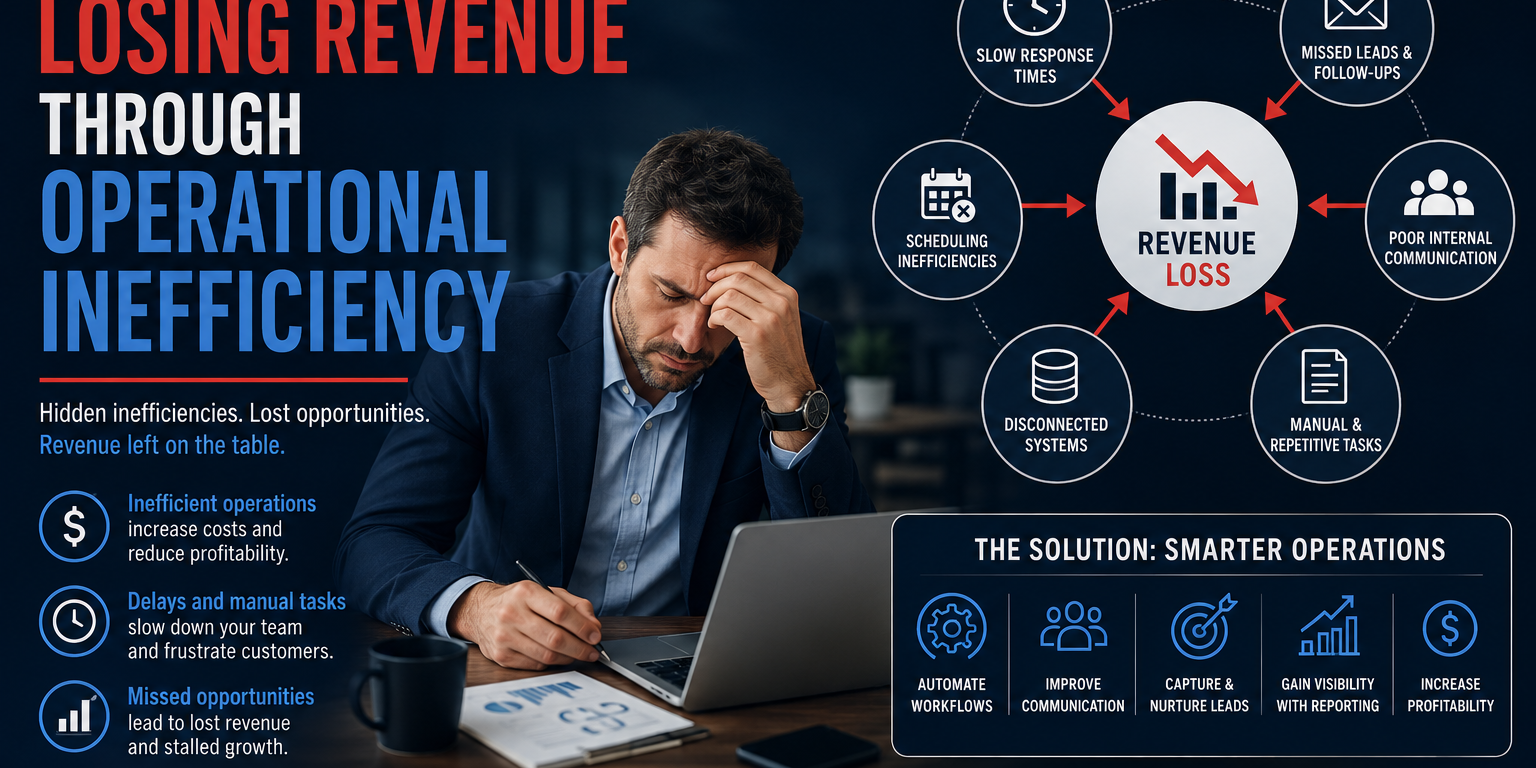
Operational inefficiency may include:
- Delayed customer responses
- Missed sales opportunities
- Poor internal communication
- Repetitive manual tasks
- Scheduling confusion
- Inconsistent follow-up
- Administrative overload
- Disconnected software systems
- Slow reporting processes
- Workflow bottlenecks
Although these issues may appear minor individually, they often create substantial financial losses over time.
Businesses experiencing operational inefficiency frequently struggle with slower growth because employees spend excessive hours managing preventable problems instead of focusing on strategic growth activities.
The Hidden Financial Cost of Inefficiency
Many operational problems create hidden revenue loss that businesses fail to track properly. Consequently, companies often underestimate how much inefficiency damages profitability each month.
For example, delayed lead response times may reduce conversion rates significantly. Administrative overload may prevent employees from focusing on higher-value responsibilities. Communication delays may frustrate customers and reduce retention rates.
Operational inefficiency creates financial damage through several areas simultaneously.
Lost Sales Opportunities
Many businesses lose potential customers simply because operational systems fail to support fast and organized communication.
Common examples include:
- Slow lead response times
- Missed appointment requests
- Forgotten follow-ups
- Delayed proposals
- Poor sales coordination
Customers today expect fast communication and streamlined experiences. Businesses operating with outdated systems often fail to meet those expectations consistently.
As a result, leads frequently move toward competitors with more organized operational infrastructures.
Employee Productivity Loss
Employees spend enormous amounts of time handling repetitive administrative tasks in inefficient businesses.
These activities may include:
- Manual data entry
- Spreadsheet updates
- Appointment coordination
- File organization
- Internal reporting
- Repetitive communication
Although these tasks appear necessary, many could become automated or streamlined through better operational systems.
When employees remain trapped inside repetitive workflows, productivity decreases significantly. Over time, this reduces operational capacity while increasing labor-related costs.
Customer Experience Problems
Operational inefficiency directly affects customer satisfaction.
Poor communication systems, scheduling errors, delayed responses, and inconsistent service experiences often frustrate customers. Consequently, businesses may struggle with retention, reviews, referrals, and long-term loyalty.
Customer experience problems frequently originate from operational disorganization rather than employee performance alone.
Businesses with stronger systems usually provide:
- Faster communication
- More organized experiences
- Better consistency
- Improved responsiveness
- Stronger professionalism
Operational structure plays a major role in customer perception.
Leadership and Decision-Making Issues
Business owners cannot make effective decisions without accurate operational visibility.
Many companies lack clear reporting systems for:
- Revenue performance
- Lead conversion rates
- Operational efficiency
- Employee productivity
- Marketing effectiveness
- Customer retention
Without proper operational reporting, businesses often make reactive decisions based on assumptions instead of accurate performance data.
This lack of visibility slows strategic growth and increases operational risk.
Common Signs Your Business Has Operational Inefficiency
Many businesses operate inefficiently without fully realizing it. However, several warning signs typically indicate operational problems exist beneath the surface.
Common indicators include:
- Employees constantly feel overwhelmed
- Customer communication becomes inconsistent
- Tasks repeatedly fall through the cracks
- Teams rely heavily on spreadsheets
- Processes change frequently without structure
- Management lacks reporting clarity
- Customers complain about responsiveness
- Administrative tasks consume excessive time
- Internal communication feels disorganized
- Scaling operations becomes increasingly difficult
Businesses experiencing several of these issues likely require operational modernization.
Why Inefficiency Becomes Worse as Businesses Grow
Operational inefficiency often becomes more severe during business growth.
Smaller companies may initially survive with informal systems because operational complexity remains manageable. However, growth introduces additional communication demands, customer interactions, scheduling requirements, and workflow dependencies.
Without scalable infrastructure, businesses eventually experience operational strain.
Growth may expose weaknesses such as:
- Lack of standardized workflows
- Poor communication systems
- Inconsistent customer management
- Disconnected software platforms
- Manual operational processes
- Reporting limitations
Businesses attempting to scale without operational modernization often experience organizational chaos instead of sustainable growth.
How AI and Automation Help Solve Inefficiency
Artificial intelligence and workflow automation now allow businesses to modernize operations more efficiently than ever before.
AI-powered systems help companies reduce repetitive tasks, improve communication speed, and create more organized workflows.
Modern operational systems may automate:
- Lead management
- Appointment scheduling
- Customer communication
- Internal notifications
- Reporting processes
- Administrative workflows
- CRM organization
- Customer follow-up systems
These improvements reduce operational friction while increasing consistency across departments.
Additionally, automation allows businesses to scale operations without increasing administrative complexity at the same pace.
The Most Important Areas to Improve First
Businesses should approach operational modernization strategically instead of attempting to automate everything simultaneously.
Several operational areas typically create the greatest return on investment.
Lead Response Systems
Lead response speed significantly affects conversion performance.
Businesses should improve:
- Inquiry routing
- Follow-up automation
- Appointment scheduling
- CRM organization
- Customer communication consistency
Faster and more organized communication often increases conversion opportunities quickly.
Internal Communication Workflows
Communication breakdowns create operational delays across nearly every department.
Businesses should standardize:
- Team notifications
- Task management
- Reporting structures
- Department coordination
- Operational updates
Better communication improves efficiency throughout the organization.
Administrative Task Reduction
Reducing repetitive administrative work creates immediate productivity improvements.
Businesses should identify:
- Manual workflows
- Repetitive communication
- Scheduling inefficiencies
- Reporting delays
- Data entry bottlenecks
Automation and operational simplification often eliminate many of these issues.
Reporting Visibility
Accurate reporting allows businesses to identify inefficiencies more effectively.
Companies should track:
- Lead conversion
- Revenue performance
- Customer retention
- Workflow efficiency
- Operational bottlenecks
Improved visibility supports stronger strategic decision-making.
Industries Most Affected by Operational Inefficiency
Operational inefficiency affects nearly every industry. However, businesses with high communication volume and administrative complexity often experience greater operational strain.
Industries frequently impacted include:
- Medical practices
- Med spas
- Plastic surgery clinics
- Dermatology offices
- Marketing agencies
- Professional service firms
- Real estate companies
- Home service businesses
- Consulting firms
- E-commerce companies
For example, med spas often struggle with appointment coordination, consultation follow-up, lead management, and patient communication. Without organized systems, clinics may lose bookings and create inconsistent customer experiences.
Operational modernization helps businesses create stronger infrastructures that support scalability and customer retention.
Why Operational Modernization Creates Competitive Advantages
Businesses with modern operational systems often outperform competitors because they operate with greater efficiency and consistency.
Modernized companies typically achieve:
- Faster customer response times
- Better internal organization
- Higher employee productivity
- Improved scalability
- Better customer experiences
- Stronger operational visibility
- Reduced administrative burden
Operational infrastructure increasingly influences business competitiveness in modern markets.
Companies relying on outdated systems may eventually struggle to keep pace with businesses operating through streamlined workflows and automation.
Human Strategy Still Matters
Although automation technology continues advancing rapidly, businesses still require strategic operational leadership.
Technology alone cannot solve organizational inefficiency without:
- Workflow design
- Operational planning
- Leadership oversight
- Process optimization
- Performance analysis
The strongest businesses combine AI-powered systems with structured operational strategy.
Companies that simply purchase automation software without operational planning often create additional confusion instead of efficiency improvements.
Frequently Asked Questions About Operational Inefficiency
How does operational inefficiency reduce profitability?
Operational inefficiency increases labor costs, slows communication, reduces productivity, and creates lost sales opportunities.
What causes operational inefficiency?
Common causes include outdated systems, poor communication, repetitive manual tasks, disconnected software, and lack of workflow standardization.
Can small businesses benefit from operational automation?
Yes. Small businesses often experience major improvements because automation reduces administrative overload and improves organizational efficiency.
What operational areas should businesses improve first?
Lead management, customer communication, scheduling systems, and administrative workflows usually provide the strongest early improvements.
Is operational modernization expensive?
Costs vary depending on business size and complexity. However, many automation tools now remain affordable for small and mid-sized businesses.
Building a More Efficient Business
Operational inefficiency quietly damages profitability, productivity, and customer experience for many businesses. Although these problems may develop gradually, they eventually create major barriers to growth and scalability.
Modern businesses require organized operational systems capable of supporting faster communication, stronger workflows, and scalable infrastructure.
Companies that modernize operations now will likely gain stronger competitive advantages in the years ahead. Businesses operating with efficient systems can respond faster, scale more effectively, and create better customer experiences while reducing operational strain.
Operational modernization should no longer be viewed as optional. Instead, it has become a necessary foundation for sustainable growth in an increasingly competitive and technology-driven business environment.