Artificial intelligence is rapidly changing the way small businesses compete. What was once considered advanced technology reserved for large enterprises has become accessible to organizations of every size. Today, AI helps companies automate repetitive work, improve customer experiences, make better decisions, and increase operational efficiency. However, technology alone does not create results. Without a clear AI implementation strategy for small businesses, organizations often invest in tools that fail to solve meaningful business problems or deliver measurable returns.
The most successful companies don’t begin with software—they begin with strategy. They identify opportunities, prioritize business objectives, prepare their teams, and implement AI in phases that generate immediate value while supporting long-term growth. An effective AI implementation strategy for small businesses transforms artificial intelligence from an exciting technology into a practical business asset.
What Is an AI Implementation Strategy for Small Businesses?
An AI implementation strategy for small businesses is a structured plan that outlines how artificial intelligence will be introduced into an organization to achieve specific business goals. Rather than adopting AI simply because competitors are doing so, businesses create a roadmap that aligns technology with operational priorities, customer needs, and growth objectives.
A successful strategy answers several important questions:
- What business problems should AI solve?
- Which departments will benefit first?
- What existing systems require integration?
- How will success be measured?
- What resources are required?
- How will employees adapt to new workflows?
Having these answers before implementation dramatically improves the likelihood of success.
Why Small Businesses Need a Strategy Before Buying AI Tools
Many organizations make the mistake of purchasing AI software before understanding how it fits within their business. This often leads to underutilized technology, frustrated employees, and disappointing results.
Instead of asking, “Which AI platform should we buy?” business owners should first ask:
- Which repetitive tasks consume the most time?
- Where do operational bottlenecks occur?
- Which customer experiences need improvement?
- What processes prevent the business from scaling efficiently?
- Which decisions could be improved with better data?
These questions shift the focus from technology to business outcomes—the foundation of every successful AI implementation.
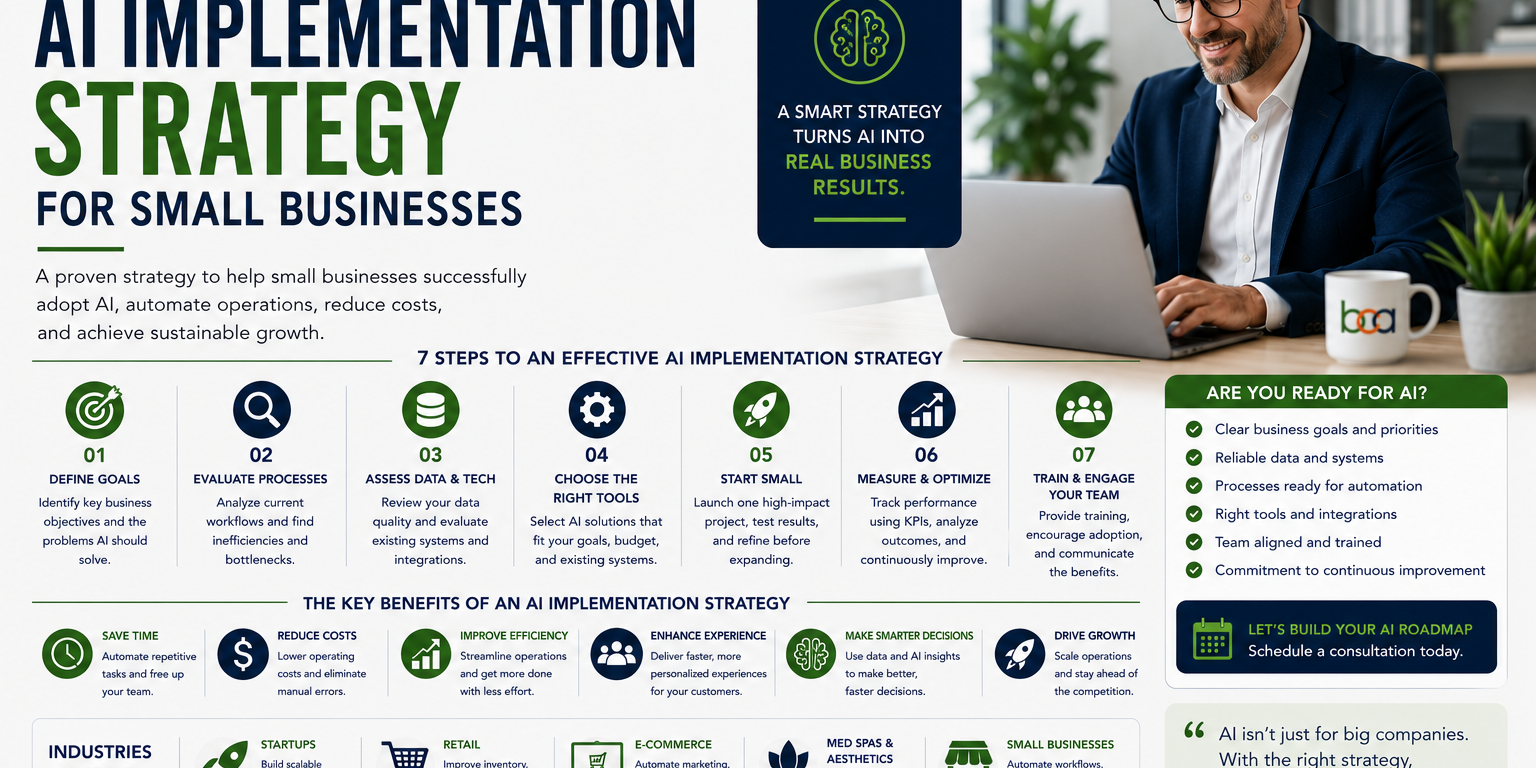
Define Clear Business Objectives
Every AI initiative should begin with measurable business goals.
For many small businesses, priorities include:
- Reducing administrative workloads.
- Improving customer response times.
- Increasing employee productivity.
- Lowering operating costs.
- Improving sales performance.
- Delivering better customer experiences.
- Scaling operations without significantly increasing payroll.
When AI projects support defined objectives, leadership can accurately evaluate their success and calculate return on investment.
Evaluate Existing Business Processes
Artificial intelligence should improve processes—not compensate for poor ones.
Before implementing AI, review your workflows to identify opportunities for improvement.
Areas commonly evaluated include:
- Customer communication
- Appointment scheduling
- Lead management
- Internal approvals
- Document management
- Reporting
- Marketing workflows
- Sales follow-up
Optimizing these processes before automation ensures AI enhances efficiency rather than accelerating existing problems.
Assess Your Technology Infrastructure
An effective AI implementation strategy for small businesses also evaluates the technology already in place.
Modern AI solutions perform best when connected to reliable business systems.
Review your current technology, including:
- CRM platforms
- Accounting software
- Marketing automation
- Project management tools
- Communication platforms
- Cloud storage
- Business intelligence dashboards
Businesses with integrated systems typically achieve faster implementations and better long-term results.
Prepare Your Business Data
Artificial intelligence depends on accurate information.
Poor-quality data often leads to poor-quality recommendations, inaccurate reporting, and ineffective automation.
Before introducing AI, review your data for:
- Accuracy
- Consistency
- Accessibility
- Duplicate records
- Missing information
- Security
Investing time in data preparation significantly improves implementation outcomes.
Start with High-Impact Projects
One of the most important principles of an AI implementation strategy for small businesses is starting small.
Rather than transforming every department simultaneously, begin with projects that deliver measurable improvements quickly.
Excellent first projects include:
- Customer support automation
- Meeting summaries
- Marketing content creation
- Lead qualification
- Appointment scheduling
- Internal knowledge management
- Email automation
- Reporting and dashboards
Early successes build organizational confidence while demonstrating the practical value of AI.
Train Your Team
Artificial intelligence should empower employees rather than replace them.
Successful organizations invest in training that helps employees understand:
- Why AI is being implemented
- How their daily work will improve
- Which repetitive tasks will be automated
- How to use new AI tools effectively
- How success will be measured
Employee engagement plays a significant role in long-term adoption.
Measure Performance
Every AI initiative should include measurable performance indicators.
Common metrics include:
- Hours saved each week
- Reduced operating costs
- Faster customer response times
- Improved productivity
- Increased sales conversions
- Customer satisfaction
- Employee adoption
- Revenue growth
These measurements help businesses refine their strategy while demonstrating return on investment.
Common Mistakes to Avoid
Even well-intentioned businesses can encounter implementation challenges.
Common mistakes include:
- Purchasing software without a strategy.
- Automating inefficient processes.
- Ignoring employee training.
- Implementing too many projects simultaneously.
- Underestimating data quality.
- Failing to measure business outcomes.
- Expecting immediate transformation.
Avoiding these mistakes significantly increases the likelihood of long-term success.
The Long-Term Benefits of AI Implementation
Artificial intelligence should be viewed as an ongoing business capability rather than a one-time project.
Businesses that follow a structured AI implementation strategy for small businesses often experience:
- Greater operational efficiency.
- Lower operating expenses.
- Faster decision-making.
- Improved customer experiences.
- Higher employee productivity.
- Better scalability.
- Increased profitability.
- Stronger competitive positioning.
As AI technologies continue to evolve, businesses with a strategic foundation will be better positioned to adopt future innovations quickly and effectively.
How Business Consulting Agency Helps Businesses Grow
At Business Consulting Agency, we help organizations develop customized AI implementation strategies that align technology with real business objectives. Our consultants evaluate existing operations, identify automation opportunities, assess organizational readiness, and create practical implementation roadmaps that reduce risk while maximizing long-term value.
Rather than recommending technology for its own sake, we focus on measurable business outcomes. Whether you’re exploring AI for the first time or expanding existing automation initiatives, our consulting services provide the expertise needed to implement AI with confidence and build a smarter, more scalable business.
Key Takeaways
A successful AI implementation strategy for small businesses begins with understanding your business—not the technology. Companies that define clear goals, optimize existing processes, prepare their data, and implement AI in carefully planned phases consistently achieve stronger results than organizations that adopt AI without a strategic framework.
Artificial intelligence offers tremendous opportunities for small businesses willing to invest in thoughtful planning. By following a structured implementation strategy, organizations can reduce costs, improve efficiency, strengthen customer relationships, and create a scalable foundation for future growth.
Frequently Asked Questions
What is an AI implementation strategy for small businesses?
An AI implementation strategy for small businesses is a structured plan that helps organizations adopt artificial intelligence in a way that aligns with business goals, operational needs, and long-term growth objectives.
Why is an AI implementation strategy important?
A strategy reduces implementation risks, prioritizes high-value opportunities, improves employee adoption, and ensures AI investments generate measurable business results.
What should small businesses automate first?
Most businesses begin with repetitive administrative tasks such as customer communication, appointment scheduling, lead management, reporting, and document management because these areas often deliver quick and measurable returns.
How long does AI implementation take?
Simple AI initiatives may be implemented within a few weeks, while larger projects involving multiple departments typically require several months and are often completed in phases.
Should small businesses hire an AI consulting firm?
Working with an experienced AI consulting firm helps businesses avoid costly mistakes, develop a practical implementation strategy, identify the highest-value opportunities, and accelerate successful adoption while maximizing return on investment.