
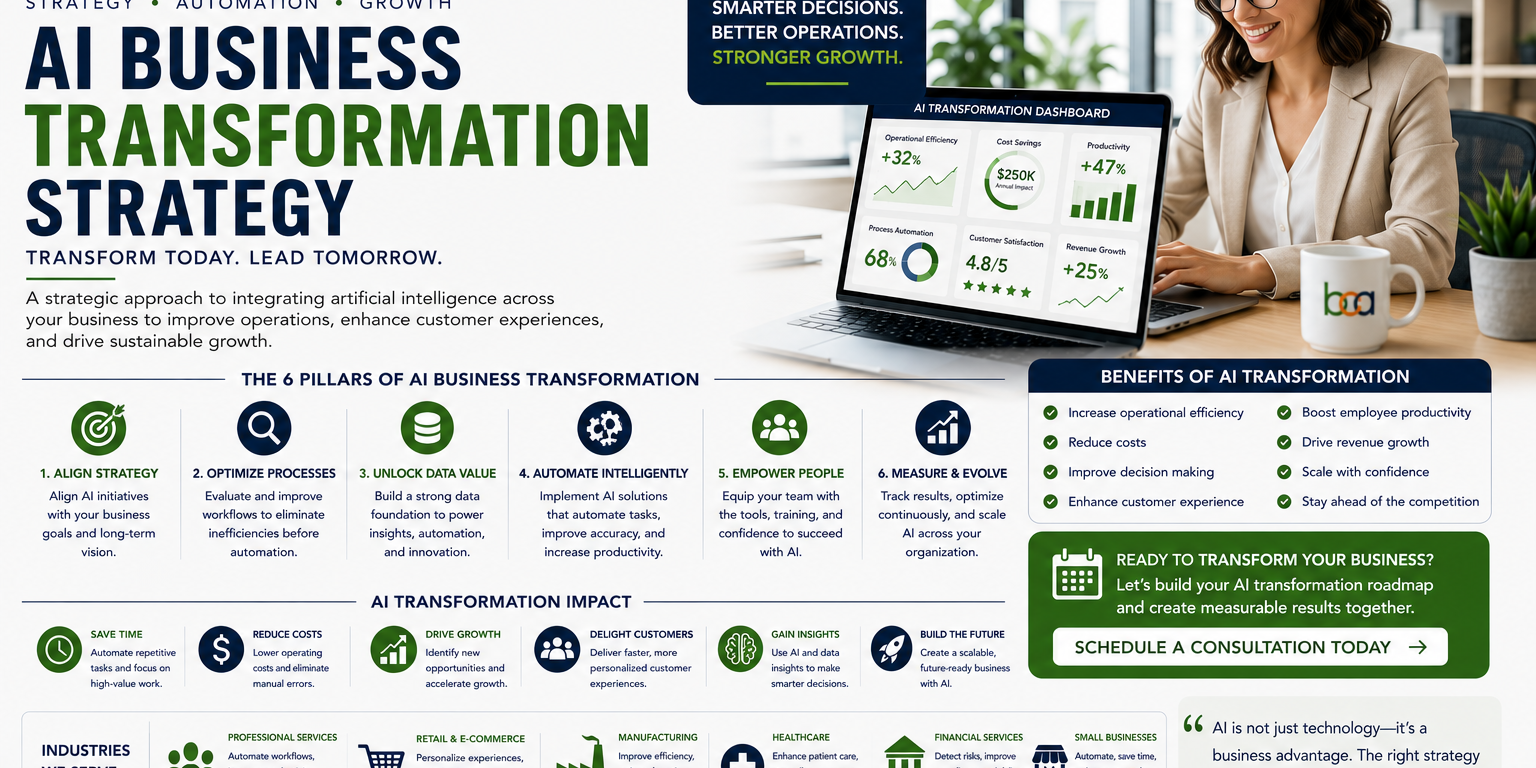
Artificial intelligence is reshaping how businesses compete, innovate, and grow. While many organizations begin by experimenting with AI tools, the companies achieving the greatest results take a much broader approach. Instead of viewing AI as a collection of individual technologies, they develop a comprehensive AI business transformation strategy that aligns artificial intelligence with their long-term business objectives.
Business transformation is about more than automation. It involves rethinking how work is performed, how employees collaborate, how customers interact with the organization, and how leadership makes strategic decisions. An effective AI business transformation strategy provides the framework needed to modernize operations, improve efficiency, and create sustainable competitive advantages.
What Is an AI Business Transformation Strategy?
An AI business transformation strategy is a long-term plan for integrating artificial intelligence throughout an organization to improve operations, decision-making, customer experiences, and business performance.
Rather than implementing AI as isolated projects, businesses establish a unified strategy that supports company-wide objectives.
An effective strategy focuses on:
- Business growth
- Operational efficiency
- Digital innovation
- Customer experience
- Employee productivity
- Scalable business systems
- Data-driven decision making
- Continuous improvement
The objective is not simply to adopt AI but to transform how the business operates.
Why Businesses Need a Transformation Strategy
Many organizations invest in AI software without changing the underlying business processes. As a result, they automate inefficient workflows instead of improving them.
An AI business transformation strategy helps organizations:
- Align AI with business goals.
- Prioritize high-value initiatives.
- Reduce implementation risks.
- Improve technology investments.
- Increase employee adoption.
- Maximize return on investment.
- Create scalable business operations.
Businesses that begin with strategy consistently outperform those that simply purchase technology.
Align Artificial Intelligence with Business Goals
Technology should always support business objectives.
Before implementing AI, leadership should define measurable goals such as:
- Improving operational efficiency.
- Increasing revenue.
- Reducing operating costs.
- Enhancing customer satisfaction.
- Accelerating business growth.
- Improving employee productivity.
- Strengthening competitive positioning.
Every AI initiative should contribute directly to one or more of these objectives.
Evaluate Your Current Business Environment
Understanding your current operations is essential before implementing AI.
Organizations should evaluate:
- Existing business processes.
- Technology infrastructure.
- Data quality.
- Customer experience.
- Employee workflows.
- Reporting capabilities.
- Operational bottlenecks.
This assessment identifies the areas where AI can generate the greatest business impact.
Modernize Business Processes Before Automating Them
Artificial intelligence cannot solve inefficient processes by itself.
Businesses should first simplify and optimize workflows before introducing automation.
Common areas for improvement include:
- Customer communication.
- Appointment scheduling.
- Lead management.
- Internal approvals.
- Document processing.
- Sales follow-up.
- Marketing campaigns.
- Reporting.
Improving workflows first creates a stronger foundation for AI implementation.
Build a Data-Driven Organization
Artificial intelligence relies on accurate and accessible information.
Organizations should invest in improving:
- Data accuracy.
- Data consistency.
- System integration.
- Information security.
- Reporting standards.
- Data governance.
High-quality data enables AI to generate more reliable recommendations and automate business processes with greater confidence.
Empower Employees Through AI
One of the biggest misconceptions surrounding artificial intelligence is that it replaces employees.
In reality, successful organizations use AI to enhance employee performance by eliminating repetitive work and providing better information for decision-making.
Employees can use AI to:
- Automate administrative tasks.
- Improve customer communication.
- Generate reports.
- Analyze business data.
- Create marketing content.
- Summarize meetings.
- Organize knowledge.
- Increase productivity.
Businesses that position AI as a productivity tool typically achieve much higher adoption rates.
Implement AI in Phases
Business transformation should occur gradually rather than all at once.
A phased approach allows organizations to learn, adapt, and refine their strategy while minimizing disruption.
Many companies begin with:
- Customer support automation.
- Internal knowledge management.
- Marketing automation.
- Sales process improvements.
- Reporting dashboards.
- Workflow automation.
Each successful project builds momentum for broader organizational transformation.
Measure Business Transformation
Every AI initiative should include measurable performance indicators.
Leadership should monitor:
- Productivity improvements.
- Cost reductions.
- Revenue growth.
- Customer satisfaction.
- Employee engagement.
- Process efficiency.
- Decision-making speed.
- Return on investment.
These measurements help organizations continuously optimize their AI strategy while demonstrating measurable business value.
Common Challenges During Business Transformation
Transforming an organization requires leadership, planning, and ongoing commitment.
Common challenges include:
- Employee resistance.
- Poor change management.
- Legacy technology.
- Disconnected software.
- Inconsistent business data.
- Limited AI expertise.
- Unclear priorities.
Addressing these challenges early significantly improves implementation success.
Characteristics of Successful AI-Driven Organizations
Organizations that successfully transform their businesses with AI often share several characteristics.
They:
- Have executive leadership support.
- Focus on business outcomes instead of technology.
- Continuously improve processes.
- Invest in employee education.
- Measure performance consistently.
- Build scalable systems.
- Adapt quickly to technological change.
These organizations view AI as a long-term business capability rather than a one-time technology investment.
How Business Consulting Agency Helps Businesses Grow
Business Consulting Agency helps organizations develop customized AI business transformation strategies that align technology with measurable business objectives. We work closely with leadership teams to evaluate operations, identify automation opportunities, optimize workflows, and create practical implementation roadmaps that support sustainable growth.
Our consulting approach combines business strategy with artificial intelligence to help organizations improve efficiency, reduce operational costs, strengthen customer experiences, and build scalable systems for the future. Whether your business is beginning its AI journey or expanding existing initiatives, we help you transform operations with confidence and measurable results.
Key Takeaways
Developing an AI business transformation strategy is one of the most important investments organizations can make as artificial intelligence continues to reshape the modern business landscape. Companies that focus on strategy before technology consistently achieve better operational efficiency, stronger employee adoption, improved customer experiences, and higher returns on investment.
Rather than implementing AI through disconnected projects, businesses should adopt a comprehensive transformation strategy that aligns every initiative with long-term goals. This structured approach creates a stronger, more agile organization capable of adapting to future opportunities while maintaining a lasting competitive advantage.
Frequently Asked Questions
What is an AI business transformation strategy?
An AI business transformation strategy is a structured plan for integrating artificial intelligence into business operations, decision-making, and customer experiences to improve long-term performance and growth.
Why is an AI business transformation strategy important?
It helps organizations align AI investments with business objectives, reduce implementation risks, improve operational efficiency, and maximize return on investment.
What is the first step in business transformation?
The first step is evaluating current business processes, technology infrastructure, data quality, and organizational goals to identify the highest-value AI opportunities.
How long does AI business transformation take?
Business transformation is an ongoing process. Many organizations begin seeing measurable improvements within a few months, while larger transformation initiatives continue to evolve over several years.
Should small businesses develop an AI business transformation strategy?
Yes. Small businesses often benefit significantly because a structured strategy helps prioritize investments, improve efficiency, reduce costs, and create scalable systems that support sustainable growth.