
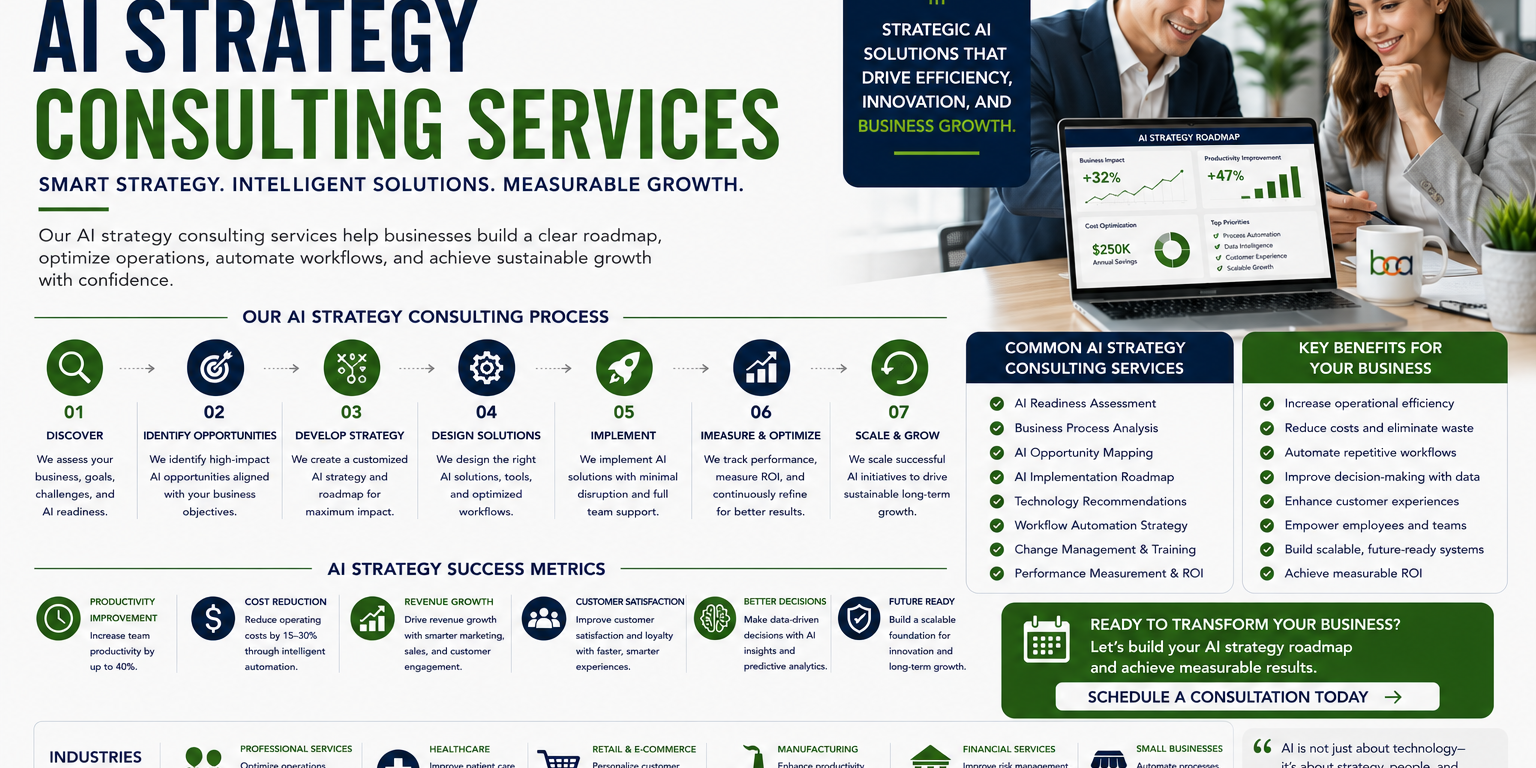
Artificial intelligence is creating new opportunities for businesses to improve operational efficiency, strengthen customer relationships, reduce administrative costs, and make more informed decisions. Yet many organizations struggle to translate these opportunities into measurable financial results. They purchase AI software, experiment with automation tools, and encourage employees to adopt new technologies without establishing a clear connection between those investments and their broader business objectives.
Developing an effective AI strategy for business requires a more disciplined approach. Rather than beginning with technology selection, companies must first identify the operational challenges they want to solve, evaluate their existing systems, determine where artificial intelligence can create meaningful value, and establish a realistic implementation plan. This process helps organizations avoid unnecessary spending while building capabilities that support sustainable growth.
A well-designed business AI strategy also addresses the practical challenges of implementation. Data quality, employee readiness, systems integration, cybersecurity, financial planning, and organizational accountability all influence whether an AI initiative delivers its intended benefits. Without adequate preparation, even sophisticated technology can create additional complexity instead of improving business performance.
This guide explains how to develop an AI strategy for your business, evaluate potential applications, prioritize investments, manage implementation risks, and measure the financial and operational results of AI adoption.
What Is an AI Business Strategy?
An AI business strategy is a structured plan that explains how an organization will use artificial intelligence to achieve specific business objectives. It connects technology investments with operational requirements, financial priorities, customer needs, and long-term growth plans. Unlike an isolated software implementation, an AI strategy considers how different systems, departments, employees, and processes must work together to produce measurable improvements.
An effective strategy identifies where AI can create value, which initiatives should receive priority, what resources are required, and how success will be evaluated. It also establishes appropriate governance so that AI systems operate reliably, protect sensitive information, and support responsible decision-making. These considerations are particularly important when technology interacts with customers, processes financial information, or influences business-critical operations.
For example, a professional services company may want to reduce the time employees spend processing customer inquiries and preparing routine reports. Its strategy could involve improving the existing CRM, introducing AI-assisted inquiry classification, connecting reporting systems, and establishing performance indicators that measure processing time and service quality. The objective is not simply to introduce AI but to improve the underlying business operation.
Businesses considering this type of modernization can explore Business Consulting Agency’s AI Business Systems consulting services to understand how AI planning, operational improvement, and systems integration can support broader business objectives.
Why Businesses Need an AI Strategy Before Implementing Technology
AI applications have become increasingly accessible, allowing organizations to experiment with tools that previously required substantial technical expertise. While this accessibility creates opportunities, it also increases the risk of fragmented adoption. Departments may purchase overlapping subscriptions, employees may introduce unauthorized applications, and managers may struggle to determine whether the technology is generating measurable value.
A defined AI strategy helps businesses establish priorities before committing significant resources. Instead of evaluating applications according to popularity or technical sophistication, leadership can assess whether each proposed initiative addresses an important operational problem. This approach encourages more disciplined spending and makes it easier to compare AI investments with other business improvement opportunities.
Strategic planning also reduces the likelihood of automating inefficient processes. If a company has unclear employee responsibilities, inconsistent customer information, or unreliable workflows, introducing AI may accelerate existing problems rather than resolve them. Business processes should therefore be evaluated and improved before they are automated.
An AI strategy creates a common framework for decision-making across departments. Finance can evaluate economic returns, operations can assess workflow requirements, technology teams can review integration and security, and management can determine whether proposed initiatives support the company’s long-term direction.
Align AI Initiatives With Measurable Business Objectives
The foundation of an effective AI strategy is a clear understanding of what the business needs to accomplish. Organizations should begin by identifying their most important financial and operational priorities rather than creating a list of AI applications they would like to use. This distinction ensures that technology serves the business instead of becoming an independent initiative disconnected from commercial performance.
Business objectives should be specific enough to measure and meaningful enough to justify investment. A company seeking greater profitability may prioritize reducing repetitive administrative work, improving sales conversion, or lowering the cost of processing transactions. An organization experiencing rapid growth may focus on operational capacity, service consistency, and the ability to support more customers without proportionally increasing staffing requirements.
Examples of measurable objectives include:
- Reducing average customer inquiry processing time by 25%.
- Improving the percentage of qualified leads contacted within the company’s target response window.
- Decreasing manual invoice processing time while maintaining approval controls.
- Reducing recurring reporting preparation from several hours to a shorter, verified workflow.
- Improving the accuracy and availability of operational information.
- Increasing transaction capacity without a corresponding increase in administrative expenses.
These are examples of possible targets, not guaranteed outcomes. Actual goals should reflect the organization’s baseline performance, available resources, and financial requirements.
Management should also establish how each objective contributes to business performance. Reducing processing time may create additional employee capacity, but that capacity does not automatically translate into lower operating expenses. Financial benefits should be estimated conservatively and connected to realistic changes in costs, revenue, or operational output.
Assess Your Current Business Operations and AI Readiness
Before selecting AI projects, companies should evaluate their existing processes, technology infrastructure, data quality, and employee capabilities. This assessment reveals whether the organization is prepared to implement AI effectively and identifies operational weaknesses that should be corrected before additional technology is introduced.
An AI readiness assessment should examine how work currently moves through the organization. Management needs to understand which activities are repetitive, where employees encounter delays, how information is exchanged between departments, and which tasks require substantial manual effort. This analysis often reveals opportunities for improvement that do not require sophisticated AI systems.
Evaluate Existing Business Processes
A process assessment should document how important activities are performed, who is responsible for each stage, what information is required, and where errors or delays occur. Customer inquiries, sales follow-up, appointment scheduling, financial reporting, document management, and internal approvals are common areas worth examining.
The objective is to identify measurable inefficiencies rather than assume that every repetitive task should be automated. Some processes may benefit from better procedures, clearer responsibilities, or improved use of existing software. Others may justify AI-assisted classification, document extraction, forecasting, or workflow coordination.
Review Technology Infrastructure and Integration Requirements
Most businesses already use multiple applications for sales, marketing, finance, customer service, and operations. Before introducing additional AI systems, organizations should determine whether these applications can exchange information reliably and whether existing platforms already provide suitable automation capabilities.
Disconnected systems can undermine AI performance by producing incomplete records, inconsistent data, and duplicated work. A business that implements AI-assisted sales follow-up without reliable CRM information may generate inaccurate communications or contact prospects at inappropriate times.
Companies with significant integration challenges may benefit from reviewing BCA’s AI Operations & Infrastructure consulting services, which address connected workflows, operational systems, and business modernization.
Assess Data Quality and Employee Readiness
Artificial intelligence depends on access to information that is sufficiently accurate, relevant, and appropriately governed for its intended purpose. Businesses should examine whether important records are complete, whether information is stored consistently, and whether employees understand the limitations of AI-generated outputs.
Employee readiness is equally important. Staff members need to understand how new systems affect their responsibilities, when human review is required, and how to report inaccurate or unexpected results. A company that introduces technology without training or clear procedures may experience inconsistent adoption and unreliable outcomes.
Identify High-Value AI Opportunities Across Your Business
Once the organization understands its operational priorities and readiness, it can begin identifying AI use cases that address specific business problems. The most valuable opportunities are not necessarily the most technically advanced. In many organizations, relatively straightforward applications can improve efficiency and reduce administrative friction when implemented within well-designed workflows.
AI for Sales and Revenue Operations
Sales teams often spend considerable time updating CRM records, reviewing customer histories, preparing follow-up messages, and coordinating appointments. AI can assist with summarizing conversations, classifying inquiries, identifying incomplete records, and preparing communication drafts. These applications may help employees respond more consistently while reducing repetitive administrative tasks.
The financial justification should be based on measurable outcomes, such as response time, qualified lead conversion, sales cycle length, or contribution profit. A business with recurring sales pipeline weaknesses should evaluate those problems before purchasing advanced forecasting or sales intelligence applications.
AI for Customer Service and Communication
Customer service departments may benefit from AI-assisted inquiry classification, knowledge retrieval, response drafting, and request routing. These applications can reduce the effort required to process routine questions while allowing employees to concentrate on more complex customer needs.
However, organizations must establish appropriate safeguards to prevent inaccurate responses, unauthorized disclosures, or inappropriate automated decisions. Customer satisfaction, response accuracy, escalation rates, and employee correction requirements should be monitored alongside productivity improvements.
AI for Finance and Administrative Workflows
Finance and administrative teams frequently handle repetitive activities involving invoices, documentation, approvals, and reporting. AI-assisted document extraction, transaction classification, and exception identification can support these processes when suitable controls are maintained.
Businesses should distinguish between preparing information and authorizing consequential actions. An AI system that extracts invoice details for employee review presents different risks from one that independently approves payments. Financial workflows should retain appropriate authorization, reconciliation, and audit procedures.
AI for Operations and Internal Knowledge Management
Operational teams may spend significant time locating procedures, preparing recurring reports, coordinating information, and resolving inconsistencies between systems. AI-assisted knowledge retrieval, document summarization, and workflow monitoring can improve information accessibility and reduce repetitive work.
The strongest opportunities typically involve well-documented processes with sufficient transaction volume and measurable performance problems. Organizations should evaluate whether AI improves accuracy, reduces delays, or increases capacity rather than measuring success solely by the number of tasks automated.
Prioritize AI Projects Based on Business Impact and Implementation Effort
After identifying potential use cases, businesses must determine which initiatives deserve investment first. Attempting to implement several AI projects simultaneously can strain financial resources, overwhelm employees, and make it difficult to identify which improvements are producing meaningful results.
An impact-effort matrix provides a practical framework for comparing projects according to expected business value and implementation complexity. High-impact, low-effort initiatives are generally attractive starting points, while high-impact, high-effort projects may require more extensive planning and financial justification.
| Project category | Business characteristics | Recommended action |
|---|---|---|
| High impact, low effort | Strong potential value with manageable implementation requirements | Prioritize |
| High impact, high effort | Significant strategic value but greater complexity and cost | Plan and validate |
| Low impact, low effort | Limited benefits with modest resource requirements | Implement selectively |
| Low impact, high effort | Weak economic justification and substantial complexity | Defer or eliminate |
Businesses should consider more than implementation effort alone. Financial return, data readiness, employee capacity, security requirements, and strategic dependencies can all influence the appropriate sequence. A project with an attractive impact-effort score may still require postponement if critical information is unavailable or operational safeguards have not been established.
Our related guide, How to Prioritize AI Projects Using an Impact-Effort Matrix, explores the evaluation framework, scoring criteria, and financial considerations in greater detail.
Calculate AI Implementation Costs and Expected Return on Investment
Financial planning is essential because AI implementation costs extend beyond the initial software subscription. Organizations may need to invest in configuration, systems integration, data preparation, employee training, technical support, cybersecurity, and ongoing maintenance. These expenses should be included when comparing potential projects and estimating their economic value.
A useful starting point is total cost of ownership, which combines initial implementation expenses with recurring operating costs over the evaluation period. Businesses should compare this amount with realistic financial benefits, including avoided expenses, additional contribution profit, and productivity improvements that can be translated into measurable economic value.
The basic ROI formula is:
AI ROI (%) = [(Financial Benefits − Total AI Costs) ÷ Total AI Costs] × 100
Consider a hypothetical company implementing an AI-assisted administrative workflow. The first-year investment is estimated at $8,000, including configuration, subscriptions, training, and support. Management estimates that the system could produce $12,000 in annual economic benefits through reduced external processing expenses and improved operational capacity.
If the full benefits are realized, the illustrative first-year ROI would be:
($12,000 − $8,000) ÷ $8,000 × 100 = 50%
This calculation provides a useful financial comparison, but it depends on the quality of the underlying assumptions. Employee time savings should not automatically be classified as cash savings, and additional sales should be evaluated using contribution profit rather than gross revenue. Organizations should also consider conservative scenarios in which implementation takes longer or the expected benefits are only partially realized.
For a more detailed budgeting framework, see our related article, How to Calculate AI Implementation Costs for a Small Business, covering implementation expenses, total cost of ownership, and financial evaluation.
Develop a Practical AI Implementation Roadmap
An AI strategy becomes actionable when it is translated into a realistic implementation roadmap. The roadmap should establish project sequencing, responsibilities, resource requirements, success criteria, and review milestones. It should also identify dependencies between initiatives so that businesses do not attempt advanced integrations before foundational processes and information systems are ready.
Establish the Initial Implementation Phase
The initial phase should focus on one or two high-confidence opportunities with manageable implementation requirements. Management should document baseline performance, establish project ownership, and define the conditions required for a successful pilot. Early initiatives should be sufficiently limited to allow testing and correction without creating unnecessary disruption.
For example, a business might begin with AI-assisted classification of incoming customer inquiries. During the pilot, employees could review the classifications before routing decisions are finalized. Management would measure classification accuracy, processing time, correction requirements, and customer response performance to determine whether broader deployment is justified.
Expand Proven Workflows Across Departments
After an initial initiative demonstrates reliable performance, the organization can consider expanding it to additional teams, locations, or processes. Expansion should be based on observed results rather than assumptions that the technology will perform equally well in every environment.
At this stage, businesses may need additional training, integration work, documentation, monitoring, and support procedures. Management should also review whether increased usage changes software expenses, data access requirements, or operational risks.
Establish Long-Term Optimization and Governance
AI implementation should not be treated as a one-time software installation. Business requirements evolve, technology changes, and automated workflows may require adjustments as operating conditions develop. Organizations need clear ownership for monitoring performance, resolving errors, reviewing costs, and determining when systems should be improved or retired.
A sustainable roadmap therefore includes periodic performance reviews, financial reassessments, employee feedback, and ongoing evaluation of security and compliance requirements. These activities help ensure that AI remains aligned with business priorities after the initial implementation is completed.
Manage AI Risks, Security, and Governance
Responsible AI adoption requires organizations to understand the operational, financial, legal, and reputational risks associated with their proposed applications. These risks vary according to the information processed, the decisions influenced, and the level of automation involved. A system that prepares internal meeting summaries presents a different risk profile from one that handles sensitive customer information or supports financial decisions.
The National Institute of Standards and Technology AI Risk Management Framework provides voluntary guidance for evaluating and managing AI-related risks. Its approach emphasizes governance, understanding the operating context, measuring potential risks, and establishing appropriate management practices throughout the AI lifecycle.
Businesses should incorporate several controls into their AI strategies:
- Define who is accountable for each AI system and its outputs.
- Establish rules for handling confidential and sensitive information.
- Validate accuracy before relying on AI-generated recommendations.
- Maintain human oversight for consequential decisions.
- Monitor system performance and document significant errors.
- Review vendor security, data handling, and contractual terms.
- Establish procedures for correcting or disabling unreliable automation.
These safeguards should be proportionate to the risks of each application. Excessive controls can make simple projects unnecessarily expensive, while insufficient oversight can expose organizations to avoidable operational and financial consequences.
Prepare Employees and Management for AI Adoption
Technology adoption depends heavily on the people responsible for using and supervising new systems. Employees may be uncertain about how AI will affect their responsibilities, whether outputs can be trusted, or how to handle errors. Without clear communication and practical training, organizations may experience inconsistent usage, workarounds, and resistance to otherwise beneficial changes.
Management should explain why an AI initiative is being introduced, which business problem it addresses, and how employees are expected to use it. Training should include realistic examples from the company’s workflows rather than relying exclusively on generic software demonstrations. Employees should understand both the capabilities and limitations of the technology, including situations that require human review.
Organizations should also create feedback mechanisms so that employees can report problems and recommend improvements. Frontline users often identify operational exceptions that were not apparent during initial planning. Incorporating this feedback into system refinement can improve reliability and help the business achieve the intended benefits.
Measure AI Strategy Performance With Meaningful KPIs
A business AI strategy should establish performance indicators before implementation begins. Without baseline measurements, organizations may struggle to determine whether AI has actually improved operations or merely changed how employees perform their work. Meaningful measurement connects technology performance to the financial and operational objectives established during strategic planning.
Different AI projects require different metrics. A customer service application may be evaluated through response time, resolution accuracy, and customer satisfaction. A finance workflow may be measured through processing cost, exception frequency, and approval cycle time. A sales application may require analysis of lead response, qualification accuracy, and conversion performance.
| Business objective | Relevant KPI | Evaluation purpose |
|---|---|---|
| Reduce administrative workload | Processing time per transaction | Measures workflow efficiency |
| Improve customer service | Response time and resolution accuracy | Evaluates service quality |
| Strengthen sales operations | Qualified lead conversion rate | Measures commercial performance |
| Reduce operating expenses | Cost per completed process | Evaluates financial efficiency |
| Improve information quality | Error and correction rates | Measures reliability |
| Increase operational capacity | Transactions handled per employee | Evaluates scalability |
| Improve investment performance | Realized ROI and payback period | Measures economic value |
Performance reviews should consider changes in business volume, employee staffing, customer mix, and market conditions. A reduction in processing time may reflect improved procedures rather than AI alone, while increased revenue may result from marketing changes unrelated to the technology. Management should avoid attributing every positive outcome to AI without sufficient supporting evidence.
Common Mistakes Businesses Make When Developing an AI Strategy
One of the most common mistakes is selecting technology before identifying the business problem it should solve. Companies may purchase AI applications because competitors are using them or because the software appears innovative, only to discover that the tools do not address their most important operational needs. Beginning with measurable business objectives creates a stronger foundation for investment decisions.
Another frequent problem is underestimating the work required to prepare existing systems and information. AI applications often perform well during demonstrations using organized data and ideal workflows, while actual business environments contain incomplete records, inconsistent procedures, and unusual exceptions. Businesses should account for these conditions during project planning rather than assuming that deployment will be straightforward.
Organizations also encounter difficulties when they attempt too many initiatives simultaneously. Launching several projects can divide management attention, increase training requirements, and make financial results harder to evaluate. A phased strategy allows companies to validate assumptions, develop internal capabilities, and expand only when the evidence supports additional investment.
Finally, businesses should avoid measuring success solely through software usage or the number of tasks automated. Technology adoption is not the ultimate objective. The relevant question is whether the organization has improved profitability, customer experience, operational reliability, or its capacity to grow.
When Should a Business Hire an AI Strategy Consultant?
Not every business requires external assistance to develop an AI strategy. Organizations with straightforward workflows, experienced internal technology teams, and clearly defined objectives may be able to evaluate and implement certain applications independently. However, outside expertise can become valuable when initiatives involve multiple departments, complex integrations, significant financial commitments, or substantial organizational change.
An AI strategy consultant can help management assess operational requirements, compare implementation alternatives, establish financial assumptions, identify risks, and develop a coordinated roadmap. External guidance may also be useful when a company has already invested in several AI applications but cannot determine whether they are producing sufficient value.
Businesses should evaluate consultants according to their understanding of operational processes, financial performance, technology integration, and change management. The strongest engagement is not necessarily the one recommending the most advanced technology. It is the one that establishes a credible path from an identified business problem to a measurable improvement.
Frequently Asked Questions About AI Business Strategy
What should an AI strategy for business include?
An effective AI business strategy should define organizational objectives, assess existing operations, identify potential AI applications, prioritize investments, establish implementation requirements, and specify how results will be measured. It should also address employee readiness, data quality, security, governance, and ongoing system maintenance. The level of detail should reflect the company’s size, technical environment, and operational complexity.
How does a small business develop an AI strategy?
A small business should begin by identifying recurring operational problems and establishing measurable improvement goals. Management can then evaluate existing software, review data readiness, identify suitable AI opportunities, and compare implementation costs with expected benefits. Starting with a limited pilot allows the business to test assumptions before committing to larger investments.
How much does developing an AI strategy cost?
The cost depends on the company’s size, operational complexity, number of departments, existing technology, and whether external consulting is required. A focused internal assessment may require relatively little direct spending, while a comprehensive transformation strategy involving multiple systems and specialized expertise may require a larger investment. Businesses should distinguish strategy development costs from the subsequent expense of implementing recommended projects.
What is the difference between AI strategy and AI implementation?
AI strategy determines why and where artificial intelligence should be used, which initiatives deserve priority, and what outcomes the organization expects to achieve. AI implementation involves configuring, integrating, testing, deploying, and maintaining the selected systems. Both activities are necessary for complex initiatives, but strategic planning should guide implementation decisions rather than follow them.
How long does it take to develop an AI business strategy?
A focused strategy for a small organization may be developed over several weeks, while a comprehensive assessment involving multiple departments, complex systems, and significant governance requirements may take longer. The appropriate timeline depends on the availability of operational information, management participation, technical requirements, and the number of initiatives being evaluated. Businesses should prioritize the quality of the assessment over completing the process according to an arbitrary schedule.
Final Thoughts: Build an AI Strategy Around Business Results
Developing an AI strategy for your business is not primarily about adopting the latest technology. It is about identifying where artificial intelligence can improve financial performance, operational efficiency, customer experience, and long-term scalability. Companies that begin with clear objectives, evaluate existing processes, and prioritize investments according to measurable value are better positioned to make disciplined technology decisions.
An effective strategy connects business planning with implementation requirements, financial analysis, employee readiness, and responsible governance. It also establishes the performance indicators needed to determine whether individual initiatives justify their costs. By approaching AI as part of a coordinated business improvement program, organizations can reduce unnecessary complexity and build systems that support sustainable growth.
Business Consulting Agency helps companies develop practical AI strategies, modernize operations, improve workflows, and evaluate intelligent business systems. Explore our AI Business Systems consulting services to discuss how a structured AI modernization strategy can support your organization’s business objectives.