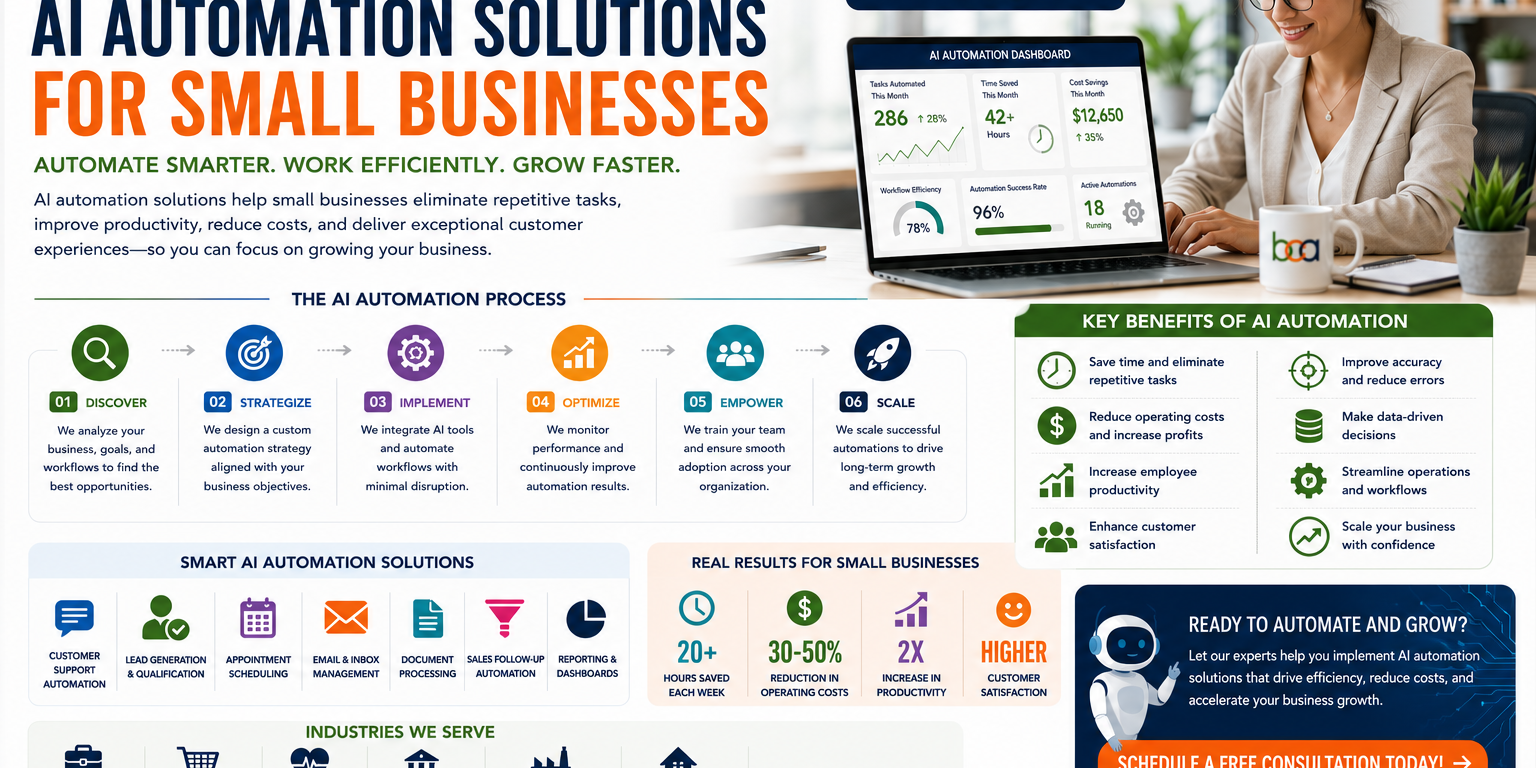
Artificial intelligence is transforming the way small businesses operate by making automation more intelligent, adaptable, and efficient than ever before. While traditional automation follows predefined rules, AI-powered automation can analyze information, recognize patterns, make recommendations, and continuously improve performance over time. As a result, businesses are finding new ways to streamline operations, improve customer experiences, and reduce operating costs without significantly increasing staff.
Choosing the right AI automation solutions for small businesses begins with understanding your business objectives rather than selecting technology based solely on popularity. Every organization has unique processes, challenges, and growth goals. Implementing AI successfully requires identifying where automation will create the greatest impact while ensuring new technologies integrate seamlessly with existing operations.
What Are AI Automation Solutions for Small Businesses?
AI automation solutions for small businesses combine artificial intelligence with workflow automation to eliminate repetitive tasks, improve decision-making, and increase operational efficiency.
Unlike traditional automation, AI-powered systems can learn from data, recognize trends, and adapt to changing business conditions.
Common AI automation solutions include:
- Customer support automation
- Lead qualification
- Appointment scheduling
- Email management
- Marketing automation
- Document processing
- Sales follow-up
- Business reporting
These solutions help businesses improve productivity while allowing employees to focus on strategic, customer-focused work.
Why Small Businesses Are Investing in AI Automation
Small businesses often operate with limited staff, making efficiency critical for sustainable growth.
Implementing AI automation allows organizations to:
- Reduce manual workloads.
- Respond to customers faster.
- Improve operational consistency.
- Lower administrative costs.
- Increase employee productivity.
- Improve business insights.
- Scale without significantly increasing payroll.
- Deliver better customer experiences.
Rather than replacing employees, AI automation helps teams accomplish more with the resources they already have.
Identify Business Processes That Can Be Automated
The most successful automation initiatives begin with processes that consume significant time and offer measurable opportunities for improvement.
Many businesses start by automating:
- Customer inquiries
- Appointment reminders
- Lead nurturing
- Proposal generation
- Invoice processing
- Internal approvals
- Employee onboarding
- Reporting and dashboards
Focusing on these activities often produces immediate improvements in efficiency and customer service.
Integrate AI with Your Existing Business Systems
Effective automation depends on connected technology.
Before implementing new AI solutions, businesses should evaluate how automation will integrate with existing systems, including:
- CRM platforms
- Accounting software
- Marketing platforms
- Project management applications
- Inventory systems
- Communication tools
- Cloud storage
- Customer support software
Well-integrated systems reduce duplicate work and improve data accuracy across the organization.
Improve Customer Experience Through AI Automation
One of the greatest advantages of AI automation is the ability to deliver faster, more personalized customer interactions.
Businesses can use AI to:
- Answer common questions instantly.
- Route customer inquiries.
- Schedule appointments.
- Personalize communications.
- Recommend products or services.
- Follow up with prospects automatically.
These capabilities improve customer satisfaction while allowing employees to focus on more complex interactions.
Increase Productivity Across Every Department
AI automation is no longer limited to customer service or marketing.
Organizations are using intelligent automation throughout their operations, including:
- Sales
- Finance
- Human resources
- Marketing
- Operations
- Executive reporting
- Administration
- Project management
When multiple departments benefit from automation, organizations experience significant improvements in overall productivity.
Common Mistakes When Implementing AI Automation
Businesses often encounter unnecessary challenges by approaching automation without a clear strategy.
Common mistakes include:
- Automating inefficient workflows.
- Selecting software before defining objectives.
- Ignoring employee training.
- Implementing too many projects at once.
- Underestimating integration requirements.
- Failing to measure business outcomes.
Avoiding these mistakes leads to smoother implementations and stronger long-term results.
How to Measure the Success of AI Automation
Every automation initiative should produce measurable business improvements.
Organizations should monitor:
- Hours saved each week.
- Operating cost reductions.
- Employee productivity.
- Customer response times.
- Sales conversion rates.
- Customer satisfaction.
- Process efficiency.
- Return on investment.
Tracking these metrics allows businesses to continuously optimize their automation strategy.
The Future of AI Automation for Small Businesses
Artificial intelligence is evolving rapidly, making automation increasingly accessible and affordable for organizations of every size.
Businesses that invest in AI automation today will be better positioned to:
- Adapt to changing markets.
- Improve operational agility.
- Increase profitability.
- Deliver superior customer experiences.
- Support sustainable growth.
- Build scalable business systems.
Organizations that delay adoption risk falling behind competitors that leverage AI to improve efficiency and decision-making.
How Business Consulting Agency Helps Businesses Grow
Business Consulting Agency helps organizations identify, implement, and optimize AI automation solutions for small businesses that align with their operational goals. Our consultants evaluate existing workflows, identify automation opportunities, recommend appropriate technologies, and develop implementation strategies that improve efficiency while reducing operational complexity.
Whether you’re automating a single department or transforming your entire organization, we help you implement AI solutions that deliver measurable business results and support long-term growth.
Key Takeaways
AI automation solutions for small businesses provide practical opportunities to improve productivity, reduce costs, and enhance customer experiences. However, successful automation begins with strategy rather than technology. Businesses that evaluate their processes, prioritize high-impact opportunities, and implement AI through a structured roadmap consistently achieve better outcomes.
As artificial intelligence continues to advance, organizations that embrace intelligent automation will be better equipped to compete, innovate, and grow. By implementing the right solutions at the right time, small businesses can create a more efficient, scalable, and resilient operation.
Frequently Asked Questions
What are AI automation solutions for small businesses?
AI automation solutions combine artificial intelligence with workflow automation to streamline business processes, improve decision-making, and increase operational efficiency.
Which business processes should be automated first?
Many businesses begin with customer service, appointment scheduling, lead management, marketing automation, document processing, and reporting because these areas typically provide quick and measurable returns.
Are AI automation solutions expensive?
Many modern AI platforms offer affordable subscription-based pricing, making intelligent automation accessible to small and growing businesses.
Can AI automation replace employees?
No. Most businesses use AI automation to eliminate repetitive work, allowing employees to focus on strategic responsibilities, customer relationships, and higher-value activities.
Why should businesses work with an AI automation consultant?
An experienced consultant helps identify the highest-value automation opportunities, avoid costly implementation mistakes, integrate new technologies effectively, and develop a long-term automation strategy that supports sustainable business growth.