Businesses today face increasing pressure to do more with fewer resources. Rising labor costs, growing customer expectations, and expanding operational complexity make efficiency more important than ever. While many organizations have invested in automation, true operational excellence comes from continuously improving how work is performed. This is where AI business process optimization provides a significant competitive advantage.
Unlike traditional process improvement initiatives that rely primarily on manual analysis, artificial intelligence enables businesses to evaluate workflows, identify inefficiencies, predict bottlenecks, and recommend improvements based on real-time data. Organizations that embrace AI business process optimization can streamline operations, improve productivity, enhance customer experiences, and build scalable systems capable of supporting long-term growth.
What Is AI Business Process Optimization?
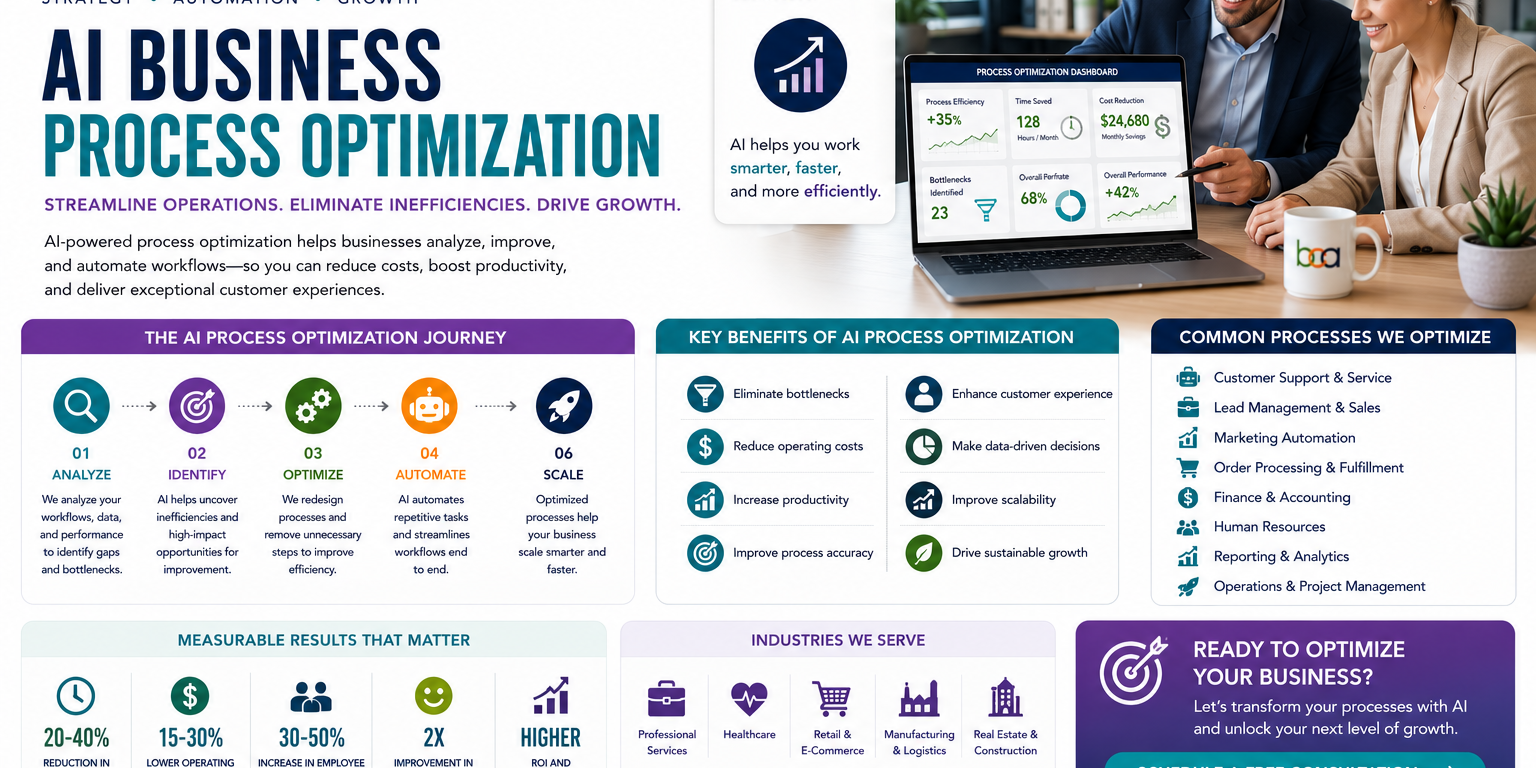
AI business process optimization is the practice of using artificial intelligence to analyze, improve, and automate business workflows to increase efficiency and overall performance.
Instead of simply automating repetitive tasks, AI helps organizations continuously evaluate how work is performed and identifies opportunities to improve productivity, reduce waste, and enhance decision-making.
An effective optimization strategy typically focuses on:
- Workflow analysis
- Process automation
- Data-driven decision-making
- Operational efficiency
- Resource allocation
- Customer experience
- Performance monitoring
- Continuous improvement
The objective is to build smarter business systems that become more efficient over time.
Why Businesses Are Prioritizing Process Optimization
Many organizations believe they have an automation problem when, in reality, they have a process problem.
Automating inefficient workflows often creates faster inefficiencies rather than better business performance.
AI business process optimization helps organizations:
- Eliminate operational bottlenecks.
- Reduce manual work.
- Improve process consistency.
- Lower operating costs.
- Increase employee productivity.
- Improve customer satisfaction.
- Support business scalability.
- Generate better operational insights.
Businesses that optimize processes before expanding automation typically achieve stronger long-term results.
Identify Operational Bottlenecks
Every organization has areas where work slows down.
Artificial intelligence can analyze operational data to identify bottlenecks involving:
- Customer inquiries
- Lead management
- Sales approvals
- Project workflows
- Inventory management
- Financial reporting
- Internal communication
- Administrative processes
Addressing these bottlenecks improves both productivity and customer experience.
Optimize Workflows Before Automating Them
Automation should support optimized processes—not replace process improvement.
Businesses should review workflows to identify opportunities to:
- Remove unnecessary steps.
- Eliminate duplicate work.
- Improve communication.
- Reduce manual approvals.
- Simplify reporting.
- Standardize procedures.
- Improve accountability.
Optimized workflows create a stronger foundation for AI implementation.
Use AI to Improve Decision-Making
Artificial intelligence enables leaders to make faster, more informed decisions.
Organizations can leverage AI to:
- Analyze operational trends.
- Forecast demand.
- Predict resource requirements.
- Monitor performance.
- Identify operational risks.
- Recommend process improvements.
These capabilities help organizations respond more effectively to changing business conditions.
Improve Customer Experiences Through Better Processes
Customer experience depends heavily on operational efficiency.
AI business process optimization helps improve:
- Response times.
- Service consistency.
- Appointment scheduling.
- Order processing.
- Customer communications.
- Issue resolution.
- Personalized experiences.
When internal processes improve, customers notice the difference.
Create Scalable Business Operations
Growth often exposes operational weaknesses.
Businesses that optimize processes early are better prepared to:
- Support higher customer volumes.
- Expand services.
- Enter new markets.
- Improve profitability.
- Reduce administrative overhead.
- Scale without proportionally increasing staffing.
Scalable systems become one of the organization’s greatest competitive advantages.
Common Process Optimization Mistakes
Organizations frequently encounter avoidable challenges during optimization initiatives.
Common mistakes include:
- Automating inefficient processes.
- Ignoring employee feedback.
- Failing to measure performance.
- Optimizing individual departments instead of entire workflows.
- Underestimating change management.
- Treating optimization as a one-time project.
Continuous improvement should become part of the organization’s culture.
Measure Optimization Success
Every optimization initiative should include measurable performance indicators.
Businesses should monitor:
- Process completion times.
- Operating costs.
- Productivity improvements.
- Customer satisfaction.
- Error rates.
- Employee efficiency.
- Revenue growth.
- Return on investment.
These metrics help organizations evaluate the effectiveness of their optimization efforts while identifying additional opportunities for improvement.
The Future of AI Business Process Optimization
Artificial intelligence is becoming increasingly capable of identifying operational improvements automatically.
Future AI systems will not simply automate tasks—they will continuously monitor business performance, recommend improvements, predict operational risks, and optimize workflows with minimal human intervention.
Organizations that begin investing in AI business process optimization today will be better prepared to adapt to changing technologies while maintaining efficient, scalable operations.
How Business Consulting Agency Helps Businesses Grow
Business Consulting Agency helps organizations improve operational performance through AI business process optimization. Our consultants evaluate existing workflows, identify operational inefficiencies, recommend automation opportunities, and develop customized optimization strategies that improve productivity, reduce costs, and support long-term growth.
Whether your goal is improving a single department or optimizing your entire organization, we provide practical consulting services that transform business processes into competitive advantages.
Key Takeaways
AI business process optimization is more than automation. It is a strategic approach to improving how work is performed across an organization. Businesses that analyze workflows, eliminate inefficiencies, leverage artificial intelligence, and continuously improve operations consistently achieve higher productivity, lower operating costs, and stronger customer experiences.
As artificial intelligence continues to evolve, organizations that embrace process optimization will build smarter, more resilient businesses capable of adapting to future opportunities while maintaining sustainable growth.
Frequently Asked Questions
What is AI business process optimization?
AI business process optimization uses artificial intelligence to analyze, improve, and automate workflows, helping businesses operate more efficiently while reducing costs and improving productivity.
How does AI improve business processes?
AI identifies inefficiencies, analyzes operational data, automates repetitive tasks, predicts bottlenecks, and recommends improvements that help organizations optimize performance.
Which business processes benefit most from AI optimization?
Customer service, sales, marketing, finance, operations, human resources, reporting, and administrative workflows are among the areas that often see the greatest improvements.
Is AI business process optimization suitable for small businesses?
Yes. Small businesses often experience significant benefits because optimized processes improve efficiency, reduce manual work, and support scalable growth without requiring substantial increases in staffing.
Why should businesses hire a process optimization consultant?
An experienced consultant helps identify hidden inefficiencies, prioritize high-impact improvements, implement AI strategically, and develop long-term optimization plans that maximize business performance while minimizing implementation risks.