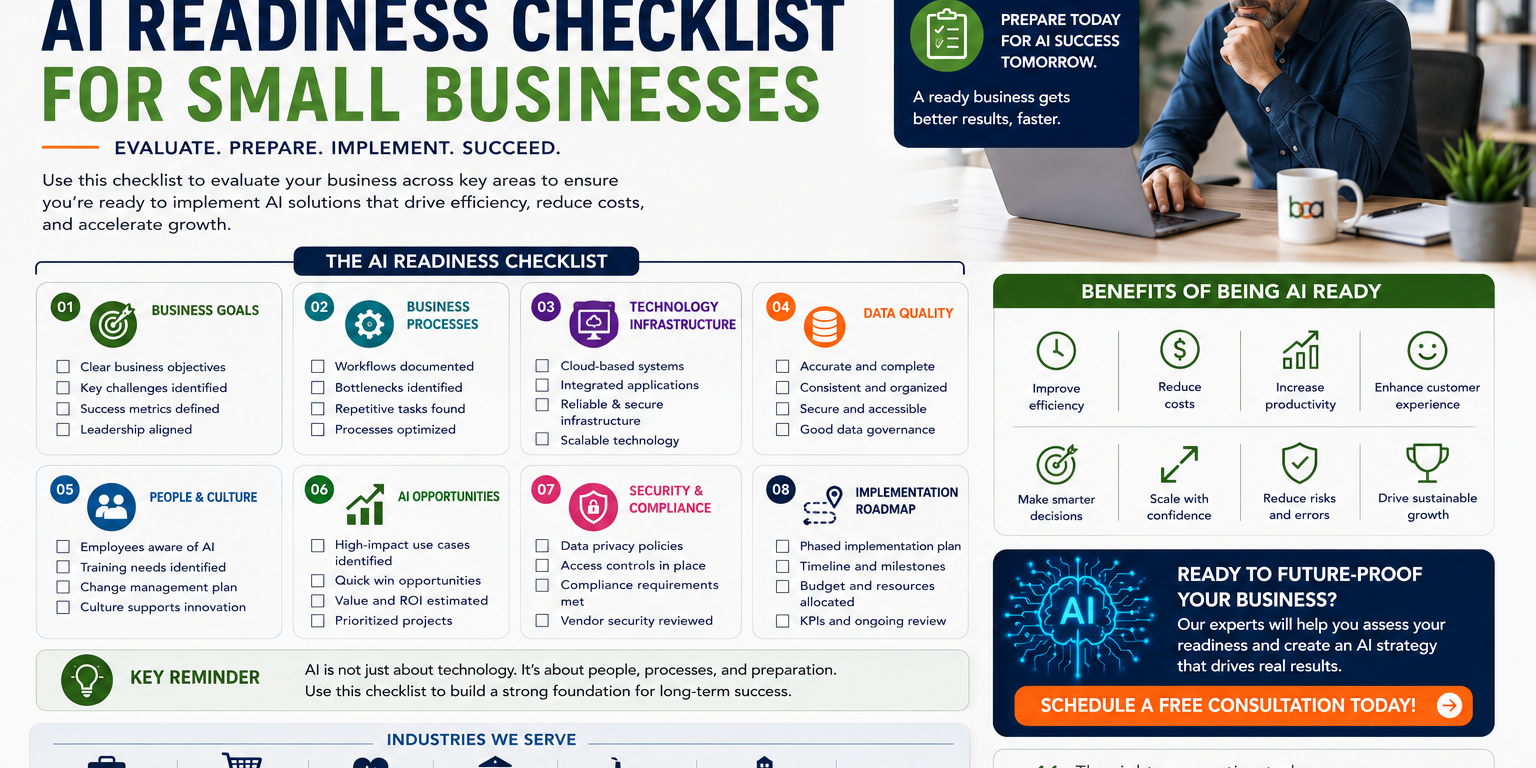
Many small businesses are eager to adopt artificial intelligence but struggle with one important question: Are we actually ready for AI? While AI promises greater efficiency, lower operating costs, and improved decision-making, successful implementation depends on much more than selecting the right software. Organizations must first evaluate their business processes, technology infrastructure, data quality, and organizational readiness. An AI readiness checklist for small businesses provides a practical framework for determining whether your company is prepared to implement AI successfully.
Businesses that complete a structured readiness assessment before investing in AI consistently achieve better results. They avoid costly implementation mistakes, prioritize the right projects, improve employee adoption, and build a stronger foundation for long-term growth.
Why Every Small Business Needs an AI Readiness Checklist
Artificial intelligence affects every part of a business, including operations, customer service, sales, marketing, finance, and leadership. Without proper preparation, organizations often invest in AI tools that fail to deliver measurable value.
Using an AI readiness checklist for small businesses helps organizations:
- Evaluate current capabilities.
- Identify operational gaps.
- Reduce implementation risks.
- Improve technology planning.
- Prioritize automation opportunities.
- Build employee confidence.
- Support long-term business growth.
- Maximize return on investment.
Rather than reacting to AI trends, businesses develop a structured implementation strategy based on their unique needs.
Evaluate Your Business Goals
Successful AI implementation always begins with clearly defined objectives.
Business owners should ask:
- Which challenges consume the most time?
- Where do operational bottlenecks occur?
- Which customer experiences need improvement?
- What repetitive tasks should be automated?
- How will success be measured?
Clear business objectives ensure every AI initiative supports meaningful organizational outcomes.
Review Your Current Business Processes
Artificial intelligence performs best when integrated into efficient workflows.
Review existing processes to identify:
- Manual approvals.
- Duplicate work.
- Repetitive administrative tasks.
- Customer service delays.
- Sales bottlenecks.
- Communication gaps.
- Reporting inefficiencies.
Improving these workflows before implementing AI creates stronger long-term results.
Assess Your Technology Infrastructure
Your technology environment plays a major role in AI implementation success.
Review whether your organization has:
- Cloud-based software.
- Modern CRM systems.
- Secure data storage.
- Integrated business applications.
- Reliable reporting tools.
- API connectivity.
- Scalable infrastructure.
Organizations with connected systems generally implement AI more efficiently.
Evaluate Data Quality
Artificial intelligence depends on reliable information.
Your AI readiness checklist for small businesses should include evaluating whether your business data is:
- Accurate.
- Complete.
- Consistent.
- Organized.
- Secure.
- Easily accessible.
High-quality data significantly improves AI performance and business insights.
Prepare Employees for AI Adoption
Technology alone does not create successful transformation.
Businesses should evaluate:
- Employee awareness.
- Training requirements.
- Change management plans.
- Leadership support.
- Department collaboration.
- Organizational culture.
Employees who understand how AI supports their work are much more likely to embrace change.
Identify High-Value AI Opportunities
Not every department needs AI immediately.
Many organizations begin with projects involving:
- Customer support.
- Appointment scheduling.
- Lead management.
- Marketing automation.
- Internal reporting.
- Meeting summaries.
- Document management.
- Sales follow-up.
Focusing on high-impact opportunities generates quick wins while building organizational confidence.
Address Security and Compliance
As businesses implement AI, protecting sensitive information becomes increasingly important.
Organizations should evaluate:
- Data privacy policies.
- Access controls.
- Cybersecurity procedures.
- Regulatory compliance.
- Vendor security standards.
- Employee awareness.
Strong governance protects both the business and its customers throughout implementation.
Create an AI Implementation Roadmap
Once readiness has been evaluated, businesses should develop a roadmap that prioritizes implementation activities.
An effective roadmap includes:
- Business objectives.
- AI priorities.
- Project timelines.
- Budget planning.
- Employee training.
- Technology integration.
- Performance measurement.
- Continuous optimization.
Following a roadmap allows businesses to implement AI in manageable phases while minimizing operational disruption.
Common AI Readiness Mistakes
Many organizations overlook critical preparation steps before implementing AI.
Common mistakes include:
- Purchasing AI software without a strategy.
- Ignoring business process improvement.
- Underestimating data quality.
- Failing to involve employees.
- Implementing too many projects simultaneously.
- Neglecting performance measurement.
- Expecting immediate transformation.
Avoiding these mistakes significantly improves implementation success.
How Business Consulting Agency Helps Businesses Grow
Business Consulting Agency helps organizations evaluate their readiness for artificial intelligence through comprehensive assessments, strategic planning, and customized implementation roadmaps. We work closely with business owners and leadership teams to identify automation opportunities, improve operational efficiency, strengthen technology infrastructure, and develop AI strategies that deliver measurable business results.
Whether you’re exploring AI for the first time or preparing for a larger digital transformation initiative, our consultants provide the expertise needed to move forward with confidence and clarity.
Key Takeaways
An AI readiness checklist for small businesses provides a structured approach to preparing for successful AI adoption. Businesses that evaluate their goals, optimize processes, improve data quality, prepare employees, and develop implementation roadmaps consistently achieve stronger operational outcomes and higher returns on investment.
Artificial intelligence is not simply another technology investment. It is a business transformation initiative that requires thoughtful planning and ongoing optimization. Organizations that begin with preparation will be better positioned to leverage AI as a long-term competitive advantage.
Frequently Asked Questions
What is an AI readiness checklist for small businesses?
An AI readiness checklist helps businesses evaluate their people, processes, technology, and data before implementing artificial intelligence.
Why is AI readiness important?
Proper preparation reduces implementation risks, improves employee adoption, and increases the likelihood of achieving measurable business results.
What should businesses evaluate before implementing AI?
Organizations should assess business objectives, workflows, technology infrastructure, data quality, employee readiness, security, and leadership support.
How often should businesses review their AI readiness?
Businesses should review their readiness before major AI initiatives and periodically as technology, operations, and business objectives evolve.
Should small businesses hire an AI consultant before implementing AI?
Working with an experienced AI consultant helps businesses identify the highest-value opportunities, avoid common implementation mistakes, and develop a practical strategy that supports long-term growth and measurable return on investment.