
Businesses across nearly every industry are experiencing major operational changes because of artificial intelligence and workflow automation. Many companies once relied heavily on manual systems, repetitive administrative tasks, spreadsheets, and disconnected software platforms. However, those outdated systems now create inefficiencies that reduce productivity, slow growth, and increase operational costs.
As competition becomes more aggressive, small businesses must modernize faster. Companies that continue using fragmented workflows often struggle with communication delays, inconsistent customer experiences, and operational bottlenecks. Meanwhile, businesses implementing AI-powered systems are improving efficiency while creating scalable infrastructures that support long-term growth.
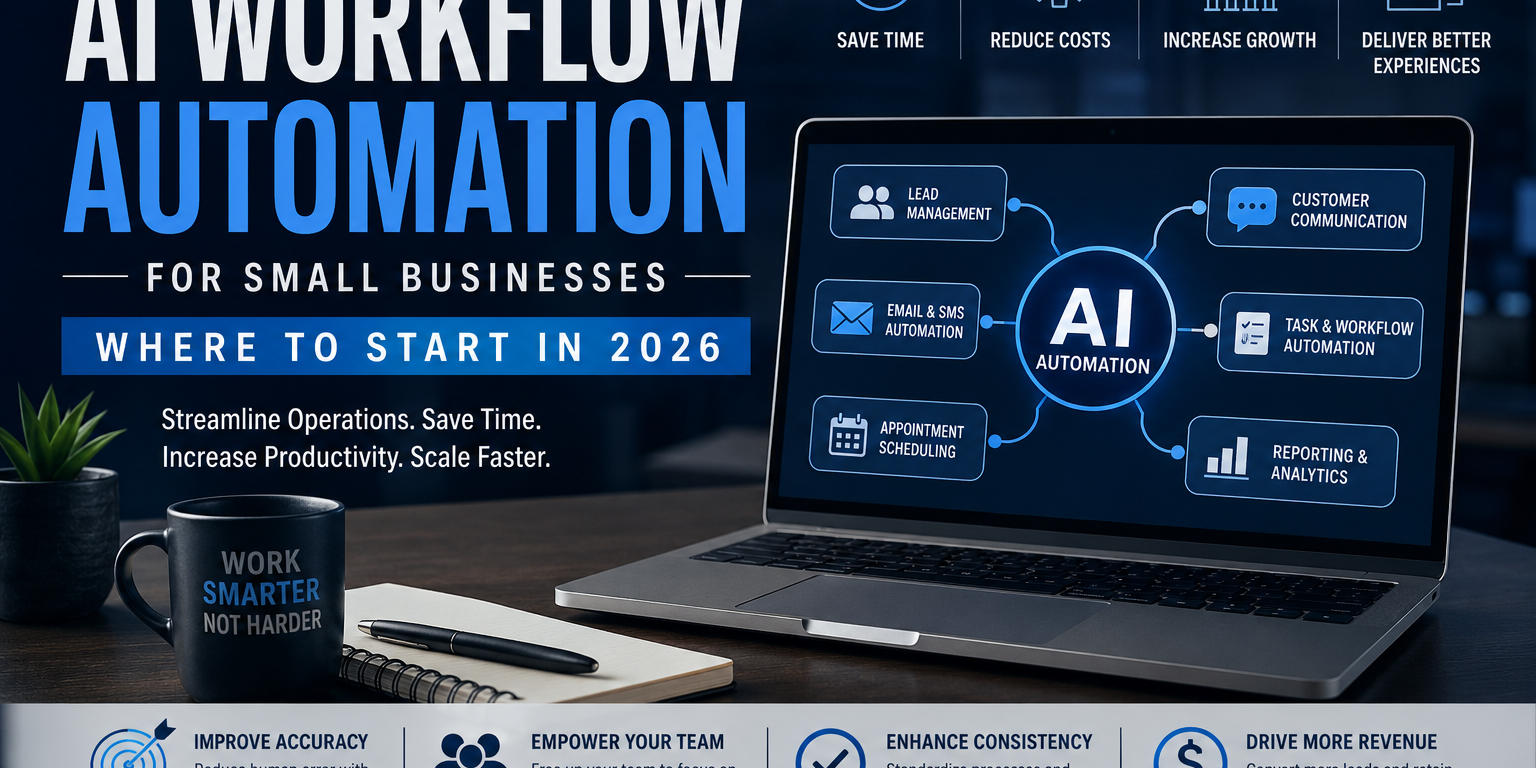
AI workflow automation is no longer reserved for large corporations with massive budgets. Modern platforms and automation tools now allow smaller companies to automate lead management, customer communication, scheduling, reporting, operations, and administrative processes. As a result, business owners can focus more attention on growth, customer experience, and revenue generation instead of repetitive daily tasks.
Understanding where to begin remains one of the biggest challenges for many organizations. Business owners often feel overwhelmed by the number of AI tools available today. Additionally, many companies implement automation incorrectly because they fail to create a structured operational strategy first. Learn how AI workflow automation for small businesses reduces inefficiencies, improves productivity, and scale operations in 2026.
Businesses should approach automation strategically rather than randomly adopting software. The most successful workflow automation systems simplify operations, eliminate inefficiencies, and improve internal communication without creating unnecessary complexity.
Why AI Workflow Automation Matters More in 2026
The business environment has changed dramatically during the last several years. Customers now expect faster responses, better communication, and highly organized customer experiences. At the same time, businesses face increasing pressure to reduce operational costs while improving productivity.
Manual systems often create several operational problems, including:
- Delayed customer responses
- Missed leads and opportunities
- Scheduling inefficiencies
- Administrative overload
- Poor follow-up consistency
- Internal communication breakdowns
- Reporting inaccuracies
- Employee burnout
Although many businesses recognize these issues, they frequently underestimate how much revenue inefficiency actually costs them each month.
Operational inefficiency affects nearly every department within a company. Sales teams lose opportunities because follow-up processes fail. Administrative teams spend excessive hours managing repetitive tasks. Management teams lack accurate reporting visibility. Customer service experiences become inconsistent because workflows are not standardized.
AI workflow automation addresses these challenges by creating structured operational systems that improve speed, consistency, and scalability.
Businesses implementing automation correctly often experience improvements in several areas, including:
- Faster customer response times
- Better lead conversion rates
- Improved internal efficiency
- Reduced labor-intensive tasks
- More organized operational systems
- Better customer retention
- Stronger reporting visibility
- Increased scalability
Consequently, workflow automation has become one of the most important modernization strategies for small businesses entering 2026.
The Biggest Mistake Businesses Make With AI Automation
Many businesses make the mistake of purchasing multiple AI tools before understanding their actual operational problems. Unfortunately, this approach usually creates confusion instead of efficiency.
Automation should never begin with software selection alone. Instead, businesses must first analyze operational bottlenecks, repetitive tasks, and communication inefficiencies.
For example, some companies purchase automation platforms without clearly understanding:
- Which tasks consume excessive employee time
- Which systems create operational delays
- Which customer communication processes fail
- Which departments experience workflow breakdowns
- Which reporting systems lack accuracy
Without this operational clarity, businesses often create fragmented systems that increase complexity.
Successful automation requires strategic planning first. Businesses should focus on simplifying workflows before automating them. Otherwise, automation may accelerate inefficient systems instead of improving them.
The Best Areas to Automate First
Small businesses should prioritize high-impact operational areas when beginning workflow automation. Starting with manageable systems allows companies to achieve faster results while avoiding unnecessary complexity.
Several operational categories usually provide the strongest early return on investment.
Lead Management and Follow-Up
Many businesses lose revenue because leads are not handled consistently. Manual follow-up systems frequently create delays, missed opportunities, and communication gaps.
AI workflow automation can improve lead management by automating:
- Lead capture forms
- CRM organization
- Appointment scheduling
- Follow-up messaging
- Lead routing
- Reminder notifications
- Pipeline tracking
As a result, businesses improve response consistency while reducing administrative workload.
Customer Communication Systems
Customer communication remains one of the most valuable automation opportunities for small businesses.
AI-powered systems can automate:
- Appointment confirmations
- Customer reminders
- Follow-up emails
- Review requests
- SMS notifications
- Chat support systems
- Customer onboarding
These systems improve customer experiences while reducing manual communication tasks.
Additionally, automation creates consistency across customer interactions, which strengthens professionalism and customer trust.
Administrative Workflow Automation
Administrative overload significantly reduces productivity for many businesses. Employees often spend excessive hours handling repetitive operational tasks that could easily become automated.
Common administrative automation opportunities include:
- Document organization
- Invoice generation
- Internal notifications
- Data entry
- Scheduling coordination
- Reporting updates
- File management
Reducing repetitive administrative work allows businesses to redirect energy toward higher-value growth activities.
Reporting and Analytics
Many business owners operate without accurate operational visibility. Consequently, they struggle to identify inefficiencies, growth opportunities, and performance issues.
AI reporting systems can help businesses track:
- Lead conversion rates
- Customer acquisition performance
- Operational efficiency
- Marketing performance
- Customer retention
- Team productivity
- Revenue trends
Better reporting allows companies to make more informed strategic decisions.
How Small Businesses Should Begin AI Automation
Businesses should approach workflow automation through a phased implementation strategy. Attempting to automate everything simultaneously often creates confusion and operational instability.
The most effective approach involves several foundational steps.
Step 1: Identify Operational Bottlenecks
Businesses should first evaluate where inefficiencies occur most frequently.
Common bottleneck indicators include:
- Delayed communication
- Missed appointments
- Employee overload
- Slow response times
- Customer complaints
- Manual reporting problems
- Repetitive administrative tasks
This operational analysis creates the foundation for automation planning.
Step 2: Prioritize High-Impact Systems
Not every process should become automated immediately. Businesses should prioritize systems that produce the greatest operational improvements first.
Lead management, customer communication, and scheduling systems often provide the fastest return on investment.
Step 3: Simplify Existing Workflows
Complex workflows should become simplified before automation begins.
Businesses frequently attempt to automate broken systems. However, simplification should always occur before automation implementation.
Clear workflows improve automation success significantly.
Step 4: Choose Scalable Platforms
Businesses should select systems capable of supporting future growth.
Scalable automation platforms help companies:
- Centralize operations
- Improve communication
- Reduce software fragmentation
- Support team collaboration
- Create operational consistency
Long-term scalability should remain a major consideration during platform selection.
Step 5: Continuously Optimize Systems
Automation should never remain static. Businesses must continuously monitor performance and improve workflows over time.
Operational optimization helps companies maintain efficiency while adapting to evolving business needs.
Industries Benefiting Most From AI Workflow Automation
Nearly every industry can benefit from operational automation. However, some sectors experience particularly strong advantages because of customer communication demands and administrative complexity.
Industries seeing rapid automation adoption include:
- Medical practices
- Med spas
- Dermatology clinics
- Plastic surgery offices
- Real estate companies
- Professional service firms
- Marketing agencies
- E-commerce businesses
- Home service companies
- Consulting firms
For example, med spas and aesthetic clinics frequently automate appointment reminders, lead nurturing, consultation follow-up, and customer retention systems.
These operational improvements help clinics increase bookings while improving customer experiences.
Why Human Strategy Still Matters
Although AI automation continues evolving rapidly, human strategy remains essential.
Automation tools alone cannot solve operational problems without strategic implementation. Businesses still require leadership, planning, operational structure, and workflow design.
The most successful companies combine:
- AI-powered efficiency
- Human operational strategy
- Customer-focused communication
- Scalable systems
- Strong leadership oversight
This balanced approach creates sustainable business growth.
Businesses that rely entirely on disconnected AI tools without strategic direction often create operational confusion instead of improvement.
The Future of Small Business Operations
The future of business operations will become increasingly automated, integrated, and data-driven. Companies that modernize early will likely gain significant operational advantages over competitors still relying on outdated systems.
AI workflow automation will continue improving:
- Operational speed
- Customer experiences
- Internal communication
- Revenue visibility
- Scalability
- Decision-making accuracy
Additionally, automation platforms will become more accessible and affordable for small businesses.
Companies delaying modernization may eventually struggle to compete against businesses operating with significantly greater efficiency.
Business owners should view AI workflow automation as a long-term operational investment rather than a temporary technology trend.
Common Questions About AI Workflow Automation
Is AI workflow automation expensive for small businesses?
Many automation platforms are now affordable for small businesses. Costs vary depending on complexity, integrations, and operational goals.
Can automation replace employees?
Automation typically improves employee productivity rather than replacing entire teams. Most businesses use automation to reduce repetitive tasks and improve efficiency.
How long does automation implementation take?
Implementation timelines vary based on operational complexity. Smaller systems may launch within days, while larger operational infrastructures require phased development.
What is the best first automation for small businesses?
Lead management and customer communication systems often provide the strongest early operational improvements.
Do businesses still need consultants if AI tools exist?
Yes. AI tools require strategic implementation, operational planning, workflow design, and optimization. Without proper structure, businesses often misuse automation systems.
Building a Smarter Business Infrastructure
AI workflow automation is transforming how modern businesses operate. Companies that embrace operational modernization now will position themselves more competitively for future growth.
The most successful businesses in 2026 will not necessarily be the largest companies. Instead, many will be organizations operating with greater efficiency, smarter systems, and stronger operational infrastructures.
Small businesses no longer need massive teams to scale effectively. With the right workflow automation strategy, companies can improve productivity, reduce operational friction, and create more scalable systems for long-term growth.
Businesses should approach automation carefully, strategically, and with clear operational objectives. When implemented properly, AI workflow automation becomes a powerful foundation for modernization, scalability, and sustainable business success. Learn how AI workflow automation for small businesses reduces inefficiencies, improves productivity, and scale operations in 2026. Talk to an AI Growth Specialist and get started.