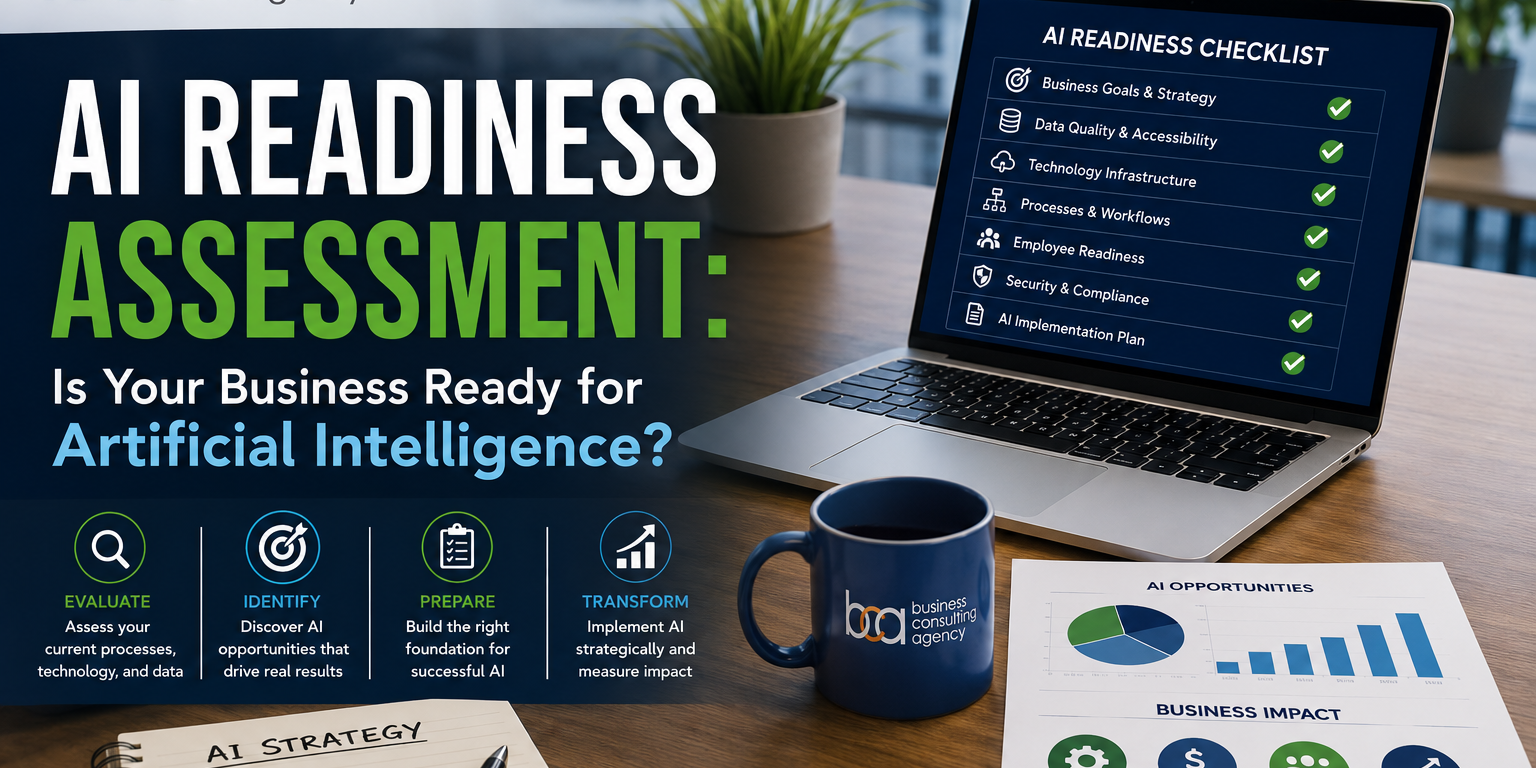
Artificial intelligence is rapidly transforming how businesses operate, compete, and grow. From automating repetitive administrative work to improving customer experiences and delivering deeper business insights, AI has become one of the most valuable tools available to modern organizations. However, purchasing AI software is only one part of the equation. Before implementing any new technology, businesses should determine whether they are truly prepared to take advantage of it.
This is where an AI readiness assessment becomes invaluable.
Many organizations invest in artificial intelligence before evaluating their internal processes, technology infrastructure, employee readiness, and operational goals. Unfortunately, this often leads to poor adoption, wasted software investments, and disappointing results. Businesses that begin with a structured readiness assessment are far more likely to implement AI successfully and achieve measurable returns.
Whether you operate a startup, retail business, e-commerce company, med spa, aesthetic practice, or another small business, understanding your current level of AI readiness is the first step toward building a smarter and more efficient organization.
What Is an AI Readiness Assessment?
An AI readiness assessment is a structured evaluation of your business designed to determine whether your organization is prepared to implement artificial intelligence successfully.
Rather than focusing on technology alone, the assessment examines how your business operates today and identifies where AI can create measurable improvements.
A comprehensive assessment typically evaluates:
- Business objectives
- Current workflows
- Technology infrastructure
- Data quality
- Customer experience
- Employee readiness
- Operational bottlenecks
- Security and compliance
- Existing software ecosystem
- Growth objectives
The goal is not simply to determine whether your business can use AI. Instead, it identifies where AI will create the greatest return on investment while minimizing implementation risks.
Why Every Business Should Start with an Assessment
Many companies purchase AI platforms because competitors are using them or because a software demonstration appears impressive. While enthusiasm for innovation is important, implementing technology without a strategy often creates unnecessary complexity.
Businesses that complete an AI readiness assessment first gain several advantages.
Clear Business Priorities
Instead of chasing every new AI tool, leadership gains clarity about which operational challenges should be solved first.
Better Return on Investment
Investments become focused on measurable business improvements rather than software features.
Lower Implementation Risk
Potential obstacles are identified before implementation begins, reducing disruption and improving employee adoption.
Stronger Employee Buy-In
When employees understand why AI is being implemented and how it supports their work, adoption rates increase significantly.
Five Areas Every AI Readiness Assessment Should Evaluate
1. Operational Efficiency
Begin by reviewing your current business processes.
Ask questions such as:
- Which tasks consume the most employee time?
- Where do delays occur?
- Which processes are repetitive?
- Which activities create customer frustration?
- Which workflows depend heavily on manual data entry?
These areas often provide the fastest opportunities for automation.
2. Technology Infrastructure
AI works best when integrated into a stable technology environment.
Evaluate:
- CRM systems
- Marketing platforms
- Accounting software
- Customer support systems
- Scheduling platforms
- Internal communication tools
Businesses using disconnected software may benefit from improving integration before expanding AI capabilities.
3. Data Quality
Artificial intelligence relies on accurate information.
Review the quality of your:
- Customer records
- Sales data
- Marketing analytics
- Inventory information
- Financial reporting
Poor data quality limits the effectiveness of AI-powered recommendations and automation.
4. Employee Readiness
Technology adoption depends on people.
Evaluate whether your team:
- Understands AI basics
- Is open to change
- Receives adequate training
- Has leadership support
- Understands implementation goals
Organizations that invest in employee education typically achieve stronger long-term results.
5. Business Goals
Every AI project should support measurable business objectives.
Common goals include:
- Increasing productivity
- Improving customer service
- Reducing operational costs
- Growing revenue
- Automating repetitive work
- Scaling operations
- Enhancing reporting and decision-making
Without clearly defined objectives, businesses often struggle to measure success.
Industry Examples
Startup Ventures
Startups benefit from AI by automating administrative work, improving customer acquisition, and scaling operations without immediately increasing payroll.
Retail Businesses
Retailers use AI to improve inventory forecasting, customer personalization, and sales analytics while enhancing the shopping experience.
E-commerce Companies
Online businesses implement AI for product recommendations, marketing automation, customer support, pricing optimization, and inventory management.
Med Spas and Aesthetic Practices
Aesthetic businesses increasingly use AI for consultation scheduling, patient communication, follow-up automation, CRM management, and reputation management.
Small Businesses
Across every industry, small businesses use AI to reduce repetitive work, improve communication, increase productivity, and create more scalable operations.
Signs Your Business Is Ready for AI
Your business is likely ready to begin implementing AI if:
- Employees spend excessive time on repetitive tasks.
- Customer inquiries are increasing.
- Operations have become more complex.
- Business growth is slowing because of manual processes.
- Leadership needs better reporting and business insights.
- Customer expectations continue rising.
- Existing software no longer works efficiently together.
- Administrative work limits employee productivity.
If several of these challenges sound familiar, your business may be an excellent candidate for AI implementation.
Common Mistakes to Avoid
Businesses should avoid:
- Purchasing AI software without a strategy.
- Automating broken processes.
- Ignoring employee training.
- Implementing too many AI tools at once.
- Measuring software usage instead of business outcomes.
- Failing to establish success metrics before implementation.
A structured assessment helps prevent these costly mistakes.
Frequently Asked Questions
What is an AI readiness assessment?
It is a structured evaluation that determines how prepared a business is to implement artificial intelligence successfully.
How long does an assessment take?
Most small business assessments can be completed within a few days, depending on organizational complexity.
Is every business ready for AI?
Nearly every business can benefit from AI, but implementation priorities vary based on operational maturity, technology infrastructure, and business goals.
Why work with an AI consultant?
An experienced consultant identifies the highest-value opportunities, develops an implementation roadmap, and helps businesses avoid expensive implementation mistakes.
What happens after the assessment?
Businesses typically receive recommendations, implementation priorities, technology guidance, and a phased roadmap for introducing AI into daily operations.
Preparing for Long-Term Success
Artificial intelligence is changing the way businesses compete, communicate, and grow. Organizations that begin with a structured AI readiness assessment position themselves for more successful implementation because they understand where AI will create the greatest impact before investing in technology.
Rather than rushing into software purchases, business owners should focus on understanding their operations, defining measurable objectives, and preparing employees for change. This strategic approach reduces risk, improves adoption, and creates a stronger foundation for long-term growth.
An AI readiness assessment is more than a technology review. It is the first step toward building a more efficient, scalable, and future-ready business.