Artificial intelligence has quickly become one of the most significant business innovations of the decade. What was once viewed as emerging technology has now become an essential competitive advantage for companies of every size. Large enterprises have invested billions into AI-powered operations, but today’s small businesses have access to many of the same technologies at a fraction of the cost. They just need to know how to implement AI in a small business properly.
Despite this growing accessibility, many business owners remain unsure how to begin. Some experiment with AI chatbots or content generators without a broader strategy. Others postpone implementation because they believe artificial intelligence is too expensive, too complicated, or only beneficial for large corporations.
Both assumptions are costly. Successful AI adoption is not about installing software or replacing employees. It is about improving how a business operates. When implemented strategically, AI helps organizations eliminate repetitive work, improve customer experiences, increase productivity, support better decision-making, and create scalable systems that grow alongside the business.
Whether you operate a startup, retail business, e-commerce company, consulting firm, med spa, or aesthetic practice, artificial intelligence can become one of your most valuable business assets. However, the companies achieving the greatest results all follow a structured implementation process instead of adopting AI randomly.
This guide explains how to implement AI in a small business using a practical, step-by-step framework that reduces risk while maximizing return on investment.
Why Every Small Business Needs an AI Strategy
Many businesses begin using AI without establishing clear objectives. While experimenting with technology can be valuable, long-term success requires a strategic foundation. Artificial intelligence should support business goals rather than become the goal itself.
An effective AI strategy aligns technology with the areas that matter most to business performance. These usually include revenue growth, customer experience, operational efficiency, cost reduction, employee productivity, and long-term scalability.
Without a roadmap, businesses often purchase multiple AI tools that overlap in functionality or fail to integrate with existing systems. This creates confusion, increases software costs, and slows adoption across the organization. Businesses that start with strategy consistently achieve better outcomes than those that begin with software.
What AI Can Do for Small Businesses
Artificial intelligence is no longer limited to simple chatbots or automated content generation. Modern AI solutions can improve nearly every department within an organization.
- Automate repetitive administrative work
- Improve customer service and response speed
- Qualify and nurture leads
- Generate marketing content and campaign ideas
- Analyze business performance
- Forecast sales and demand
- Personalize customer experiences
- Optimize inventory and operations
- Schedule appointments and consultations
- Improve internal communication and reporting
Rather than replacing employees, these systems allow teams to focus on strategic, customer-facing, and revenue-generating activities. This is especially important for small businesses that need to operate efficiently without unnecessary overhead.
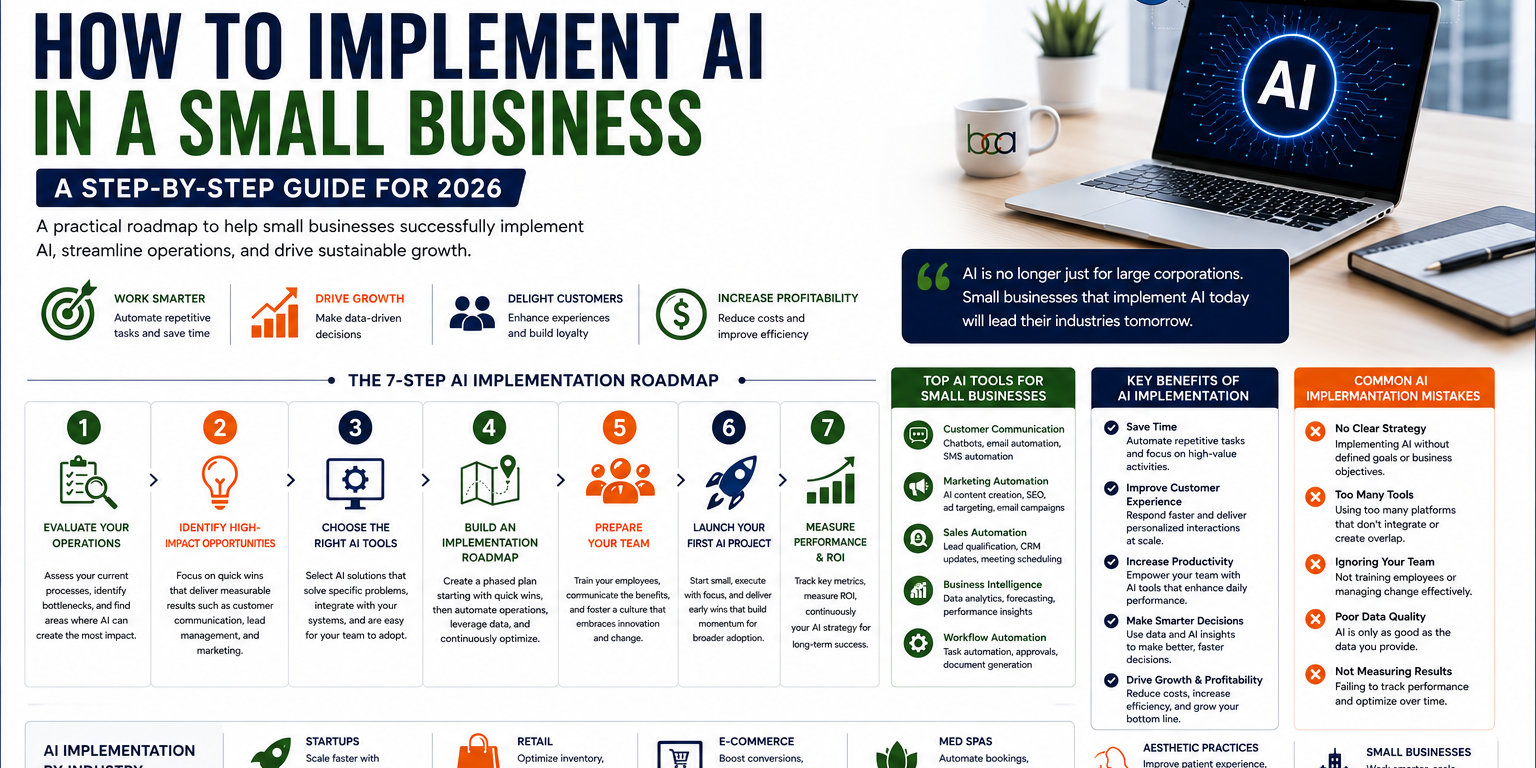
Step 1: Evaluate Your Current Business Operations
Before selecting any AI platform, evaluate how your business operates today. This assessment identifies where artificial intelligence can deliver the greatest value. Many AI projects fail because businesses attempt to automate processes they do not fully understand.
Start by reviewing the daily activities that keep the company running. Look at your customer journey, sales process, marketing activities, administrative responsibilities, reporting systems, internal communication, and existing software tools.
The objective is to identify friction. Which tasks consume the most time? Where do delays occur? Which activities are repetitive? What frustrates employees? Where are customers waiting? These operational bottlenecks usually represent the best opportunities for AI implementation.
For example, a med spa may discover that staff spend hours manually following up with consultation leads. An e-commerce business may find that customer service questions repeat daily. A startup may realize that founders spend too much time creating reports, proposals, and investor updates. A retail business may struggle with demand forecasting and customer segmentation.
Each of these problems can often be improved through AI implementation, but the right solution depends on the workflow behind the issue.
Step 2: Identify High-Impact AI Opportunities
Not every process should be automated immediately. Small businesses should start with improvements that produce measurable results while minimizing implementation complexity.
The highest-impact opportunities usually involve customer communication, lead management, marketing execution, reporting, scheduling, and repetitive administrative processes.
Customer Communication
AI can automate live chat, appointment reminders, email follow-up, SMS notifications, customer onboarding, and frequently asked questions. These improvements increase responsiveness while reducing administrative work.
For many small businesses, communication speed directly affects revenue. A business that responds to inquiries quickly often converts more leads than a competitor with slower follow-up systems.
Sales and Lead Management
AI helps sales teams qualify leads, route inquiries, schedule consultations, prioritize opportunities, automate follow-up, and organize CRM records. Businesses frequently see immediate improvements in lead response times and conversion rates after optimizing these processes.
This is particularly important for service-based companies, med spas, aesthetic practices, consulting firms, and other businesses where each lead may carry significant revenue potential.
Marketing
Artificial intelligence supports marketing by improving content planning, SEO research, email campaigns, advertising optimization, audience segmentation, and customer personalization. Marketing teams can execute campaigns faster while making better data-driven decisions.
For small businesses, AI can reduce the time required to create campaign ideas, product descriptions, blog outlines, email sequences, and promotional messaging. However, human strategy and brand judgment remain essential.
Operations and Administration
Administrative work can quietly consume large portions of a team’s week. AI can help automate meeting notes, document preparation, internal reporting, task routing, scheduling, file organization, and routine communication.
These improvements reduce operational drag while allowing employees to focus on higher-value work.
Step 3: Choose the Right AI Tools
One of the biggest mistakes businesses make is believing that more AI tools automatically produce better results. In reality, a carefully selected technology stack almost always outperforms a collection of disconnected applications.
Every tool should solve a specific business problem while integrating seamlessly with your existing systems. Before investing in any platform, evaluate whether it solves a measurable operational challenge, integrates with your current software, is easy for employees to learn, can scale with your business, provides measurable return on investment, and includes appropriate security features.
Avoid implementing AI simply because it is trending. Every technology decision should support your overall business strategy.
Essential AI Categories for Small Businesses
Although every business has unique requirements, most organizations benefit from solutions in several core categories.
- Customer communication tools such as chat assistants, email automation, SMS automation, appointment reminders, customer support routing, and virtual receptionists
- Marketing automation tools for content generation, SEO research, email personalization, advertising optimization, customer segmentation, and social media scheduling
- Sales automation tools for lead qualification, CRM updates, proposal generation, meeting scheduling, sales forecasting, and pipeline management
- Business intelligence tools that identify revenue trends, customer behavior, marketing performance, operational bottlenecks, employee productivity, and financial forecasts
The best solution is rarely the most complex option. Small businesses should prioritize usability, integration, and measurable business value.
Step 4: Build an AI Implementation Roadmap
Successful AI implementation rarely happens all at once. The strongest organizations implement artificial intelligence through carefully planned phases. A phased roadmap reduces disruption and helps employees adopt new tools more effectively.
Phase One: Quick Wins
Focus first on improvements that deliver immediate value. Examples include AI meeting summaries, email automation, customer chat assistants, appointment reminders, and CRM automation. These projects build confidence while allowing employees to experience the benefits of AI firsthand.
Phase Two: Operational Automation
Once employees become comfortable with AI, businesses can automate larger operational processes. This often includes workflow automation, internal approvals, customer onboarding, reporting systems, project management, and document generation.
Operational efficiency increases significantly during this stage because the business starts connecting multiple systems together rather than improving isolated tasks only.
Phase Three: Business Intelligence
After operational improvements are established, AI can begin supporting strategic decision-making. Businesses may implement predictive analytics, revenue forecasting, customer lifetime value analysis, demand forecasting, sales forecasting, and financial reporting.
Leadership gains far greater visibility into business performance. Better reporting allows owners and managers to make decisions based on evidence instead of assumptions.
Phase Four: Continuous Optimization
Artificial intelligence continues improving over time. Businesses should review AI performance quarterly and identify opportunities to improve workflows, reduce costs, increase automation, expand integrations, and enhance customer experiences.
Continuous optimization creates long-term competitive advantages because the business keeps improving instead of treating AI as a one-time project.
Step 5: Prepare Your Employees
Technology succeeds only when employees embrace it. One of the biggest reasons AI projects fail is poor change management rather than poor technology. Employees should understand that AI exists to improve their work, not replace them.
Successful businesses explain why AI is being implemented, demonstrate practical benefits, provide training, encourage feedback, start with manageable projects, and celebrate early successes. Employee confidence often determines the long-term success of AI adoption.
Small businesses should also define appropriate usage guidelines. Employees need to understand when AI should be used, when human review is required, and how sensitive customer or company information should be protected.
Step 6: Launch Your First AI Project
Rather than attempting to transform the entire organization immediately, launch one carefully selected project. The first project should be easy to understand, measurable, and directly connected to a business problem.
Ideal first projects include a customer service chatbot, AI-powered appointment scheduling, CRM automation, marketing content assistance, email automation, meeting transcription, or an internal knowledge assistant.
Before launching, define the current baseline. For example, if the project focuses on lead response, measure the current average response time, number of missed inquiries, and conversion rate. After implementation, compare results against the baseline.
This approach turns AI implementation into a measurable business improvement instead of a vague technology experiment.
Step 7: Measure Performance and Return on Investment
Artificial intelligence should produce measurable business improvements. Track performance before implementation and compare results afterward. Successful AI implementation focuses on outcomes rather than technology features.
Important metrics include customer response time, lead conversion rate, administrative hours saved, customer satisfaction, employee productivity, revenue growth, operational costs, customer retention, appointment bookings, and marketing ROI.
For example, if an aesthetic practice implements automated consultation follow-up, the practice should measure changes in booked consultations, show rates, and treatment revenue. If an e-commerce company uses AI for abandoned cart recovery, it should measure recovered revenue and conversion rate improvements.
The most useful AI systems produce clear operational and financial benefits.
AI Implementation by Industry
Every industry benefits from AI differently. Implementation should always align with operational priorities, customer expectations, and revenue opportunities.
Startup Ventures
Startups require scalable systems while operating with limited resources. Artificial intelligence helps founders automate administrative work, improve investor reporting, build marketing systems, generate content, improve customer acquisition, manage customer support, and reduce operating costs.
AI allows startups to grow faster without immediately increasing payroll. It can also help founders test ideas, analyze markets, document processes, and create early operational structure.
Retail Businesses
Retail businesses benefit from AI through inventory forecasting, personalized promotions, customer segmentation, demand forecasting, sales analytics, loyalty optimization, and local marketing support. These improvements strengthen customer experiences while improving profitability.
Retailers can use AI to understand buying patterns, identify slow-moving products, recommend promotions, and communicate with customers more effectively.
E-Commerce Businesses
Online retailers generate significant operational data. AI helps optimize product recommendations, site search, dynamic pricing, customer service, cart abandonment recovery, inventory planning, email marketing, and advertising campaigns.
Even modest improvements in conversion rates can produce substantial revenue growth for e-commerce businesses. AI also helps online stores personalize shopping experiences at scale.
Med Spas and Aesthetic Practices
The aesthetic industry has become one of the fastest adopters of AI-powered business systems because lead response, consultation follow-up, and patient communication directly affect revenue.
Artificial intelligence supports consultation scheduling, lead nurturing, automated follow-up, appointment reminders, review generation, patient education, CRM automation, reputation management, and reactivation campaigns.
These improvements allow providers to focus more time on patient care while maintaining consistent communication throughout the customer journey.
Small Businesses
Small businesses often realize the fastest return on investment because operational improvements affect every department. AI enables owners to reduce repetitive work, improve customer communication, make faster decisions, scale operations, increase productivity, and build more efficient organizations.
Modern AI allows small businesses to compete with much larger competitors through smarter operations rather than larger teams.
The 10 Most Common AI Implementation Mistakes
Many businesses invest in artificial intelligence expecting immediate results. However, technology alone rarely transforms an organization. Successful AI implementation depends on strategy, leadership, employee adoption, and continuous optimization.
1. Implementing AI Without a Business Strategy
Perhaps the biggest mistake businesses make is purchasing AI software before defining clear business objectives. Artificial intelligence should never become the strategy itself. Every implementation should answer what business problem is being solved, which processes need improvement, what measurable outcomes are expected, and how success will be measured.
2. Trying to Automate Everything Immediately
Many organizations become excited about AI and attempt to automate every department simultaneously. This often creates employee confusion, workflow disruptions, increased costs, poor adoption, and implementation delays. Instead, focus on one high-impact project at a time.
3. Choosing Technology Before Understanding Processes
Artificial intelligence improves processes. It does not automatically fix broken ones. If existing workflows are inefficient, AI may simply automate those inefficiencies. Businesses should simplify workflows, eliminate unnecessary steps, standardize processes, and document procedures before automation begins.
4. Ignoring Employee Adoption
Employees determine whether AI succeeds. Organizations that fail to train and involve staff often experience resistance. Successful companies explain the purpose of AI, demonstrate practical benefits, provide ongoing education, encourage employee feedback, and celebrate early successes.
5. Measuring Technology Instead of Business Results
Many organizations evaluate AI based on features rather than outcomes. Businesses should measure revenue growth, time saved, customer satisfaction, productivity improvements, reduced operational costs, and faster response times.
6. Using Too Many AI Platforms
Businesses often purchase multiple AI applications that perform similar functions. This creates software overlap, higher subscription costs, employee confusion, data silos, and poor integration. A streamlined technology ecosystem usually performs better than dozens of disconnected applications.
7. Forgetting Data Quality
Artificial intelligence depends on accurate information. Poor data produces poor recommendations. Businesses should regularly maintain customer records, CRM systems, financial data, inventory information, and marketing analytics.
8. Ignoring Cybersecurity
As businesses adopt AI, protecting sensitive information becomes increasingly important. Organizations should evaluate data encryption, user permissions, vendor security, privacy compliance, and access controls.
9. Failing to Review Performance
Artificial intelligence requires ongoing refinement. Successful organizations regularly review workflow efficiency, customer feedback, employee productivity, financial impact, and automation opportunities.
10. Waiting Too Long
Some businesses continue postponing AI adoption because they believe the technology will mature further. Meanwhile, competitors continue improving operations, reducing costs, and enhancing customer experiences. The companies beginning today will likely enjoy several years of operational advantage over businesses that delay implementation.
AI Trends That Will Shape Small Businesses Through 2030
Artificial intelligence is evolving rapidly, and the businesses preparing today will be better positioned for tomorrow’s opportunities. Several major trends are expected to reshape small business operations during the remainder of this decade.
AI Will Become Embedded in Every Business Platform
Rather than purchasing standalone AI software, businesses will increasingly use AI integrated directly into their existing systems. CRM platforms, accounting software, marketing platforms, project management tools, and customer service applications are rapidly embedding AI capabilities into their products. This will simplify implementation while reducing software complexity.
Hyper-Personalized Customer Experiences
AI will continue improving customer interactions by delivering highly personalized recommendations, communications, and support. Businesses will better understand customer behavior while creating more meaningful experiences that strengthen loyalty and retention.
Predictive Business Intelligence
Instead of reviewing historical reports, business owners will increasingly rely on AI to predict future outcomes. Examples include sales forecasting, inventory planning, customer retention analysis, revenue projections, staffing recommendations, and marketing optimization. Decision-making will become increasingly proactive rather than reactive.
Autonomous Business Operations
Many routine administrative activities will become largely autonomous. Businesses will automate scheduling, internal reporting, proposal generation, customer onboarding, vendor communication, financial reporting, and workflow approvals. Employees will spend more time solving complex business problems instead of managing repetitive administrative tasks.
AI Will Become a Competitive Standard
Artificial intelligence will soon become as common as email, cloud computing, and business websites. Businesses that fail to modernize may struggle to compete against organizations operating with greater speed, efficiency, and intelligence.
Frequently Asked Questions
How long does it take to implement AI in a small business?
Simple automation projects may be completed within a few weeks, while comprehensive AI transformation initiatives typically require several months using a phased implementation strategy.
Is AI expensive for small businesses?
Not necessarily. Many AI platforms offer affordable subscription models suitable for small businesses. The greatest value comes from selecting the right tools and implementing them strategically.
What is the first AI project a small business should implement?
Customer communication, appointment scheduling, CRM automation, and workflow automation often provide the fastest return on investment.
Can AI replace employees?
Artificial intelligence is designed to improve employee productivity rather than eliminate entire teams. Most successful businesses use AI to automate repetitive work while allowing employees to focus on strategic, creative, and customer-facing responsibilities.
Which industries benefit the most from AI?
Nearly every industry benefits from AI implementation. Startup ventures, retail businesses, e-commerce companies, med spas, aesthetic practices, healthcare organizations, consulting firms, and professional service providers are among the fastest adopters.
Should I hire an AI consultant?
Businesses implementing multiple AI systems or modernizing operations often benefit from working with an experienced AI consultant. A consultant helps create a strategic roadmap, avoid costly implementation mistakes, and maximize return on investment.
Future-Proof Your Business with AI
Artificial intelligence is no longer an emerging technology. It has become a fundamental component of modern business strategy. Organizations that embrace AI thoughtfully can improve operational efficiency, strengthen customer relationships, reduce administrative overhead, and build scalable systems that support sustainable growth.
However, successful AI adoption requires more than simply purchasing software. Businesses achieve the greatest results when implementation begins with a clear strategy, measurable objectives, and a phased roadmap aligned with operational priorities.
Whether you operate a startup venture, retail business, e-commerce company, consulting firm, med spa, or aesthetic practice, artificial intelligence offers practical opportunities to modernize operations and create long-term competitive advantages.
The businesses leading their industries over the next decade will not necessarily have the largest budgets or the biggest teams. They will be the organizations that successfully combine experienced leadership with intelligent automation, data-driven decision-making, and continuously optimized business systems.
Implementing AI is not simply about keeping pace with technology. It is about building a smarter, more resilient, and more profitable business prepared for the future.