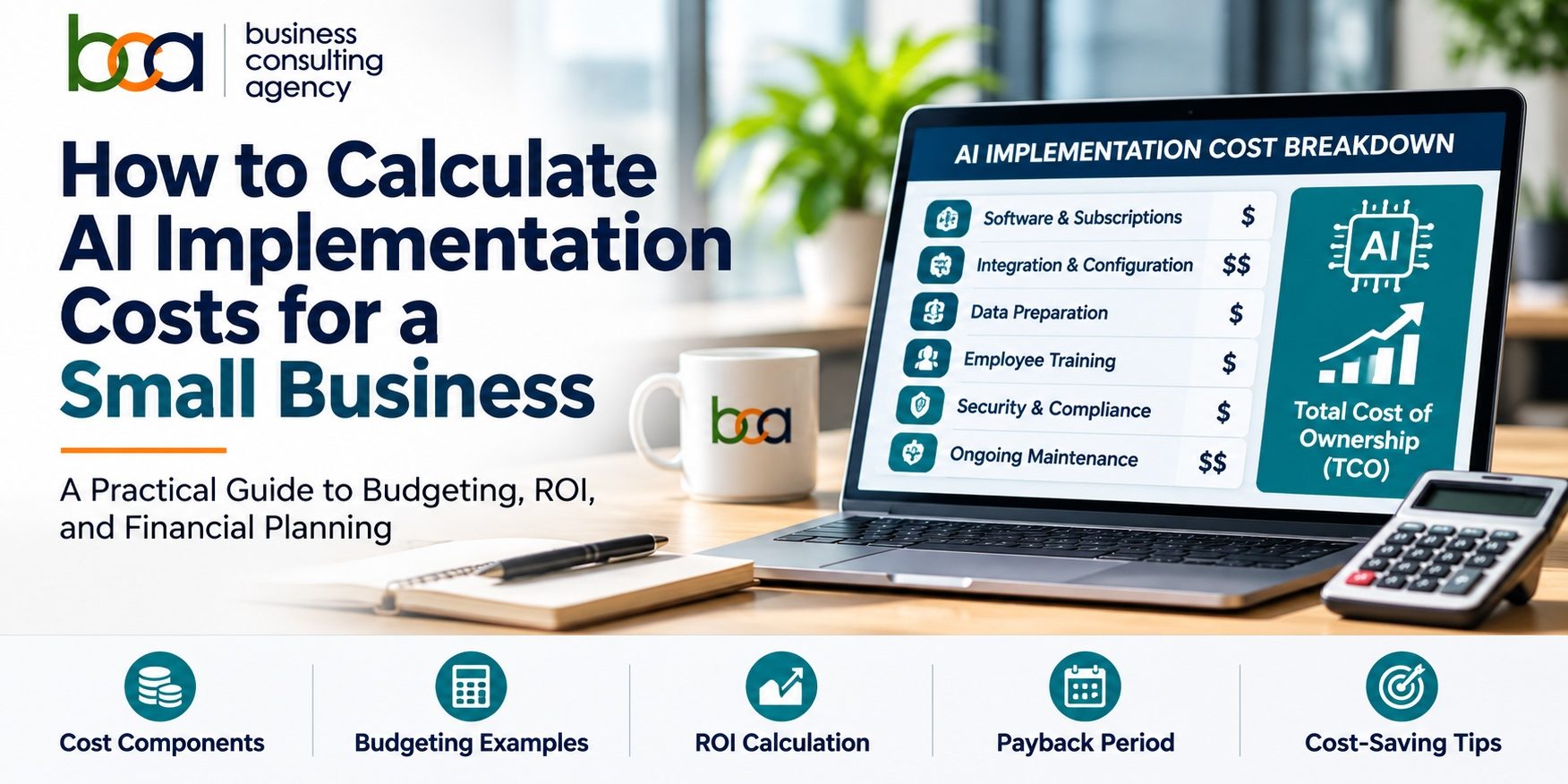
Artificial intelligence is becoming increasingly accessible to small businesses, but affordability depends on more than the monthly price of an AI subscription. Companies must also account for workflow integration, employee training, data preparation, security, maintenance, and the time required to achieve measurable results. Understanding AI implementation costs for small businesses is essential before committing resources to new technology.
A business might spend less than $100 per month experimenting with a standalone AI application, while a customized automation project involving multiple software systems could require thousands of dollars in implementation work. Neither approach is automatically better. The right investment depends on the business problem, operational complexity, expected financial return, and ongoing support requirements.
This guide explains how to estimate AI implementation expenses, build a realistic budget, calculate return on investment, and determine whether an AI project makes financial sense.
What Does AI Implementation Actually Cost?
AI implementation costs vary significantly based on the technology being introduced and the work required to make it operational.
A company using AI to summarize internal documents may need only software subscriptions, employee training, and appropriate data protection policies. A business automating customer inquiries across its website, CRM, email, and scheduling systems will face additional integration, testing, and maintenance expenses.
The distinction is important because purchasing AI software is not the same as implementing an AI-powered business system.
For budgeting purposes, small businesses can classify projects into three categories:
| Implementation type | Illustrative initial budget | Typical scope |
|---|---|---|
| Basic AI adoption | $100–$1,500 | Standalone AI tools, configuration, and initial training |
| Integrated workflow automation | $1,500–$10,000 | AI connected to existing applications and business processes |
| Customized AI business system | $10,000–$50,000+ | Multiple integrations, tailored workflows, governance, and substantial implementation |
These are illustrative planning scenarios, not verified industry averages or vendor quotations. Actual costs can fall outside these ranges.
A basic deployment may involve very little technical work. More complex implementations can require consultants, developers, automation specialists, software vendors, and internal employees working together.
Businesses considering broader modernization should review how Business Consulting Agency’s AI Business Systems services approach AI integration, operational planning, and workflow improvements.
The Seven Major Components of an AI Implementation Budget
An accurate budget separates the cost of acquiring technology from the expenses associated with implementing and operating it.
1. AI Software Subscriptions and Usage Fees
Software subscriptions are usually the most visible expense, but pricing models vary. Some providers charge per user, others charge according to usage, and some combine monthly platform fees with additional charges for API requests, document processing, storage, or premium features.
When comparing vendors, evaluate:
- Monthly and annual subscription fees
- Number of employees requiring access
- Usage limits and overage charges
- API access and integration availability
- Data storage and processing costs
- Administrative controls and security features
- Contract terms and cancellation requirements
For example, a hypothetical AI application costing $30 per user per month would require $180 monthly for six employees, or $2,160 annually before taxes, additional usage, or implementation expenses.
A low subscription price can become expensive when the software requires several additional applications to deliver the intended workflow.
2. Integration With Existing Business Systems
Many businesses already rely on customer relationship management platforms, accounting applications, scheduling tools, email systems, and project management software.
Connecting AI to these systems can require configuration, API development, workflow design, permissions management, and testing. Integration costs increase when applications lack reliable connectors or when existing data structures are inconsistent.
Consider a company that wants AI to process incoming sales inquiries. The system may need to:
- Capture inquiries from website forms and email.
- Extract relevant customer information.
- Check records in the CRM.
- Categorize or prioritize inquiries.
- Prepare personalized responses for approval.
- Create follow-up tasks.
- Record activity for reporting.
Each connection introduces implementation requirements and potential failure points.
Before paying for custom development, investigate whether existing applications already provide the required functionality. Sometimes a standard integration is sufficient, while other situations justify a more customized approach.
3. Data Preparation and Organization
AI systems are only as useful as the information and processes supporting them. If customer records contain duplicates, documents are scattered across platforms, or employees use inconsistent naming conventions, implementation may require substantial preparation.
Data-related expenses can include cleaning CRM records, standardizing fields, organizing documents, establishing access permissions, and preparing knowledge bases for AI-assisted search.
For a small business, this work may be completed internally. Larger or more complex environments may require external assistance.
Data preparation should be budgeted separately because it can consume significant staff time even when no additional software is purchased.
Businesses uncertain about their starting point can use an AI readiness checklist for small businesses to identify gaps before committing to implementation.
4. Consulting, Development, and Configuration
External expertise may be appropriate when a company lacks internal experience with automation architecture, systems integration, security, or project management.
Professional services can include:
- Business process analysis and opportunity assessment
- Technology and vendor evaluation
- AI implementation planning
- Workflow design and configuration
- Custom integration or development
- Testing and deployment
- Employee training and documentation
The scope should be clearly defined before work begins.
A useful proposal identifies deliverables, responsibilities, milestones, acceptance criteria, ongoing fees, and any exclusions. Businesses should also establish who owns the configuration, documentation, integrations, and custom-developed assets.
Avoid evaluating implementation proposals solely on hourly rates. A less expensive project that fails to integrate properly or requires extensive rework may have a higher total cost.
5. Employee Training and Change Management
Employees need to understand not only how to use an AI tool but also when its output requires review, which information may be entered, and how automated workflows affect their responsibilities.
Training costs include direct instruction, internal documentation, supervised testing, and the productive time employees spend learning new processes.
For example, training eight employees for three hours each creates 24 hours of employee time. At a fully loaded labor cost of $35 per hour, that represents $840 in internal training expense, excluding instructor or course fees.
Training should be matched to job responsibilities. A customer service employee using AI-assisted response drafting needs different guidance from a manager interpreting AI-generated financial reports.
Organizations that ignore adoption costs may discover that employees continue using old processes alongside the new system, reducing the expected return.
6. Security, Privacy, and Compliance
Businesses must evaluate how AI vendors collect, process, retain, and protect company information. The required safeguards depend on the type of data involved and the organization’s legal obligations.
Potential costs include vendor security reviews, access controls, employee policies, data protection configuration, audit logging, and professional legal or compliance advice.
Healthcare, financial services, and other regulated activities may require additional controls. Businesses should not assume that a general-purpose AI subscription is appropriate for confidential or regulated information.
Security should be included in the initial project scope rather than treated as an optional expense after deployment.
7. Maintenance, Monitoring, and Continuous Improvement
AI systems require ongoing oversight. Software providers change their products, integrations can fail, business processes evolve, and AI-generated outputs may require quality monitoring.
Recurring expenses may include subscription renewals, API usage, technical support, workflow adjustments, data maintenance, and periodic testing.
A company should also identify who will respond when an automation fails or produces incorrect information. Without clear ownership, even a relatively simple system can create operational disruption.
Maintenance expenses are especially important when calculating the total cost of ownership over multiple years.
How to Calculate the Total Cost of AI Implementation
The most useful financial measure is total cost of ownership (TCO), which captures both initial and ongoing expenses.
A practical formula is:
Total AI Cost = Initial Implementation Costs + Recurring Operating Costs + Internal Labor Costs + Contingency
Initial costs typically include consulting, setup, integration, data preparation, and initial training. Recurring costs include subscriptions, usage charges, maintenance, and ongoing support.
Internal labor should be included even when existing employees perform the work. Their time has an economic cost and may displace other revenue-producing activities.
Example: A Small Business AI Implementation Budget
Consider a hypothetical professional services company with 12 employees that wants to automate lead intake, prepare draft follow-up messages, and reduce repetitive administrative work.
Its estimated first-year budget might look like this:
| Expense | First-year cost |
|---|---|
| AI software subscriptions | $2,400 |
| Workflow integration and configuration | $3,500 |
| Data preparation | $800 |
| Employee training | $900 |
| Security and process documentation | $600 |
| Ongoing maintenance and support | $1,800 |
| Subtotal | $10,000 |
| Contingency reserve (15%) | $1,500 |
| Total estimated first-year cost | $11,500 |
This example assumes that internal labor is included within the relevant preparation and training amounts. Actual businesses should document their own labor assumptions and avoid double-counting.
The company should also distinguish between expenses that occur once and those that continue annually. If setup and integration are completed during the first year, subsequent costs may be lower, although software usage, maintenance, and new development requirements can change.
How to Calculate AI Return on Investment
An AI project should be evaluated against measurable business outcomes rather than promises of improved productivity.
A basic ROI formula is:
AI ROI (%) = [(Financial Benefits − Total AI Costs) ÷ Total AI Costs] × 100
Financial benefits may include reduced external expenses, avoided overtime, lower error-correction costs, increased contribution profit from additional sales, and productive capacity that can be redeployed.
However, not every hour saved represents a direct financial saving.
If AI reduces administrative work by 10 hours per week but employees remain on the same payroll, the company has created additional capacity rather than automatically reducing expenses. The value depends on how that capacity is used.
Example: Evaluating the Financial Return
Using the previous $11,500 first-year implementation budget, assume the business estimates the following benefits:
- 10 administrative hours saved weekly
- $30 fully loaded hourly labor cost
- 48 productive weeks annually
- $3,000 in annual avoided contractor expenses
The estimated annual value of administrative capacity is:
10 hours × $30 × 48 weeks = $14,400
Adding avoided contractor expenses produces $17,400 in potential annual economic value.
If the full $14,400 in capacity is genuinely converted into productive work worth that amount, the illustrative ROI becomes:
($17,400 − $11,500) ÷ $11,500 × 100 = 51.3%
This is a modeled scenario, not a guaranteed return. If employees do not redeploy their saved time productively, the realized financial benefit could be substantially lower.
Businesses should calculate both conservative and optimistic scenarios before approving an investment.
How to Estimate the Payback Period
The payback period estimates how long it takes for financial benefits to recover the investment.
For a simplified project with consistent monthly net benefits:
Payback Period = Initial Investment ÷ Monthly Net Financial Benefit
Suppose a business invests $6,000 upfront and expects $750 in monthly benefits after deducting recurring operating expenses.
Its estimated payback period would be:
$6,000 ÷ $750 = 8 months
This calculation assumes the monthly benefit is realized consistently and excludes financing costs, taxes, and the time value of money.
For larger projects, a monthly cash-flow forecast is more useful than a simple payback formula because implementation costs and benefits often occur at different times.
How Small Businesses Can Reduce AI Implementation Costs
Controlling costs does not necessarily mean selecting the cheapest software. The goal is to achieve the required business outcome with the least unnecessary complexity and risk.
Begin With One High-Value Workflow
Rather than attempting to automate several departments simultaneously, identify a repetitive process with measurable costs and clear operational ownership.
Examples include customer inquiry routing, invoice data entry, appointment reminders, or internal document retrieval.
A limited pilot provides an opportunity to measure results before expanding the investment.
Use Existing Technology Where Practical
Review the capabilities of software the company already licenses. CRM platforms, accounting applications, and productivity suites may include automation or AI features that eliminate the need for separate subscriptions.
Existing technology may also offer better compatibility with current workflows, although functionality and security still require evaluation.
Establish a Fixed Implementation Scope
Document exactly what the initial deployment will accomplish, which systems it will connect, what data it will use, and how success will be tested.
Separate essential requirements from future enhancements. This helps prevent scope expansion and makes vendor proposals easier to compare.
Keep Human Review Where the Risk Justifies It
Fully automated decisions are not always appropriate. For financial transactions, sensitive customer communications, or regulated activities, human approval may reduce the likelihood of expensive mistakes.
A partially automated workflow can deliver substantial efficiency improvements without requiring complex autonomous decision-making.
Monitor Costs After Deployment
Track software usage, failed workflows, manual corrections, and ongoing maintenance. An automation that initially saves time may become uneconomical if API charges increase or exceptions require frequent employee intervention.
Regular performance reviews help determine whether the system should be expanded, modified, or discontinued.
When Does Hiring an AI Consultant Make Financial Sense?
Not every small business needs external consulting to begin using AI. Straightforward tools with limited integration requirements can often be evaluated and deployed internally.
External expertise becomes more valuable when the project involves multiple business systems, sensitive information, substantial workflow changes, or a meaningful financial commitment.
A consultant may help a business avoid purchasing incompatible technology, underestimating integration costs, or building workflows that cannot scale.
Before hiring, request a proposal that explains:
- The business problem being addressed
- The proposed implementation approach
- Estimated initial and recurring costs
- Responsibilities of the consultant and internal team
- Expected deliverables and milestones
- Testing and acceptance procedures
- Security and data-handling requirements
- How business outcomes will be measured
The objective is not simply to purchase AI expertise. It is to obtain an implementation plan that creates measurable value while controlling financial and operational risk.
Business Consulting Agency provides AI business systems consulting and AI operations and infrastructure support for organizations evaluating operational modernization and workflow integration.
Common AI Budgeting Mistakes to Avoid
Several budgeting errors can undermine an otherwise promising AI initiative.
Focusing only on subscription prices. Low monthly software costs can conceal expensive integration, support, and data preparation requirements.
Assuming all time savings equal cash savings. Financial projections should distinguish between actual expense reductions and additional employee capacity.
Underestimating ongoing maintenance. Integrations, security requirements, and business processes change over time.
Purchasing overlapping tools. Multiple applications may duplicate features already available through existing software.
Failing to define success before implementation. Without baseline performance measurements, it becomes difficult to establish whether the investment created value.
Expanding before validating the pilot. A workflow should demonstrate reliable performance and acceptable economics before being deployed more broadly.
Avoiding these mistakes can improve financial predictability and make AI investments easier to evaluate objectively.
Frequently Asked Questions About AI Implementation Costs
How much does AI implementation cost for a small business?
Costs depend on software requirements, integrations, employee training, security, and ongoing support. Basic deployments can be inexpensive, while customized systems may require substantial initial investment. Businesses should request project-specific quotations rather than rely on generic averages.
What is the biggest hidden cost of implementing AI?
Internal employee time, data preparation, and workflow integration are frequently underestimated. These costs can exceed the initial software subscription expense, particularly when existing systems are poorly organized.
Is AI implementation a one-time expense?
Usually not. Businesses should expect recurring software fees, usage charges, maintenance, monitoring, and occasional workflow updates. Some projects also require ongoing technical support.
How can a business determine whether AI is worth the investment?
Calculate total cost of ownership, establish baseline performance, estimate measurable benefits, and compare conservative ROI scenarios. A limited pilot can help validate assumptions before committing to a larger deployment.
Can small businesses implement AI without hiring developers?
Yes. Many applications provide built-in AI features and no-code integrations. Custom development may become necessary when workflows involve specialized systems, complex data requirements, or functionality unavailable through standard tools.
Final Thoughts: Build an AI Budget Around Business Results
Calculating AI implementation costs for small businesses requires a complete understanding of the technology, people, processes, and ongoing resources involved. The most effective budget accounts for the full lifecycle of an AI system rather than focusing exclusively on its purchase price.
Start with a clearly defined operational problem, estimate all implementation and maintenance expenses, and measure the financial value the solution is expected to create. A smaller, well-designed deployment with a defensible return can be more valuable than an ambitious technology project without a clear business case.
Business Consulting Agency helps organizations evaluate AI opportunities, plan implementation budgets, modernize workflows, and develop scalable business systems. If your company is considering an AI investment, explore our AI Business Systems consulting services to discuss a practical approach aligned with your operational goals and financial priorities.