
Artificial intelligence presents businesses with an expanding range of opportunities to automate processes, improve customer experiences, reduce operating expenses, and strengthen decision-making. Yet one of the most important challenges facing business owners and executives is determining which opportunities deserve investment first. With hundreds of AI applications and implementation possibilities available, organizations can easily commit resources to projects that appear innovative but produce limited financial or operational value.
The ability to prioritize AI projects effectively is therefore becoming an essential business management capability. Companies need a structured way to compare potential initiatives, evaluate expected returns, assess implementation complexity, and identify which investments align with their immediate operational needs. Without this discipline, businesses risk purchasing overlapping software, launching disconnected automation projects, and exhausting budgets before achieving measurable improvements.
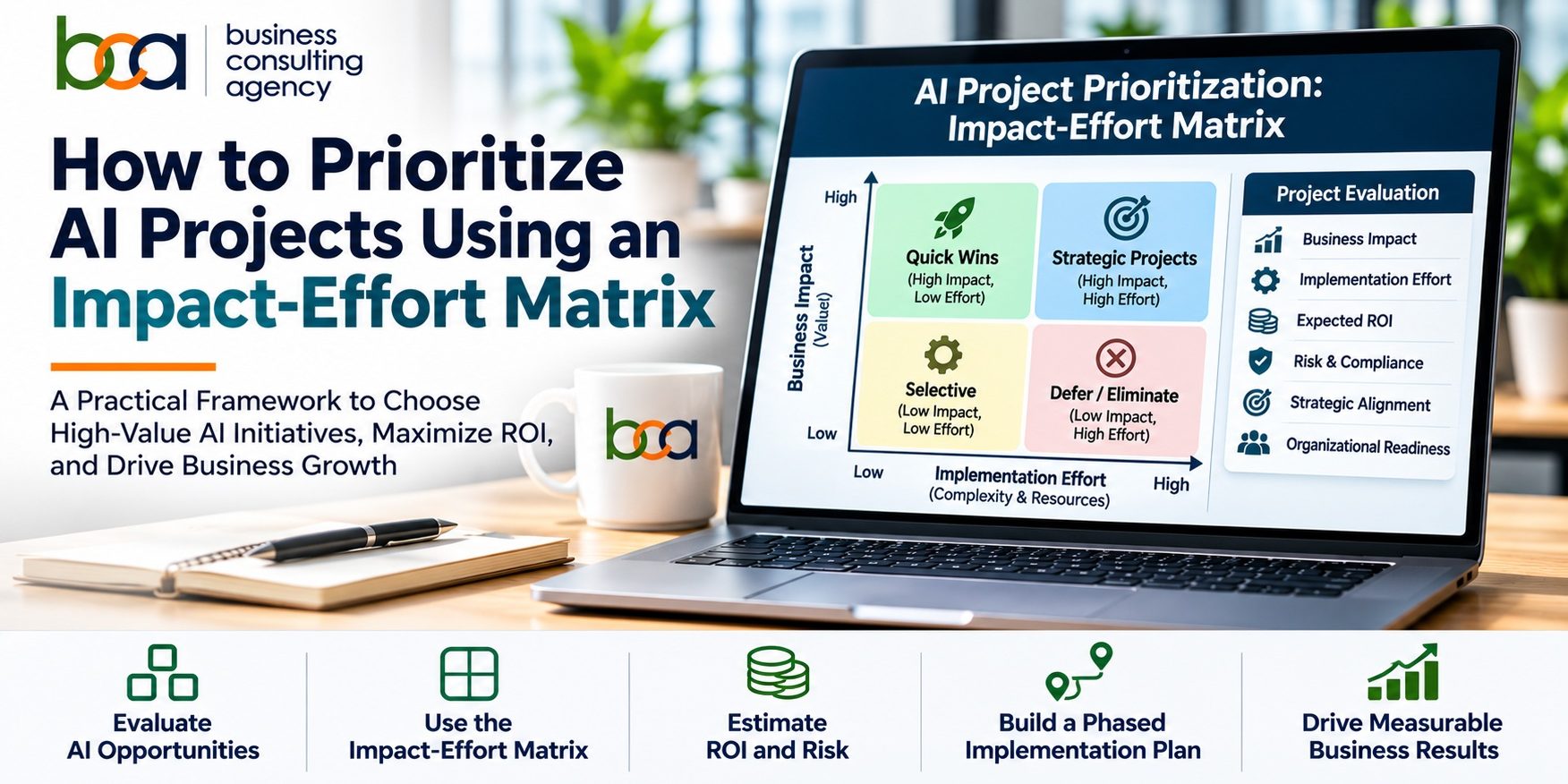
An AI impact-effort matrix provides a practical starting point. By comparing the expected business impact of an initiative against the effort required to implement it, organizations can identify opportunities that offer meaningful value without unnecessary complexity. When combined with financial analysis, risk assessment, and organizational readiness, this framework helps executives build a more disciplined AI investment portfolio.
This guide explains how to evaluate AI opportunities, construct an impact-effort matrix, calculate project priorities, and develop an implementation sequence that supports profitability, operational efficiency, and sustainable business growth.
What Is an AI Impact-Effort Matrix?
An AI impact-effort matrix is a decision-making framework used to compare potential artificial intelligence projects according to two primary dimensions: the business value they could create and the resources required to implement them. The framework is particularly useful when a company has identified several automation or AI opportunities but lacks the budget, personnel, or technical capacity to pursue all of them simultaneously.
Impact measures the expected contribution to business performance. Depending on the project, this may include reduced operating costs, increased sales conversion, improved employee productivity, faster customer response times, fewer processing errors, or better management visibility. Effort measures the implementation burden, including software configuration, systems integration, data preparation, employee training, project management, and ongoing maintenance.
Plotting projects against these dimensions produces four categories that help management determine where to concentrate resources. The matrix does not replace detailed financial planning or risk assessment, but it provides a useful first filter for separating practical business improvements from initiatives that may require substantial investment without a clear return.
| Impact-effort category | Characteristics | Recommended approach |
|---|---|---|
| High impact, low effort | Meaningful business benefits with manageable implementation requirements | Prioritize for early implementation |
| High impact, high effort | Significant potential value but substantial complexity or investment | Evaluate as strategic projects |
| Low impact, low effort | Modest benefits with limited resource requirements | Implement selectively |
| Low impact, high effort | Limited expected value despite significant implementation demands | Defer or eliminate |
The matrix is most effective when project evaluations use consistent criteria. If one department defines impact as employee time savings while another evaluates only revenue growth, the resulting comparisons may be misleading. Organizations should establish common definitions and scoring methods before ranking opportunities.
Why Businesses Need to Prioritize AI Projects Before Investing
AI adoption can become expensive when organizations approach it as a collection of individual software purchases rather than a coordinated business improvement initiative. Different departments may select tools independently, employees may experiment with overlapping applications, and management may struggle to determine whether the investments are producing meaningful results. These problems are particularly significant for small and midsize businesses operating with limited capital and internal technical resources.
Prioritization helps prevent technology spending from becoming disconnected from business objectives. Instead of asking which AI applications are most impressive, executives can ask which operational problems are most costly, which processes create the greatest friction, and which improvements have the strongest financial justification. This shifts the discussion from technological possibilities to measurable business outcomes.
Google Cloud’s guidance on evaluating and defining generative AI business use cases similarly recommends beginning with measurable business goals and determining whether AI is appropriate for achieving them. That distinction matters because not every operational problem requires artificial intelligence. Conventional automation, improved procedures, employee training, or better use of existing software may sometimes provide a more economical solution.
For businesses developing a broader modernization strategy, BCA’s AI Business Systems consulting services focus on aligning AI opportunities with operational requirements, workflow improvements, and long-term business objectives.
Identify AI Opportunities Across Existing Business Operations
Before constructing an impact-effort matrix, businesses need an inventory of potential AI use cases. This process should begin with operational discovery rather than software demonstrations. Department managers and employees often understand where repetitive tasks, communication delays, inconsistent data, and avoidable errors create unnecessary costs.
A useful assessment examines how work moves through the organization, which activities require substantial manual effort, and where technology could improve accuracy or responsiveness. The goal is to identify specific business problems that can be measured and evaluated rather than generate a long list of vaguely defined AI initiatives.
Customer Service and Communication
Customer service departments frequently manage repetitive inquiries, appointment requests, order updates, and information retrieval. AI may assist employees by categorizing incoming messages, retrieving relevant documentation, preparing draft responses, and routing requests to the appropriate team. These applications can reduce administrative workload while allowing employees to concentrate on more complex customer needs.
The business case should consider inquiry volume, average handling time, customer satisfaction, escalation rates, and the accuracy of AI-assisted responses. A customer support project that reduces processing time but produces incorrect information may create additional costs and reputational risks. Consequently, quality controls and human review requirements should be considered from the beginning.
Sales and Revenue Operations
Sales teams often spend considerable time entering CRM information, preparing follow-up messages, reviewing prospect histories, and identifying opportunities requiring attention. AI-assisted workflows may help summarize communications, classify inquiries, identify missing records, and support more consistent follow-up procedures.
However, these applications should be evaluated against actual conversion problems rather than assumptions about productivity. If a company has a weak qualification process or unreliable lead routing, improving those underlying systems may deliver greater value than implementing advanced predictive sales tools. Projects should be selected according to their potential contribution to qualified opportunities, conversion efficiency, and contribution profit.
Finance and Administrative Processes
Finance departments may benefit from AI-assisted document extraction, invoice classification, reconciliation support, and exception detection. These applications can reduce repetitive data entry and improve the speed at which information moves through administrative workflows. Their value depends on transaction volume, existing software capabilities, error rates, and the level of oversight required.
Financial workflows also carry operational and security risks. Businesses should establish appropriate approval controls and ensure that automated processes do not independently authorize payments or alter financial records without necessary safeguards. A partially automated process that prepares information for employee approval may provide a better balance between efficiency and risk than fully autonomous processing.
Operations and Internal Knowledge Management
Operational teams often spend substantial time searching for procedures, preparing reports, coordinating tasks, and transferring information between applications. AI-assisted knowledge retrieval, document summarization, and workflow monitoring may reduce these inefficiencies, particularly when employees work across several departments or locations.
The business value should be measured through reduced processing time, fewer errors, improved service consistency, or increased operational capacity. Companies should also evaluate the quality and accessibility of their existing information, since poorly organized documents and inconsistent procedures can undermine AI performance.
How to Measure the Business Impact of an AI Project
Business impact should reflect the expected contribution of a project to the organization’s financial and operational priorities. Although employee productivity is an important consideration, it should not automatically be treated as equivalent to direct cost savings. A project that saves employees several hours each week may create additional capacity without reducing payroll expenses or increasing revenue.
A practical impact assessment can evaluate five dimensions:
- Financial return: Expected contribution profit, avoided expenses, or measurable operating cost reductions.
- Operational efficiency: Improvements in processing time, workflow capacity, accuracy, or consistency.
- Customer experience: Potential reductions in delays, service errors, or unresolved requests.
- Strategic alignment: Relevance to the company’s current growth objectives and competitive priorities.
- Scalability: Ability to support increased business volume without proportionally increasing operating costs.
Each dimension can be scored from one to five, where one represents limited expected impact and five represents substantial expected impact. Organizations may assign different weights to these dimensions according to their priorities. For example, a company experiencing cash flow pressure may place greater emphasis on near-term financial benefits, while a rapidly expanding organization may prioritize scalability and operational capacity.
The important requirement is consistency. Every project should be evaluated using the same definitions, evidence standards, and financial assumptions. This allows management to compare initiatives across departments without giving disproportionate influence to whichever proposal has the most persuasive presentation.
How to Estimate AI Implementation Effort
Implementation effort includes more than the time required to configure an application. Companies must consider the work involved in connecting systems, preparing data, changing procedures, training employees, establishing security controls, and maintaining the solution after deployment. A project that appears simple during a software demonstration may require substantial operational changes before it can deliver reliable results.
Businesses can evaluate implementation effort using several criteria:
| Effort factor | Evaluation question |
|---|---|
| Technical complexity | Does the project require custom development or specialized integrations? |
| Data readiness | Is the required information accurate, accessible, and appropriately protected? |
| Employee training | How much instruction and process change will users require? |
| Implementation time | How long will configuration, testing, and deployment take? |
| Financial commitment | What initial and recurring costs are involved? |
| Maintenance requirements | Who will monitor performance, resolve errors, and manage updates? |
A low-effort project typically uses existing applications, requires limited integration, involves manageable data requirements, and can be tested without disrupting critical operations. A high-effort project may involve multiple software platforms, extensive data preparation, specialized technical resources, or significant changes to employee responsibilities.
Implementation effort should also reflect internal capacity. A project that is straightforward for a company with an experienced technology team may be difficult for a smaller organization that relies on external contractors. Consequently, effort scores should represent the company’s actual operating environment rather than generic assumptions about technical difficulty.
Build an AI Project Prioritization Scorecard
The impact-effort matrix provides a useful visual framework, but a numerical scorecard can improve consistency when several projects appear equally attractive. One practical approach is to assign each initiative an impact score, an effort score, and a separate risk classification.
For a basic model, use a five-point scale for both impact and effort:
Priority Ratio = Impact Score ÷ Effort Score
A higher ratio indicates greater expected impact relative to implementation effort. However, this ratio is only an initial screening tool. It does not measure financial ROI, and it should not override risk, compliance, strategic dependencies, or other material considerations.
Consider a hypothetical professional services company evaluating five AI initiatives.
| Proposed AI project | Impact (1–5) | Effort (1–5) | Priority ratio |
|---|---|---|---|
| AI-assisted lead routing | 5 | 2 | 2.50 |
| Internal knowledge assistant | 4 | 2 | 2.00 |
| Automated invoice data extraction | 4 | 3 | 1.33 |
| Advanced sales forecasting system | 4 | 5 | 0.80 |
| Automated meeting summaries | 2 | 1 | 2.00 |
These scores are illustrative and would need to be adjusted using the company’s actual workflows, technology, costs, and business priorities. They demonstrate why the project with the greatest technological sophistication is not necessarily the strongest initial investment.
AI-assisted lead routing ranks highly because it could address an important revenue process with manageable implementation requirements. Advanced sales forecasting, although potentially valuable, requires greater technical and operational effort and may be better suited to a later phase. Automated meeting summaries have a favorable ratio but limited overall impact, illustrating why executives should consider both the absolute impact score and the ratio.
Understand the Four Quadrants of the AI Impact-Effort Matrix
High Impact, Low Effort: Prioritize Early Opportunities
Projects in this quadrant generally offer the strongest candidates for initial implementation. They address meaningful business problems while requiring relatively limited resources, technical complexity, or organizational disruption. Examples might include automating lead assignment, improving internal document retrieval, or introducing AI-assisted classification of repetitive customer inquiries.
These initiatives can help businesses establish implementation experience, test governance procedures, and demonstrate measurable operational benefits. However, even promising projects require clear success criteria and appropriate controls. A low-effort deployment that handles sensitive information or influences consequential decisions may still require additional review.
High Impact, High Effort: Develop Strategic Investments
High-impact, high-effort projects may offer substantial long-term value but require greater planning, investment, and coordination. Examples include integrating AI across multiple business systems, developing specialized forecasting capabilities, or modernizing complex operational workflows.
These projects should be evaluated through more detailed financial modeling, technical assessments, and phased implementation plans. Management should identify dependencies, establish realistic milestones, and determine whether the organization has sufficient resources to support deployment and maintenance. A limited pilot may help validate the proposed approach before a larger commitment.
Low Impact, Low Effort: Implement Selectively
Low-impact, low-effort initiatives may improve employee convenience or eliminate minor administrative tasks without materially affecting profitability. Examples might include generating routine meeting summaries or simplifying internal formatting tasks. These projects can be worthwhile when they are inexpensive, reliable, and do not distract employees from higher-value priorities.
However, organizations should avoid confusing a large number of small AI deployments with meaningful business transformation. Each additional application can introduce subscription expenses, training requirements, and administrative responsibilities. Even inexpensive tools should have a clear purpose and identifiable owner.
Low Impact, High Effort: Defer or Eliminate
Projects with limited expected business value and substantial implementation requirements generally represent poor investment candidates. They may involve complex custom development, expensive integrations, or extensive workflow changes without a credible financial justification.
Businesses should question whether these initiatives solve a sufficiently important problem, whether a simpler alternative exists, or whether the project is being driven primarily by enthusiasm for technology. Deferring an unattractive project preserves capital and organizational capacity for opportunities with stronger potential returns.
Add Financial ROI to Your AI Prioritization Process
An impact-effort matrix helps identify promising opportunities, but financial analysis is necessary before approving meaningful investments. Companies should estimate the total cost of ownership and compare that expense with realistic financial benefits over an appropriate period.
A basic return-on-investment calculation is:
AI ROI (%) = [(Financial Benefits − Total AI Costs) ÷ Total AI Costs] × 100
Total costs should include software subscriptions, configuration, integrations, data preparation, employee training, internal labor, maintenance, and relevant security requirements. Financial benefits may include avoided expenses, reduced error-correction costs, additional contribution profit, or employee capacity that can be converted into measurable economic value.
For example, consider a company evaluating an AI-assisted customer inquiry workflow. The estimated first-year implementation cost is $6,000, including setup, subscriptions, training, and support. Management estimates that the project could produce $9,000 in annual economic benefits through avoided contractor expenses and additional productive capacity.
If the full $9,000 benefit is realized, the illustrative ROI would be:
($9,000 − $6,000) ÷ $6,000 × 100 = 50%
However, the company should test whether the expected benefits are realistic. Employee hours saved do not automatically translate into cash savings, and additional revenue should be evaluated using contribution profit rather than gross sales. A conservative scenario may provide a more useful basis for decision-making than an optimistic projection.
Businesses developing detailed financial estimates should also review our article, How to Calculate AI Implementation Costs for a Small Business, which explains implementation budgets, total cost of ownership, and payback calculations.
Evaluate AI Risks Before Finalizing Project Priorities
A high impact-effort score does not automatically make an AI initiative suitable for deployment. Projects involving sensitive customer information, financial decisions, regulated activities, or significant operational dependencies may require additional safeguards. Risk assessment should therefore function as a separate approval requirement rather than being hidden within a single numerical score.
The National Institute of Standards and Technology AI Risk Management Framework provides a useful reference for organizations evaluating AI governance and risk. Its approach emphasizes governing AI activities, understanding operational context, measuring risks, and managing those risks throughout the system lifecycle.
Businesses should consider several questions before approving an AI project. What information will the system access? How will outputs be validated? Who is responsible when errors occur? Can employees override or disable the automation? What contractual or regulatory requirements apply? These questions are especially important when AI influences customer commitments, payments, employee decisions, or confidential information.
An initiative with attractive financial potential may still need to be postponed until appropriate safeguards are established. Conversely, a project with modest financial benefits may deserve attention if it reduces an important operational or compliance risk. Effective prioritization requires management judgment alongside quantitative scoring.
Create a Phased AI Implementation Roadmap
Once projects have been evaluated, organizations should translate the prioritization results into a practical implementation sequence. A roadmap should reflect available resources, project dependencies, employee capacity, and the time required to measure outcomes. Launching too many initiatives simultaneously can create competing demands on technical teams and make it difficult to determine which investments are producing value.
A phased approach allows businesses to build experience and expand selectively.
Initial Phase: Validate High-Confidence Opportunities
Begin with one or two projects that offer meaningful business value and manageable implementation requirements. Establish baseline performance metrics, define the intended workflow, assign responsibility, and document the criteria for successful deployment. Early projects should be sufficiently limited to permit testing and correction without disrupting critical operations.
For example, a company might introduce AI-assisted lead classification while retaining employee approval for routing decisions. The pilot could measure classification accuracy, response time, manual correction requirements, and the effect on qualified lead handling. These results would provide evidence for determining whether the system should be expanded.
Expansion Phase: Integrate Proven Workflows
After an initial project demonstrates reliable performance, the business can consider connecting it with additional applications or departments. Expansion should be based on actual operating results rather than assumptions that the technology will perform equally well in every environment.
At this stage, organizations may need more formal documentation, monitoring procedures, employee training, and technical support. Managers should also evaluate whether increased usage changes subscription costs, integration requirements, or security exposure.
Strategic Phase: Pursue Complex Modernization Projects
Larger initiatives may become appropriate once the organization has established reliable data practices, implementation experience, and a clearer understanding of AI economics. These projects can include advanced operational intelligence, multi-system automation, and customized business infrastructure.
Strategic deployments should be managed as business investments with defined financial expectations, executive accountability, and ongoing performance reviews. The objective is to build scalable capabilities that support the company’s long-term operating model rather than accumulate disconnected technologies.
Common Mistakes When Prioritizing AI Initiatives
Even organizations using structured evaluation frameworks can make poor investment decisions when scoring assumptions are unrealistic or important operational factors are overlooked. One frequent mistake is assigning high impact scores to projects without establishing how the expected benefits will be measured. Claims that AI will improve productivity or increase revenue are insufficient unless management can identify the affected process, baseline performance, and credible mechanism for improvement.
Another problem is underestimating implementation effort. Software demonstrations often show ideal workflows with clean data and limited exceptions, while actual business environments contain inconsistent records, unusual customer requirements, and legacy systems. Companies should evaluate the work required to deploy, maintain, and govern the technology under real operating conditions.
Businesses should also avoid prioritizing projects solely because employees or competitors are using particular AI applications. Popularity does not establish suitability, and a solution that works well in one organization may produce limited value in another. The strongest project portfolio reflects the company’s specific operational weaknesses, financial priorities, and available resources.
Finally, organizations should revisit their rankings periodically. Business conditions change, software capabilities improve, and implementation costs can decline or increase. An initiative that was unattractive six months earlier may become worthwhile after a system upgrade or operational change, while a previously promising project may no longer justify investment.
Frequently Asked Questions About AI Project Prioritization
What is the best way to prioritize AI projects?
A practical approach is to identify specific business problems, estimate the potential impact of solving them, assess implementation effort, and compare opportunities using consistent criteria. Financial ROI, organizational readiness, strategic alignment, and risk should also influence final decisions. An impact-effort matrix provides an accessible starting point, but larger investments require more detailed analysis.
What makes an AI project high impact?
A high-impact AI project addresses a meaningful business problem and produces measurable improvements in profitability, operating costs, customer experience, capacity, or strategic performance. The significance of an initiative depends on the company’s objectives and baseline conditions. A relatively simple automation may have greater impact than a sophisticated AI application if it eliminates a recurring operational bottleneck.
How do small businesses choose their first AI project?
Small businesses should begin by examining repetitive workflows, recurring errors, communication delays, and activities that consume substantial employee time. The strongest initial project usually combines a clearly defined problem, measurable benefits, manageable costs, and limited implementation risk. A controlled pilot can help validate the business case before broader deployment.
Should AI projects be prioritized by ROI or implementation effort?
Both factors matter, but neither should be considered independently. ROI helps determine whether an investment is economically justified, while implementation effort indicates the resources and complexity required to achieve the expected outcome. Risk, timing, and project dependencies should also influence the decision. A high-return initiative may need to wait if the organization lacks the necessary data or technical capacity.
How often should a company review its AI project priorities?
A quarterly review is a reasonable starting point for many organizations, with additional assessments when business priorities, technology capabilities, or financial conditions change materially. Active projects should be monitored more frequently according to their complexity and operational significance. Regular reassessment helps ensure that AI investments remain aligned with business needs.
Final Thoughts: Invest in AI Projects That Deliver Measurable Business Value
Learning how to prioritize AI projects is essential for organizations seeking to modernize operations without wasting capital on disconnected technologies or unnecessary complexity. An impact-effort matrix helps business leaders compare opportunities objectively, identify practical early investments, and distinguish strategic initiatives from projects that offer limited financial or operational value.
The strongest AI implementation strategies combine structured prioritization with realistic cost estimates, measurable success criteria, risk management, and phased deployment. By beginning with clearly defined business problems and evaluating technology according to its ability to improve performance, companies can build AI capabilities that support sustainable growth rather than technology adoption for its own sake.
Business Consulting Agency helps organizations evaluate AI opportunities, prioritize implementation investments, modernize operational systems, and develop scalable business infrastructure. Explore our AI Business Systems consulting services to develop a practical modernization strategy aligned with your company’s operational and financial objectives.