Artificial intelligence and business automation have become two of the most talked-about technologies in today’s business world. Unfortunately, many business owners use these terms interchangeably, assuming they describe the same thing. While both technologies improve efficiency and reduce manual work, they serve different purposes and deliver different outcomes. AI automation vs. business automation, find out the differences here for your business.
Understanding the distinction between AI automation and business automation is essential when developing a long-term modernization strategy. Implementing the wrong solution—or expecting one technology to perform the role of the other—can lead to wasted investments, inefficient workflows, and missed opportunities.
Businesses that clearly understand when to automate processes and when to leverage artificial intelligence are better positioned to improve productivity, reduce costs, enhance customer experiences, and scale operations successfully.
Whether you operate a startup, retail business, e-commerce company, med spa, aesthetic practice, or another growing organization, understanding these technologies will help you make smarter investment decisions.
What Is Business Automation?
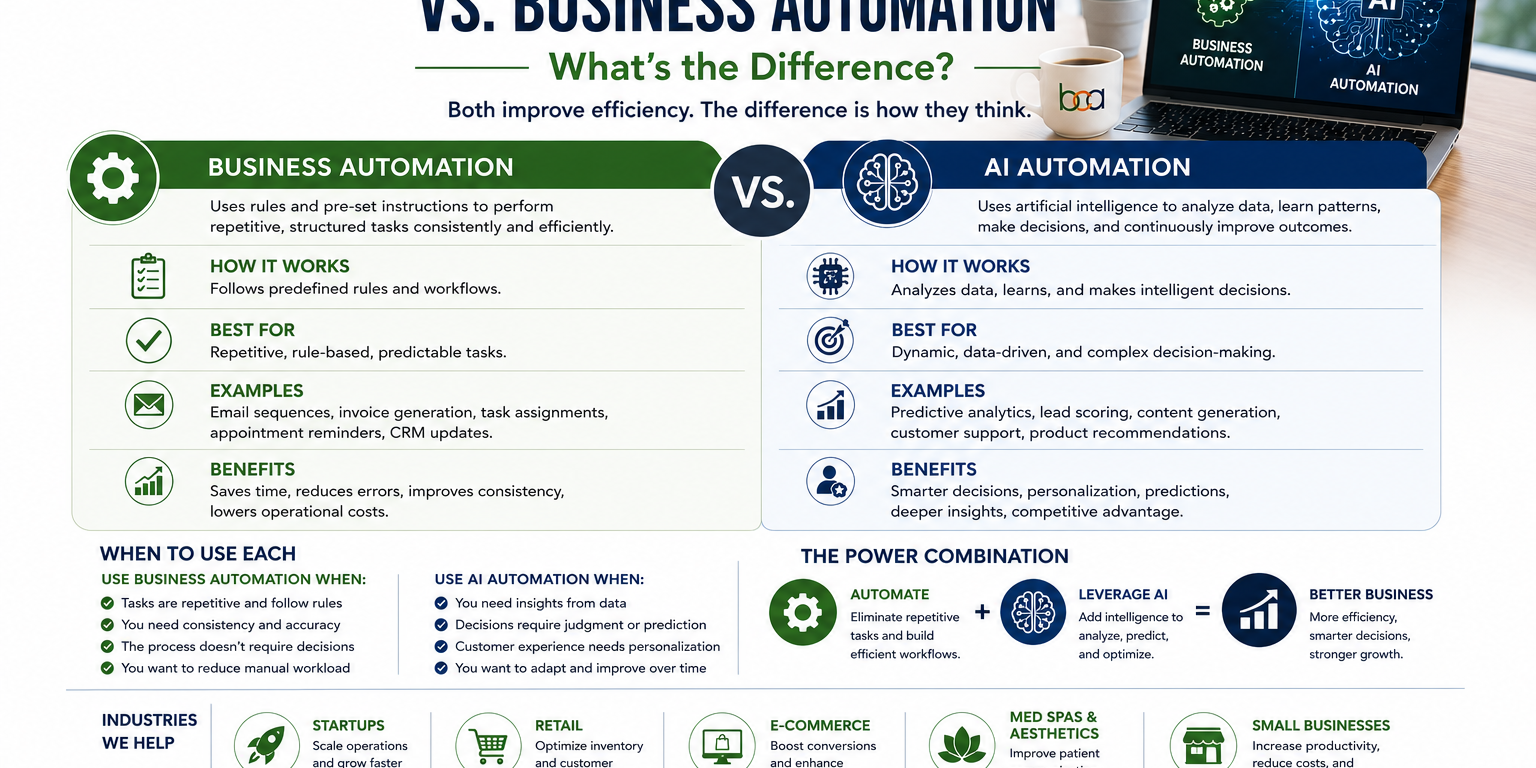
Business automation refers to using software to perform repetitive, rule-based tasks with little or no human intervention. These systems follow predefined instructions and execute the same process consistently every time.
Business automation is ideal for structured activities that rarely change.
Common examples include:
- Appointment reminders
- Invoice generation
- Employee onboarding
- Email sequences
- CRM updates
- Payroll processing
- Inventory notifications
- Task assignments
- Approval workflows
- Customer follow-up
Business automation increases efficiency by reducing manual work while ensuring consistency across the organization.
What Is AI Automation?
AI automation builds upon traditional automation by incorporating artificial intelligence into business processes. Rather than simply following predefined rules, AI systems can analyze information, recognize patterns, make recommendations, and continuously improve based on new data.
AI automation can perform more dynamic tasks, such as:
- Analyzing customer behavior
- Prioritizing sales leads
- Predicting inventory demand
- Generating marketing content
- Summarizing meetings
- Recommending products
- Responding intelligently to customer inquiries
- Forecasting revenue
- Identifying operational trends
Unlike traditional automation, AI adapts and improves as it processes additional information.
The Biggest Differences
Although both technologies improve efficiency, they solve different business challenges.
Business Automation
Business automation focuses on executing repetitive tasks exactly the same way every time.
Examples include:
- Sending appointment reminders
- Moving leads between CRM stages
- Creating invoices
- Scheduling recurring reports
- Triggering email campaigns
It follows predefined rules and does not make independent decisions.
AI Automation
AI automation introduces intelligence into workflows.
Instead of following only fixed rules, AI can:
- Interpret customer questions
- Detect purchasing patterns
- Recommend next actions
- Generate written content
- Predict future outcomes
- Learn from historical data
It supports better decision-making while reducing manual analysis.
Which Should Your Business Implement First?
For most organizations, business automation should come before AI automation.
Why?
Because AI performs best when built on organized processes.
If workflows are inconsistent or undocumented, introducing AI often magnifies existing inefficiencies instead of solving them.
A practical implementation roadmap is:
- Document your processes.
- Eliminate unnecessary steps.
- Automate repetitive workflows.
- Introduce AI where intelligent decision-making adds value.
- Continuously optimize both systems.
This phased approach reduces implementation risk and creates a stronger operational foundation.
Benefits of Business Automation
Business automation helps organizations:
- Save employee time
- Improve consistency
- Reduce manual errors
- Increase operational efficiency
- Improve customer communication
- Lower administrative costs
- Standardize workflows
- Scale operations more effectively
These improvements often produce immediate operational gains.
Benefits of AI Automation
AI automation expands on these advantages by enabling businesses to:
- Make better decisions
- Personalize customer experiences
- Analyze large volumes of data
- Predict future trends
- Improve lead qualification
- Enhance customer support
- Increase marketing performance
- Support strategic planning
AI enables organizations to become more proactive rather than simply more efficient.
Industry Examples
Startup Ventures
Startups often begin with business automation to create scalable processes before introducing AI-powered analytics and customer engagement.
Retail Businesses
Retailers automate inventory management while using AI to forecast demand and personalize marketing campaigns.
E-Commerce Companies
Online retailers automate order processing, shipping notifications, and customer communication while using AI for product recommendations, pricing optimization, and customer segmentation.
Med Spas and Aesthetic Practices
Aesthetic businesses automate appointment reminders, consultation follow-up, and patient communication while leveraging AI to prioritize leads, personalize patient interactions, and improve operational reporting.
Small Businesses
Across nearly every industry, combining business automation with AI allows organizations to improve efficiency while making smarter business decisions.
Common Mistakes
Businesses often make several avoidable mistakes when adopting automation technologies.
These include:
- Expecting AI to replace every workflow.
- Automating inefficient processes.
- Purchasing too many disconnected software platforms.
- Failing to train employees.
- Measuring technology usage instead of business outcomes.
- Ignoring long-term scalability.
Working with an experienced consultant helps businesses avoid these challenges while developing a practical automation strategy.
Frequently Asked Questions
Is AI automation better than business automation?
Not necessarily. Business automation and AI automation solve different problems. Most businesses benefit from implementing both as part of a long-term modernization strategy.
Can small businesses benefit from AI automation?
Absolutely. Many affordable AI platforms now allow small businesses to automate communication, marketing, customer support, reporting, and administrative work.
Do I need business automation before AI?
In most cases, yes. Organized and automated workflows provide the structure that allows AI to perform effectively.
What industries benefit most?
Startup ventures, retail businesses, e-commerce companies, med spas, aesthetic practices, healthcare organizations, and professional service firms all benefit significantly from combining automation with AI.
Should I hire an AI consultant?
If your business plans to modernize multiple workflows, integrate new technologies, or build a long-term AI strategy, working with an experienced consultant can significantly reduce implementation risks and improve return on investment.
Building a Smarter Automation Strategy
Business automation and AI automation are not competing technologies—they are complementary components of a modern business strategy. Automation creates consistency by handling repetitive tasks, while artificial intelligence introduces adaptability, analysis, and intelligent decision-making. AI automation vs. business automation, find out the differences here for your business. Speak with an AI business expert.
Organizations that understand when to use each technology can streamline operations, improve customer experiences, reduce operational costs, and build scalable systems prepared for future growth.
Rather than viewing automation as a single project, successful businesses treat it as an ongoing process of continuous improvement. By combining structured workflows with intelligent AI capabilities, companies position themselves to remain competitive in an increasingly digital marketplace while creating a stronger foundation for long-term success.