Artificial intelligence is no longer a futuristic concept reserved for large corporations with massive technology budgets. Today, businesses of every size are using AI to automate repetitive tasks, improve customer experiences, increase operational efficiency, and make smarter business decisions. What are the signs your business is ready for AI?
Despite its growing accessibility, many business owners still ask the same question:
“Is my business actually ready for AI?”
The answer is different for every organization. Some companies are prepared to begin implementing AI immediately, while others may need to improve their processes or technology infrastructure before they can fully benefit from automation.
Fortunately, determining your readiness doesn’t require extensive technical knowledge. There are clear indicators that suggest your organization has reached the point where AI can begin delivering measurable business value. What are the signs your business is ready for AI?
If several of the following signs describe your business, it may be time to begin developing an AI strategy.
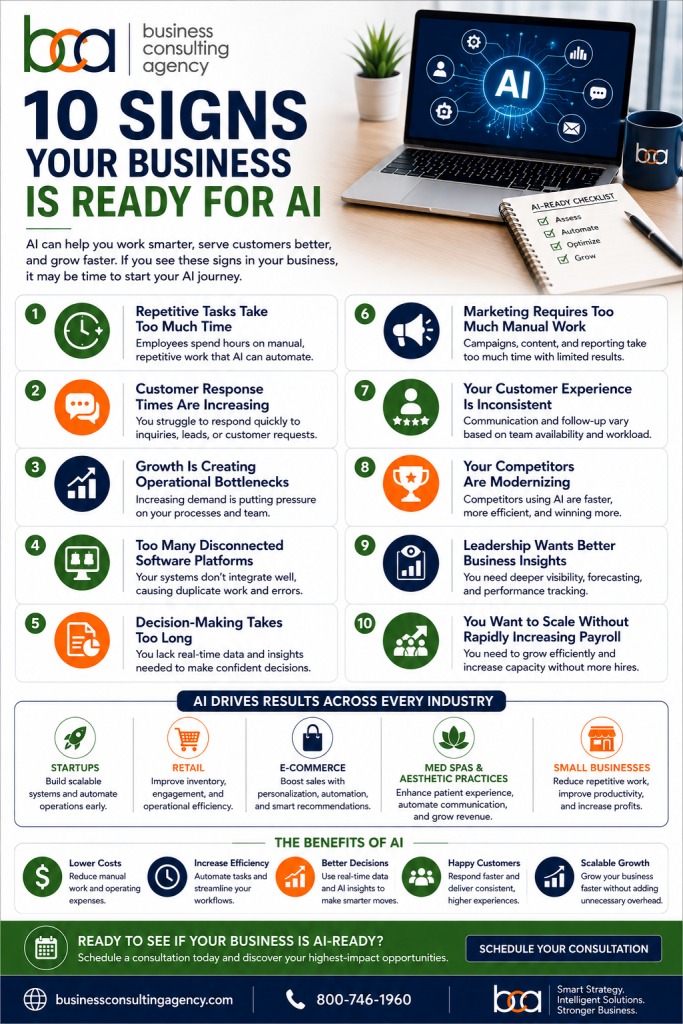
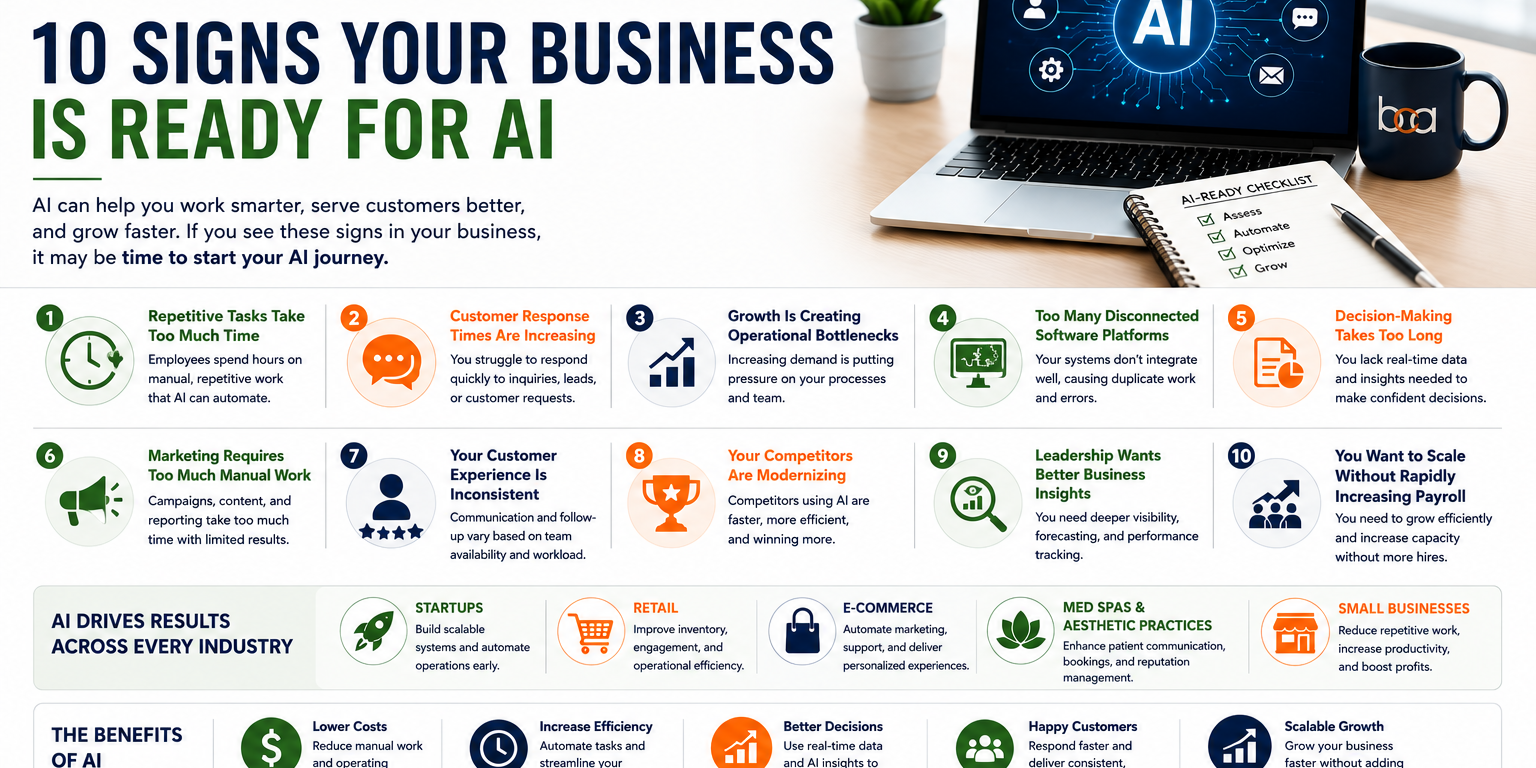
1. Your Employees Spend Too Much Time on Repetitive Tasks
One of the strongest indicators that a business is ready for AI is the amount of time employees spend performing repetitive administrative work.
Examples include:
- Scheduling appointments
- Entering customer information
- Responding to common emails
- Preparing reports
- Updating CRM records
- Sending follow-up messages
These activities consume valuable time but create relatively little strategic value.
Artificial intelligence can automate many of these responsibilities, allowing employees to focus on customer relationships, business development, and higher-level decision-making.
2. Customer Response Times Are Increasing
Today’s customers expect fast responses.
If your business struggles to:
- Return calls
- Answer emails
- Respond to website inquiries
- Follow up with leads
- Schedule appointments
AI-powered communication tools can significantly improve customer experiences while reducing administrative workloads.
Faster communication often leads to increased customer satisfaction and higher conversion rates.
3. Business Growth Is Creating Operational Bottlenecks
Growth is exciting, but it often exposes weaknesses within existing systems.
As businesses expand, owners frequently experience:
- More paperwork
- Increased customer inquiries
- Greater reporting requirements
- Larger sales pipelines
- More scheduling complexity
Rather than continually adding administrative staff, AI can automate many of these expanding responsibilities.
4. Your Team Uses Too Many Disconnected Software Platforms
Many businesses rely on multiple applications that don’t communicate effectively with one another.
Common examples include separate systems for:
- CRM
- Email marketing
- Scheduling
- Accounting
- Customer support
- Project management
Disconnected software creates duplicate work and increases the risk of errors.
An AI consultant can help integrate these systems into more efficient workflows.
5. Decision-Making Takes Too Long
Business leaders should have access to accurate information when they need it.
If important decisions require hours of collecting spreadsheets, reviewing reports, or manually analyzing data, AI-powered business intelligence tools can significantly improve reporting and forecasting.
Organizations gain faster access to meaningful insights while reducing manual analysis.
6. Marketing Requires Too Much Manual Work
Marketing has become increasingly data-driven.
Artificial intelligence can assist with:
- Content planning
- SEO research
- Email campaigns
- Audience segmentation
- Advertising optimization
- Performance reporting
Businesses often produce more consistent marketing while spending less time managing campaigns.
7. Your Customer Experience Is Inconsistent
Customers expect a consistent experience regardless of how they interact with your business.
If communication varies depending on employee availability or workload, AI can help standardize:
- Follow-up
- Appointment reminders
- Customer onboarding
- Frequently asked questions
- Lead nurturing
Consistency improves customer satisfaction while strengthening brand reputation.
8. Your Competitors Are Modernizing
Artificial intelligence is becoming a competitive advantage across nearly every industry.
Businesses that delay modernization may find themselves competing against organizations that operate:
- Faster
- More efficiently
- With lower costs
- Better customer experiences
- Smarter decision-making
Waiting too long may eventually cost more than beginning implementation today.
9. Leadership Wants Better Business Insights
Modern AI platforms provide powerful reporting capabilities.
Instead of reviewing historical reports, businesses can:
- Forecast revenue
- Predict customer behavior
- Identify trends
- Monitor operational performance
- Detect growth opportunities
Leadership gains clearer visibility into the future rather than simply reviewing the past.
10. You Want to Scale Without Rapidly Increasing Payroll
Perhaps the strongest indicator of AI readiness is the desire to grow efficiently.
Artificial intelligence allows businesses to increase operational capacity without proportionally increasing administrative staff.
This creates:
- Lower operating costs
- Improved productivity
- Greater scalability
- Higher profitability
For growing businesses, AI often becomes one of the most valuable long-term investments.
Industries That Benefit the Most
Nearly every industry can benefit from AI implementation.
Some of the fastest adopters include:
Startup Ventures
Automate operations while building scalable systems from day one.
Retail Businesses
Improve inventory forecasting, customer engagement, and operational efficiency.
E-Commerce Companies
Automate marketing, customer support, product recommendations, and order management.
Med Spas and Aesthetic Practices
Improve consultation scheduling, patient communication, CRM automation, reputation management, and lead nurturing.
Small Businesses
Reduce repetitive work, improve productivity, and strengthen customer experiences regardless of industry.
Frequently Asked Questions
How do I know if AI is right for my business?
If your business experiences repetitive administrative work, operational bottlenecks, growing customer demands, or inefficient workflows, AI can likely provide measurable improvements.
Do I need expensive software?
Not necessarily. Many AI solutions are affordable and can be implemented gradually based on business priorities.
Should I hire an AI consultant first?
Yes. An experienced consultant helps identify the highest-value opportunities before recommending specific technologies.
Can AI help very small businesses?
Absolutely. Small businesses often achieve some of the highest returns because automation improves nearly every department.
What’s the first step?
Begin with an AI readiness assessment to identify where artificial intelligence will have the greatest impact.
Preparing Your Business for the Next Stage of Growth
Artificial intelligence is becoming a standard component of modern business operations. Companies that recognize the right time to implement AI gain advantages in efficiency, customer experience, decision-making, and long-term scalability. What are the signs your business is ready for AI?
If your business exhibits several of the signs discussed in this article, now may be the ideal time to begin building an AI strategy. Rather than viewing AI as another software purchase, think of it as an investment in creating a smarter, more efficient organization capable of adapting to future opportunities.
The businesses that embrace AI strategically today will be better positioned to lead their industries tomorrow—not simply because they use better technology, but because they build stronger, more scalable business systems.