Every growing business eventually reaches a point where success begins creating new challenges. Sales increase, customer inquiries become more frequent, employees become busier, and daily operations become increasingly complex. While growth is exciting, it also exposes weaknesses in existing processes.
Many organizations respond by hiring additional staff. While expanding a team is sometimes necessary, adding employees without improving business processes often leads to higher operating costs, inconsistent workflows, and diminishing profitability.
Business process automation offers a smarter solution.
By automating repetitive, rule-based activities, organizations can eliminate operational bottlenecks, improve efficiency, reduce manual errors, and build systems capable of supporting long-term growth. Rather than replacing employees, automation enables teams to focus on higher-value work while technology handles repetitive administrative tasks.
Whether you operate a startup, retail business, e-commerce company, med spa, aesthetic practice, or another small business, business process automation can significantly improve productivity while creating a stronger foundation for future expansion.
What Is Business Process Automation?
Business process automation (BPA) is the use of technology to streamline and automate repetitive business activities. Instead of relying on manual processes, businesses create workflows that complete routine tasks automatically based on predefined rules.
Examples include:
- Appointment scheduling
- Customer follow-up emails
- Invoice generation
- CRM updates
- Employee onboarding
- Inventory notifications
- Lead routing
- Document approvals
- Project assignments
- Reporting and dashboards
Automation ensures these activities occur consistently without requiring continuous manual involvement.
Why Businesses Need Process Automation
Many organizations rely on workflows that developed gradually over time. As new software, employees, and procedures are added, operations often become more complicated than necessary.
Common warning signs include:
- Employees performing repetitive administrative work.
- Duplicate data entry.
- Missed customer follow-ups.
- Delayed approvals.
- Inconsistent customer communication.
- Manual reporting.
- Difficulty scaling operations.
These issues reduce productivity while increasing operational costs.
Process automation addresses these challenges by creating standardized, repeatable workflows that improve efficiency throughout the organization.
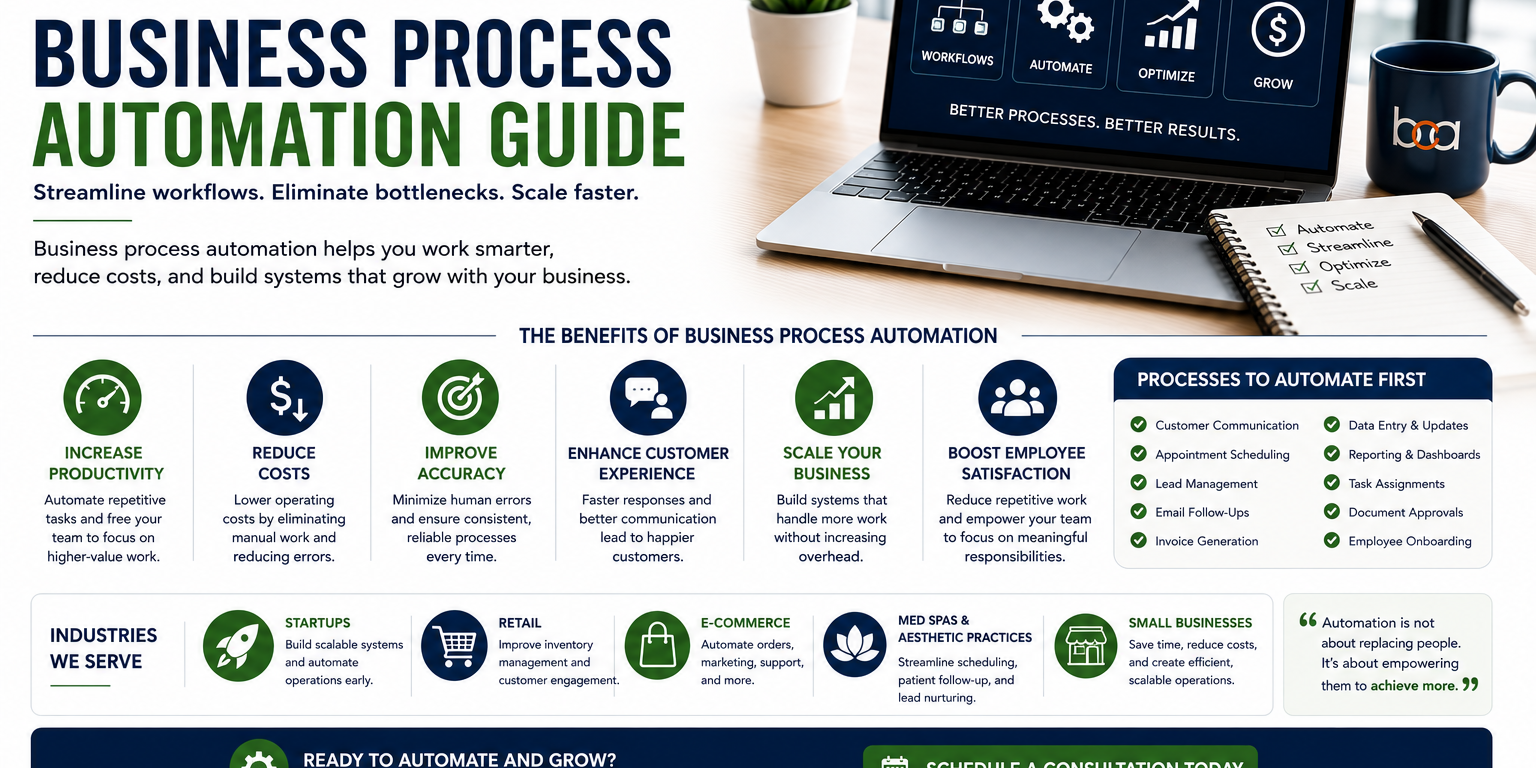
The Biggest Benefits of Business Process Automation
Increased Productivity
Automation eliminates repetitive tasks, allowing employees to focus on customer service, sales, innovation, and strategic initiatives.
Lower Operating Costs
Reducing manual work decreases administrative overhead while improving overall profitability.
Fewer Human Errors
Automated workflows reduce mistakes associated with manual data entry, repetitive processes, and inconsistent procedures.
Faster Customer Response Times
Customers receive quicker communication through automated confirmations, appointment reminders, follow-up messages, and support workflows.
Improved Employee Satisfaction
Employees spend less time on repetitive administrative work and more time performing meaningful, engaging responsibilities.
Greater Scalability
As businesses grow, automated systems handle increasing workloads without requiring proportional increases in staffing.
Business Processes That Should Be Automated First
Organizations often achieve the greatest return on investment by automating high-volume, repetitive tasks.
Common starting points include:
Customer Communication
- Welcome emails
- Appointment reminders
- Lead nurturing
- Review requests
- Customer follow-up
Sales Operations
- Lead qualification
- CRM updates
- Proposal generation
- Meeting scheduling
- Sales notifications
Marketing
- Email campaigns
- Social media scheduling
- Campaign reporting
- Lead segmentation
- Content distribution
Administration
- Employee onboarding
- Internal approvals
- Expense reporting
- Invoice generation
- Document management
Starting with these processes typically delivers measurable improvements within a relatively short period.
Business Process Automation Across Different Industries
Startup Ventures
Startups automate administrative tasks early, allowing founders to focus on customer acquisition, product development, and fundraising.
Retail Businesses
Retailers automate inventory management, customer loyalty programs, supplier notifications, and sales reporting.
E-Commerce Companies
Online businesses automate order processing, shipping updates, abandoned cart recovery, inventory synchronization, and customer communication.
Med Spas and Aesthetic Practices
Automation streamlines consultation scheduling, appointment reminders, patient follow-up, online reviews, lead nurturing, and CRM workflows.
Small Businesses
Regardless of industry, small businesses benefit from standardized processes that improve efficiency while supporting sustainable growth.
Business Process Automation vs. AI Automation
Although these technologies work together, they solve different challenges.
Business process automation focuses on executing predefined workflows consistently.
Artificial intelligence enhances those workflows by introducing decision-making, predictive analytics, personalization, and intelligent recommendations.
Many organizations begin with business process automation before introducing AI into their operations.
Common Automation Mistakes
Businesses should avoid:
- Automating inefficient processes.
- Implementing too many software platforms.
- Ignoring employee training.
- Failing to document workflows.
- Measuring technology instead of business outcomes.
- Neglecting ongoing optimization.
Working with an experienced business consultant helps organizations create automation strategies aligned with long-term objectives.
Frequently Asked Questions
What is business process automation?
Business process automation uses technology to streamline repetitive workflows and reduce manual effort throughout an organization.
Is automation only for large companies?
No. Small businesses often achieve some of the greatest benefits because automation improves productivity across every department.
What’s the first process I should automate?
Customer communication, CRM updates, appointment scheduling, and administrative workflows often provide the fastest return on investment.
Does automation replace employees?
Automation is designed to eliminate repetitive work, allowing employees to focus on higher-value activities that require creativity, relationship building, and strategic thinking.
Should I hire a consultant before automating my business?
Yes. A consultant helps identify the highest-impact opportunities, prioritize implementation, and avoid costly mistakes.
Building a More Efficient Business
Business process automation is no longer a luxury reserved for large enterprises. It has become a practical strategy for organizations that want to improve efficiency, reduce costs, and create scalable operations capable of supporting long-term growth.
The businesses that grow most successfully are rarely those with the largest teams—they are the organizations that build efficient systems capable of handling increasing demand without increasing complexity. By combining well-designed workflows with modern automation technologies, businesses can eliminate operational bottlenecks, improve customer experiences, and position themselves for sustainable growth in an increasingly competitive marketplace.