Artificial intelligence is no longer a technology reserved for large corporations with multimillion-dollar innovation budgets. Over the past few years, AI has become accessible, practical, and increasingly essential for businesses of every size. Today, small businesses have unprecedented opportunities to automate repetitive tasks, improve customer experiences, streamline operations, and make smarter business decisions through AI-powered systems.
Despite the growing availability of AI tools, many business owners remain uncertain about where to begin. Some experiment with various AI applications without a clear strategy, while others delay adoption because they assume implementation is too expensive or technically complex. Both approaches often lead to missed opportunities.
Successful AI adoption requires far more than selecting the latest software. Businesses need a structured implementation strategy that aligns artificial intelligence with operational goals, customer needs, internal processes, and long-term growth objectives. This is where AI consulting for small businesses provides measurable value.
Rather than focusing only on technology, experienced AI consultants evaluate how a business operates, identify inefficiencies, recommend practical AI solutions, and oversee implementation to ensure measurable business improvements. Whether a company operates in retail, e-commerce, startup ventures, professional services, or the aesthetic industry, artificial intelligence is rapidly becoming a competitive necessity rather than a future consideration.
What Is AI Consulting for Small Businesses?
AI consulting for small businesses is a specialized advisory service that helps organizations identify, implement, and optimize artificial intelligence technologies to improve operations, increase productivity, reduce costs, and accelerate growth.
Unlike traditional IT consulting, AI consulting focuses on business transformation rather than technology alone. An AI consultant works closely with business owners to understand their goals before recommending practical AI solutions that integrate with existing workflows.
Typical consulting engagements include AI readiness assessments, operational efficiency analysis, workflow automation planning, business process optimization, AI software recommendations, CRM automation, customer service automation, sales process improvements, marketing automation, staff training, and performance optimization.
Instead of simply purchasing software, businesses receive a comprehensive strategy designed around their specific operational needs. This strategic approach significantly improves implementation success while reducing unnecessary technology investments.
Why Small Businesses Are Investing in AI Faster Than Ever
Only a few years ago, artificial intelligence was largely viewed as an emerging technology. Today, it has become an operational advantage. Several factors are driving rapid AI adoption among small businesses.
Rising Customer Expectations
Customers expect businesses to respond faster than ever before. They want immediate answers, personalized communication, convenient scheduling, consistent follow-up, and digital self-service options. Businesses relying entirely on manual processes often struggle to meet these expectations consistently.
AI-powered systems help companies improve responsiveness while reducing employee workload. This is especially important for service businesses, retail companies, e-commerce brands, med spas, and aesthetic clinics where speed and customer experience directly affect revenue.
Increasing Labor Costs
Hiring additional employees remains one of the largest expenses for growing businesses. Rather than immediately expanding headcount, many companies now use AI to increase the productivity of existing teams.
Artificial intelligence helps employees spend less time performing repetitive administrative work and more time focusing on higher-value responsibilities. This improves output without forcing the business to increase payroll at the same pace as growth.
Operational Complexity
As businesses grow, operations naturally become more complicated. Customer inquiries increase, sales opportunities multiply, administrative tasks expand, and reporting requirements become more demanding. Without scalable systems, growth often creates operational bottlenecks.
AI helps businesses manage this complexity while maintaining operational efficiency. Companies can automate repetitive workflows, centralize customer information, improve reporting, and standardize communication.
Competitive Pressure
Businesses are increasingly competing against organizations already using AI-powered tools. Companies implementing AI successfully often respond faster, operate more efficiently, and provide stronger customer experiences. Waiting several years to modernize may leave businesses at a significant competitive disadvantage.
Common Business Problems AI Consulting Solves
Many business owners assume AI consulting is primarily about automation software. In reality, AI consultants solve operational business problems. The technology is only valuable when it improves how the business performs.
Manual Administrative Work
Employees frequently spend hours every week performing repetitive tasks such as data entry, scheduling, document creation, email responses, CRM updates, and internal reporting. These activities consume valuable time without directly generating revenue.
AI automation reduces administrative burdens while improving consistency. This allows teams to redirect energy toward sales, customer service, fulfillment, product development, and strategic growth.
Poor Lead Management
Many businesses generate leads but fail to convert them consistently. Common issues include slow follow-up, missed inquiries, disorganized CRM systems, inconsistent communication, and lost opportunities.
AI-powered lead management systems improve response speed and ensure every prospect enters a structured nurturing process. For med spas, aesthetic practices, retail businesses, e-commerce companies, and startups, this can directly improve revenue performance.
Customer Service Delays
Customers increasingly expect immediate communication. AI-powered chat assistants, intelligent routing systems, automated emails, SMS workflows, and customer support systems help businesses improve service while reducing workload for employees.
Reporting Challenges
Many small businesses struggle to understand which marketing channels perform best, why sales fluctuate, which customers generate the highest value, and where operational bottlenecks exist. AI-powered analytics provide business owners with actionable insights that support faster, more informed decisions.
Workflow Inefficiencies
Many businesses operate using disconnected systems developed over several years. Employees switch between multiple software platforms, duplicate information, and manually complete repetitive processes. AI consulting helps redesign these workflows into more streamlined, scalable operational systems.
The Biggest AI Mistake Small Businesses Make
Perhaps the most common mistake businesses make is purchasing AI tools before developing an implementation strategy. Many companies subscribe to multiple platforms because they appear impressive during demonstrations. Unfortunately, software alone rarely solves operational problems.
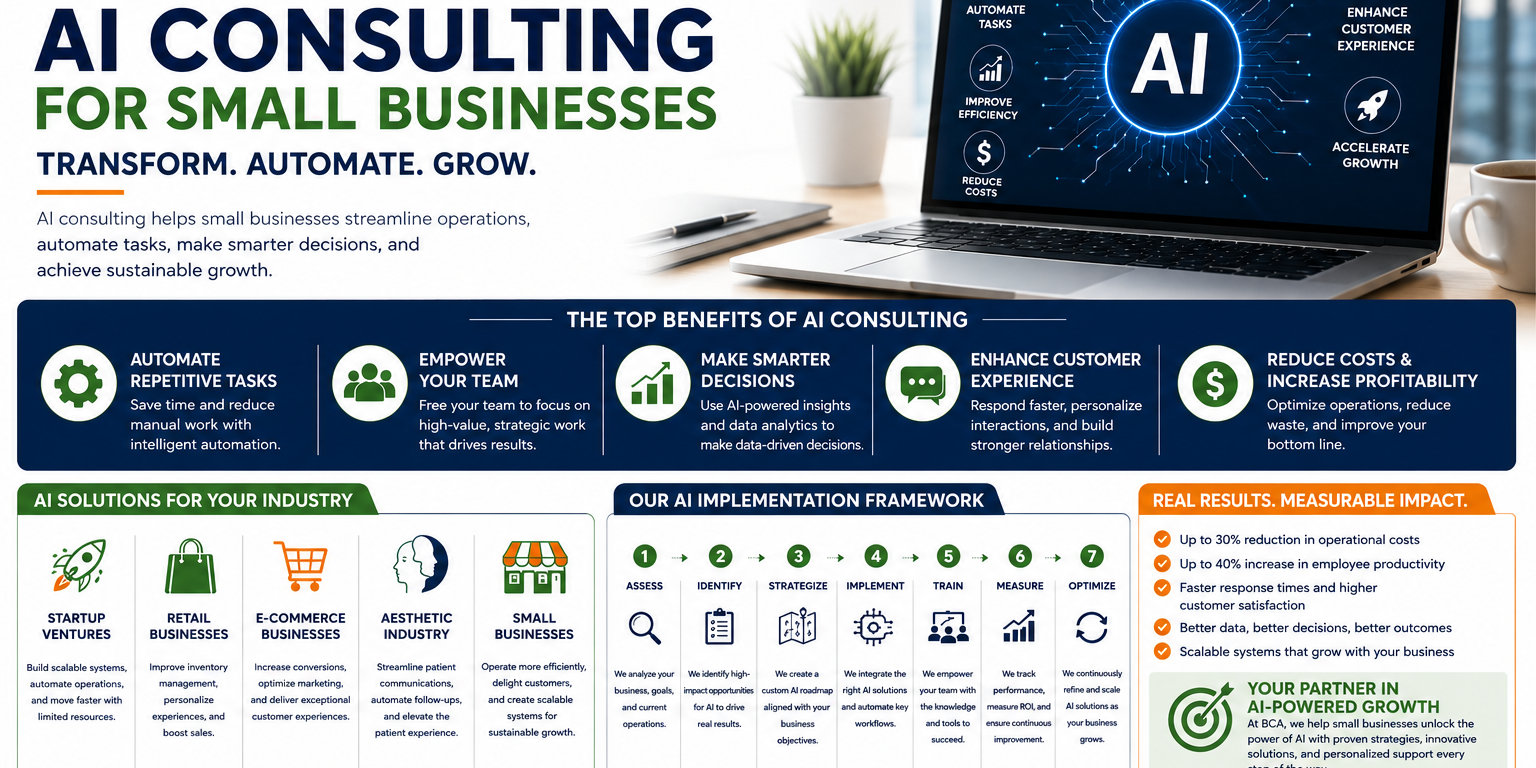
Instead, businesses often create additional complexity by introducing disconnected AI applications that employees struggle to adopt. Successful AI implementation follows a structured process. First, analyze business operations. Next, identify inefficiencies. Then, define measurable objectives, select appropriate technologies, integrate systems, train employees, measure performance, and continuously optimize.
This strategic methodology dramatically improves implementation success while maximizing return on investment.
How AI Consulting Creates Measurable Business Value
One of the biggest misconceptions surrounding artificial intelligence is that it simply replaces employees. In reality, successful AI implementation focuses on improving how businesses operate rather than eliminating people.
The greatest value comes from increasing efficiency, reducing operational friction, and allowing employees to focus on work that requires creativity, judgment, customer interaction, and relationship building.
Sales
Sales teams often spend more time performing administrative work than selling. AI consulting helps streamline lead qualification, CRM management, follow-up sequences, appointment scheduling, proposal generation, and sales forecasting. Instead of replacing sales professionals, AI allows them to spend more time speaking with qualified prospects.
Marketing
Marketing departments generate enormous amounts of data that are often difficult to analyze manually. AI can help businesses identify high-performing campaigns, generate content ideas, personalize customer messaging, improve email marketing, optimize advertising performance, and analyze customer behavior.
Rather than replacing marketing strategy, AI improves execution speed and decision-making. This is especially useful for retail, e-commerce, startup, and aesthetic businesses that depend on consistent lead generation and customer engagement.
Customer Service
Customer support is another area where AI creates immediate operational improvements. Businesses can automate frequently asked questions, appointment confirmations, status updates, review requests, customer onboarding, and support ticket routing. These improvements allow employees to focus on more complex customer interactions while improving overall response times.
Operations
Operations often present the greatest opportunity for business transformation. AI consultants frequently improve internal workflows, reporting systems, project management, inventory visibility, scheduling, team communication, and process documentation. Operational improvements compound over time because they affect nearly every department within the organization.
An AI Implementation Framework for Small Businesses
One reason many AI initiatives fail is the lack of a structured implementation plan. Rather than adopting technology randomly, businesses should follow a phased framework.
Phase 1: Business Assessment
Every successful project begins with understanding how the business currently operates. An AI consultant evaluates existing software, business objectives, operational bottlenecks, the customer journey, employee workflows, and current reporting capabilities. The goal is to identify where artificial intelligence will create measurable improvements.
Phase 2: AI Readiness Assessment
Not every business is equally prepared for AI adoption. An AI readiness assessment examines data quality, operational maturity, team readiness, technology infrastructure, process standardization, and security considerations. This assessment helps determine realistic implementation priorities.
Phase 3: Strategic Roadmap
Rather than implementing everything simultaneously, consultants develop a phased roadmap. The roadmap typically prioritizes high-impact opportunities, low implementation complexity, fast return on investment, scalability, and future integrations. This approach reduces risk while generating early wins that encourage broader adoption.
Phase 4: Implementation
Once priorities have been established, implementation begins. This may include software configuration, workflow automation, AI integrations, CRM optimization, staff onboarding, testing, and performance monitoring. Successful implementation focuses on operational improvement rather than technology alone.
Phase 5: Continuous Optimization
Artificial intelligence should never remain static. Businesses should continuously evaluate performance improvements, customer satisfaction, employee productivity, operational efficiency, revenue growth, and workflow enhancements. Organizations that continuously optimize AI systems often achieve the strongest long-term results.
AI Consulting by Industry
Although AI benefits nearly every business, implementation strategies vary significantly between industries. BCA should focus heavily on small businesses, startup ventures, retail, e-commerce, med spas, and the broader aesthetic industry because these sectors have strong modernization needs and clear commercial intent.
AI Consulting for Startup Ventures
Startup founders operate under constant pressure to grow quickly while managing limited resources. AI helps startups build lean operations, automate repetitive work, improve investor reporting, accelerate customer acquisition, manage customer support, and increase productivity. Instead of hiring large administrative teams early, startups can use AI to build scalable operational infrastructure from the beginning.
AI Consulting for Retail Businesses
Retail businesses face increasing competition from both online and physical competitors. AI helps retailers improve customer personalization, inventory forecasting, product recommendations, loyalty programs, marketing campaigns, and sales analytics. Operational improvements allow retailers to compete more effectively while improving customer experiences.
AI Consulting for E-Commerce Businesses
E-commerce businesses generate significant amounts of customer and sales data. Artificial intelligence helps optimize product recommendations, cart abandonment recovery, customer segmentation, email marketing, dynamic pricing, inventory management, and customer lifetime value analysis. Businesses that leverage AI effectively often increase conversion rates while improving operational efficiency.
AI Consulting for the Aesthetic Industry
The aesthetic industry is rapidly embracing artificial intelligence because patient communication and operational efficiency directly affect revenue. AI can support consultation scheduling, lead nurturing, appointment reminders, patient follow-up, treatment education, reputation management, review generation, and CRM automation.
Med spas, plastic surgery practices, dermatology clinics, skincare brands, and wellness clinics increasingly rely on AI to improve patient experiences while reducing administrative workload. These businesses often lose revenue through missed inquiries, slow follow-up, inconsistent consultation processes, and poor retention workflows. AI consulting helps solve those problems through better systems.
AI Consulting for Small Businesses
Small businesses often believe AI is too expensive or overly technical. In reality, they frequently experience the greatest return on investment because operational improvements affect every aspect of the organization. AI consulting allows smaller companies to compete with larger organizations by improving productivity, customer communication, operational efficiency, decision-making, workflow consistency, and growth scalability.
Measuring Return on Investment
Every AI implementation should produce measurable business outcomes. Instead of focusing on software features, businesses should evaluate results.
Important performance indicators may include faster lead response times, increased conversion rates, reduced administrative hours, improved customer satisfaction, higher employee productivity, lower operational costs, increased customer retention, faster project completion, and improved profitability.
Businesses that establish measurable objectives before implementation generally achieve stronger returns. This also helps leadership understand which AI initiatives should expand and which systems require additional optimization.
Choosing the Right AI Consultant
Selecting an AI consultant involves more than evaluating technical expertise. The best consultants understand both technology and business operations.
Look for consultants who begin with business strategy, understand operational efficiency, have implementation experience, focus on measurable outcomes, provide ongoing optimization, explain technology clearly, prioritize long-term scalability, and customize recommendations instead of selling generic solutions.
Technology should always support business objectives, not become the objective itself. A qualified AI consultant acts as a strategic partner who helps transform how a business operates rather than simply recommending software.
AI Trends That Will Shape Small Businesses Beyond 2026
Artificial intelligence continues to evolve quickly. Businesses that adopt AI strategically today will be better positioned to capitalize on the next generation of business technologies.
AI Will Become Embedded in Everyday Business Software
Rather than purchasing separate AI applications, businesses will increasingly use AI features built directly into the software they already rely on. Customer relationship management platforms, accounting software, project management systems, marketing platforms, and customer service tools are rapidly integrating AI capabilities.
Hyper-Personalized Customer Experiences
AI will help businesses deliver increasingly personalized experiences by analyzing customer behavior, purchase history, communication preferences, and engagement patterns. Businesses will be able to provide more relevant recommendations, faster support, and stronger customer relationships without dramatically increasing staff.
Smarter Business Intelligence
Business owners will spend less time manually reviewing reports and more time acting on AI-generated insights. Instead of only asking what happened last month, business leaders will increasingly ask why sales declined, which customers are most valuable, which campaign may perform best next quarter, and what operational bottlenecks should be addressed first.
Increased Operational Automation
Businesses will continue automating repetitive operational activities across every department. Examples include proposal generation, contract preparation, meeting summaries, internal reporting, customer onboarding, employee onboarding, scheduling coordination, inventory forecasting, and financial reporting.
AI Will Become a Competitive Requirement
Perhaps the biggest change over the next several years is that AI will no longer be viewed as an unusual competitive advantage. Instead, it will become part of standard business infrastructure. Organizations delaying adoption risk falling behind competitors that operate faster, make better decisions, and deliver stronger customer experiences.
Common AI Implementation Mistakes to Avoid
While AI presents enormous opportunities, many businesses still make avoidable implementation mistakes. Understanding these challenges can significantly improve long-term success.
Implementing Technology Without Strategy
Technology should support business goals. Businesses that purchase AI software without understanding operational challenges often experience disappointing results. Every implementation should begin with business objectives, not software demonstrations.
Trying to Automate Everything at Once
Large-scale implementations frequently overwhelm employees and create unnecessary disruption. Successful businesses usually begin with one or two high-impact operational improvements before expanding into additional automation projects. Small wins create momentum while reducing organizational resistance.
Ignoring Employee Adoption
Artificial intelligence succeeds only when employees understand how to use it effectively. Training, documentation, and change management remain essential components of successful implementation. Employees should view AI as a productivity tool rather than a replacement.
Focusing on Cost Instead of Value
Many businesses evaluate AI solely by subscription costs. A better approach is to evaluate hours saved, revenue generated, productivity improvements, customer satisfaction, employee efficiency, and operational scalability. The long-term business value often exceeds the software investment.
Failing to Measure Results
Without measurable goals, businesses cannot determine whether AI initiatives are successful. Every implementation should establish baseline metrics before deployment and compare performance over time. Continuous improvement remains one of the defining characteristics of successful AI adoption.
Frequently Asked Questions
What does an AI consultant do for a small business?
An AI consultant evaluates operations, identifies opportunities to improve efficiency, recommends appropriate AI technologies, develops an implementation strategy, and helps integrate AI into existing business processes.
Is AI consulting only for technology companies?
No. Businesses across nearly every industry can benefit from AI consulting. This includes retail, e-commerce, startup ventures, professional services, med spas, aesthetic clinics, skincare brands, and small businesses.
How much does AI consulting cost?
Costs vary depending on business size, project complexity, and implementation requirements. Many consulting engagements begin with an AI readiness assessment before moving into phased implementation.
How long does AI implementation take?
Simple workflow improvements may be completed within several weeks, while comprehensive operational transformation projects often require several months using a phased implementation approach.
Can AI replace employees?
Artificial intelligence is designed to improve productivity rather than replace entire teams. Most businesses use AI to automate repetitive work so employees can focus on higher-value responsibilities requiring creativity, communication, and strategic thinking.
How do I know if my business is ready for AI?
Businesses should begin with an AI readiness assessment that evaluates current operations, technology infrastructure, business goals, workflow maturity, and employee readiness before selecting AI solutions.
Transform Your Business with AI the Right Way
Artificial intelligence is fundamentally changing how businesses operate, compete, and grow. However, technology alone is not enough to create meaningful transformation. Long-term success depends on implementing AI with a clear strategy, measurable objectives, and a focus on operational excellence.
For small businesses, AI is no longer a future investment. It is a practical business tool that can improve productivity, strengthen customer relationships, reduce operational costs, and create scalable systems that support sustainable growth.
Whether you operate a startup, retail business, e-commerce company, professional service firm, med spa, skincare brand, or aesthetic practice, the businesses that begin modernizing today will be better positioned for tomorrow’s opportunities.
The most successful organizations will not simply adopt artificial intelligence. They will integrate it into their operations through thoughtful planning, continuous optimization, and a commitment to innovation.
Working with an experienced AI consulting partner helps ensure that every technology investment supports business goals, delivers measurable results, and creates a competitive advantage that continues to grow over time.