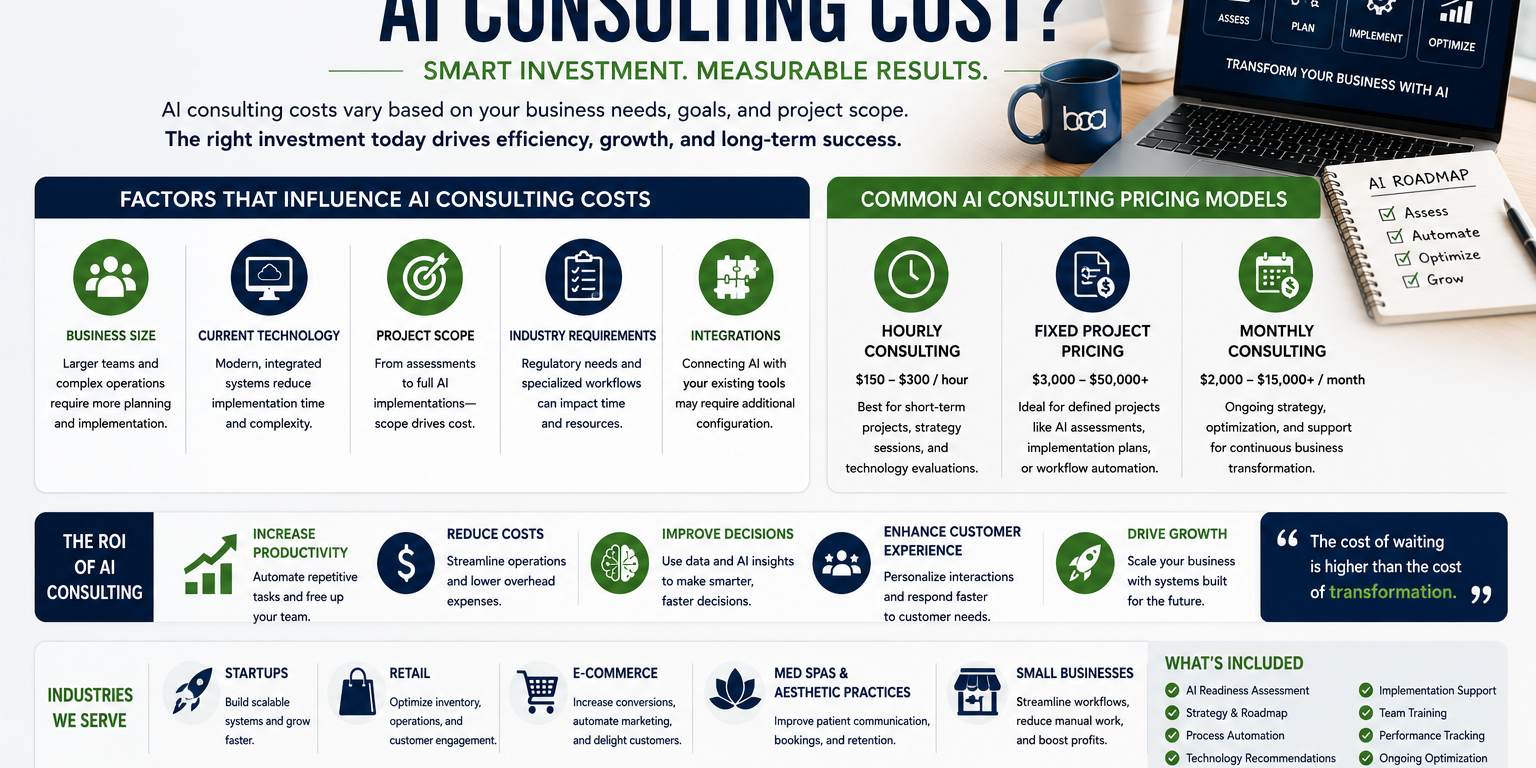
Artificial intelligence has quickly become one of the most valuable investments businesses can make to improve efficiency, reduce operational costs, and create scalable growth. From workflow automation and customer communication to predictive analytics and business intelligence, AI is helping organizations transform how they operate. AI consulting cost depends on several factors.
As interest in AI continues to grow, one of the first questions business owners ask is:
“How much does AI consulting cost?”
The answer depends on several factors, including the size of your business, the complexity of your operations, the scope of the project, and the level of implementation support required. While pricing varies significantly, understanding how AI consulting services are structured helps business owners make informed decisions and avoid investing in solutions that don’t deliver measurable value.
Rather than viewing AI consulting as a software expense, it should be considered a strategic investment in business transformation. A well-executed AI strategy often reduces operating costs, increases employee productivity, improves customer satisfaction, and creates long-term competitive advantages that far exceed the initial investment.
Why Businesses Hire AI Consultants
Many organizations recognize the potential of artificial intelligence but lack the internal expertise to determine where to begin.
Business owners often ask questions such as:
- Which AI tools should we use?
- Which processes should we automate first?
- How much should we invest?
- Will AI integrate with our existing software?
- How do we measure success?
An experienced AI consultant answers these questions while creating a roadmap tailored to the business.
Instead of experimenting with multiple software platforms, organizations gain a structured implementation strategy designed around measurable business outcomes.
Factors That Influence AI Consulting Costs
Every AI consulting project is different. Pricing depends on the goals, complexity, and scope of the engagement.
Business Size
A five-person company typically requires a different level of planning than a business with fifty or one hundred employees.
Larger organizations often have:
- More workflows
- Additional software platforms
- Larger teams
- Greater reporting requirements
- Multiple departments
These factors naturally increase project complexity.
Current Technology
Businesses already using cloud-based software, modern CRM systems, and integrated applications generally require less implementation work than organizations relying on outdated or disconnected systems.
Project Scope
Some companies only require an AI readiness assessment.
Others need:
- AI strategy development
- Workflow automation
- CRM implementation
- Staff training
- Ongoing optimization
- Executive consulting
The broader the project, the greater the investment.
Industry Requirements
Certain industries require additional planning due to regulatory requirements or specialized workflows.
Examples include:
- Healthcare
- Financial services
- Legal
- Manufacturing
- Aesthetic practices
Industry-specific expertise often adds significant value to an implementation.
Common AI Consulting Pricing Models
Most AI consultants structure pricing in one of several ways.
Hourly Consulting
Ideal for businesses seeking guidance on specific challenges or short-term projects.
Best suited for:
- Executive strategy sessions
- Technology evaluations
- AI planning
- Workflow reviews
Fixed Project Pricing
Many businesses prefer fixed pricing because budgets are predictable.
Projects often include:
- AI readiness assessments
- AI implementation roadmaps
- Workflow automation
- CRM optimization
- Employee training
Monthly Consulting
Businesses implementing AI across multiple departments often benefit from ongoing consulting relationships.
Monthly engagements commonly include:
- Strategic planning
- Performance reviews
- Continuous optimization
- New automation opportunities
- Executive advisory services
This approach supports long-term business transformation rather than isolated projects.
Should Small Businesses Invest in AI Consulting?
Absolutely.
Many business owners assume AI consulting is designed primarily for enterprise organizations.
In reality, small businesses frequently achieve the highest return on investment because operational improvements affect every department.
Artificial intelligence helps smaller organizations:
- Reduce repetitive work
- Improve customer communication
- Increase employee productivity
- Scale operations
- Make better decisions
- Improve profitability
Even modest efficiency gains can have a significant impact on a growing business.
What Should an AI Consulting Engagement Include?
A comprehensive consulting engagement should provide far more than software recommendations.
Look for services that include:
- Business assessment
- AI readiness evaluation
- Process analysis
- Implementation roadmap
- Technology recommendations
- Employee training
- Performance measurement
- Ongoing optimization
The goal is to improve business operations—not simply install technology.
The Cost of Waiting
Many businesses focus exclusively on the cost of implementing AI while overlooking the cost of delaying modernization.
Every month spent relying on inefficient manual processes may result in:
- Lost productivity
- Higher labor costs
- Slower customer response times
- Missed sales opportunities
- Reduced competitiveness
In many cases, the cost of inaction exceeds the investment required to begin implementing AI.
Industries That Benefit Most
AI consulting delivers measurable value across nearly every industry.
Some of the fastest adopters include:
Startup Ventures
Build scalable systems without increasing administrative overhead.
Retail Businesses
Improve inventory forecasting, customer engagement, and operational efficiency.
E-Commerce Companies
Automate marketing, customer service, product recommendations, and sales optimization.
Med Spas and Aesthetic Practices
Improve patient communication, consultation scheduling, lead nurturing, and reputation management.
Small Businesses
Reduce manual work, improve productivity, and create scalable operations regardless of industry.
Frequently Asked Questions
Is AI consulting expensive?
Pricing varies based on project complexity, but most businesses view AI consulting as an investment that generates measurable operational improvements rather than simply another business expense.
How long does an AI consulting project take?
Smaller projects may require only a few weeks, while larger business transformation initiatives are often implemented over several months using a phased approach.
What delivers the greatest return on investment?
Businesses typically experience the strongest ROI when they focus on automating repetitive workflows, improving customer communication, and integrating AI into core operational processes.
Can startups benefit from AI consulting?
Yes. Startups often use AI to build efficient, scalable operations while minimizing hiring costs during early growth stages.
Should I hire an AI consultant before purchasing software?
Yes. Developing a strategy before selecting technology helps businesses avoid unnecessary software purchases and ensures AI supports long-term business goals.
Investing in Business Transformation
Artificial intelligence is no longer a future technology. It has become a practical business tool capable of improving nearly every aspect of an organization. However, successful implementation requires more than purchasing software—it requires planning, strategy, and execution.
The value of AI consulting lies in helping businesses identify the highest-impact opportunities, avoid common implementation mistakes, and create a structured roadmap for long-term success.
Whether you operate a startup, retail company, e-commerce business, med spa, aesthetic practice, or another growing organization, partnering with an experienced AI consultant can accelerate modernization while ensuring every investment contributes to measurable business growth.