The excitement surrounding artificial intelligence continues to grow, but many organizations still struggle with one fundamental question: where do we begin? While AI technologies have become more accessible than ever, successful implementation requires far more than purchasing software or experimenting with chatbots. Companies that achieve measurable results follow a structured AI implementation roadmap that aligns technology with business objectives, operational processes, and long-term growth strategies. Considering an AI implementation roadmap for businesses is just good business.
Without a clear plan, businesses often invest in tools that fail to integrate with existing systems, create confusion among employees, or deliver little return on investment. An organized implementation strategy eliminates these risks while ensuring every AI initiative supports measurable business outcomes.
What Is an AI Implementation Roadmap?
An AI implementation roadmap is a structured plan that guides a business through the process of adopting artificial intelligence technologies. Instead of introducing AI randomly across departments, organizations establish clear priorities, timelines, budgets, responsibilities, and success metrics.
A comprehensive roadmap helps organizations:
- Identify high-impact automation opportunities.
- Prioritize projects based on return on investment.
- Prepare existing systems for AI integration.
- Train employees to work alongside AI technologies.
- Measure results through key performance indicators.
- Scale successful implementations across the business.
Businesses that approach AI strategically typically realize faster adoption, lower implementation costs, and greater operational improvements than companies that adopt AI without a defined framework.
Why Many AI Projects Fail
Artificial intelligence itself rarely causes implementation failures. Instead, businesses often underestimate the planning required before deploying new technologies.
Several common mistakes include:
- Purchasing AI software before defining business goals.
- Automating inefficient processes instead of improving them first.
- Failing to prepare employees for organizational change.
- Ignoring data quality and system integration.
- Attempting too many AI initiatives simultaneously.
These challenges create unnecessary complexity and reduce employee confidence. A carefully developed AI implementation roadmap minimizes these risks by establishing a logical sequence for adoption.
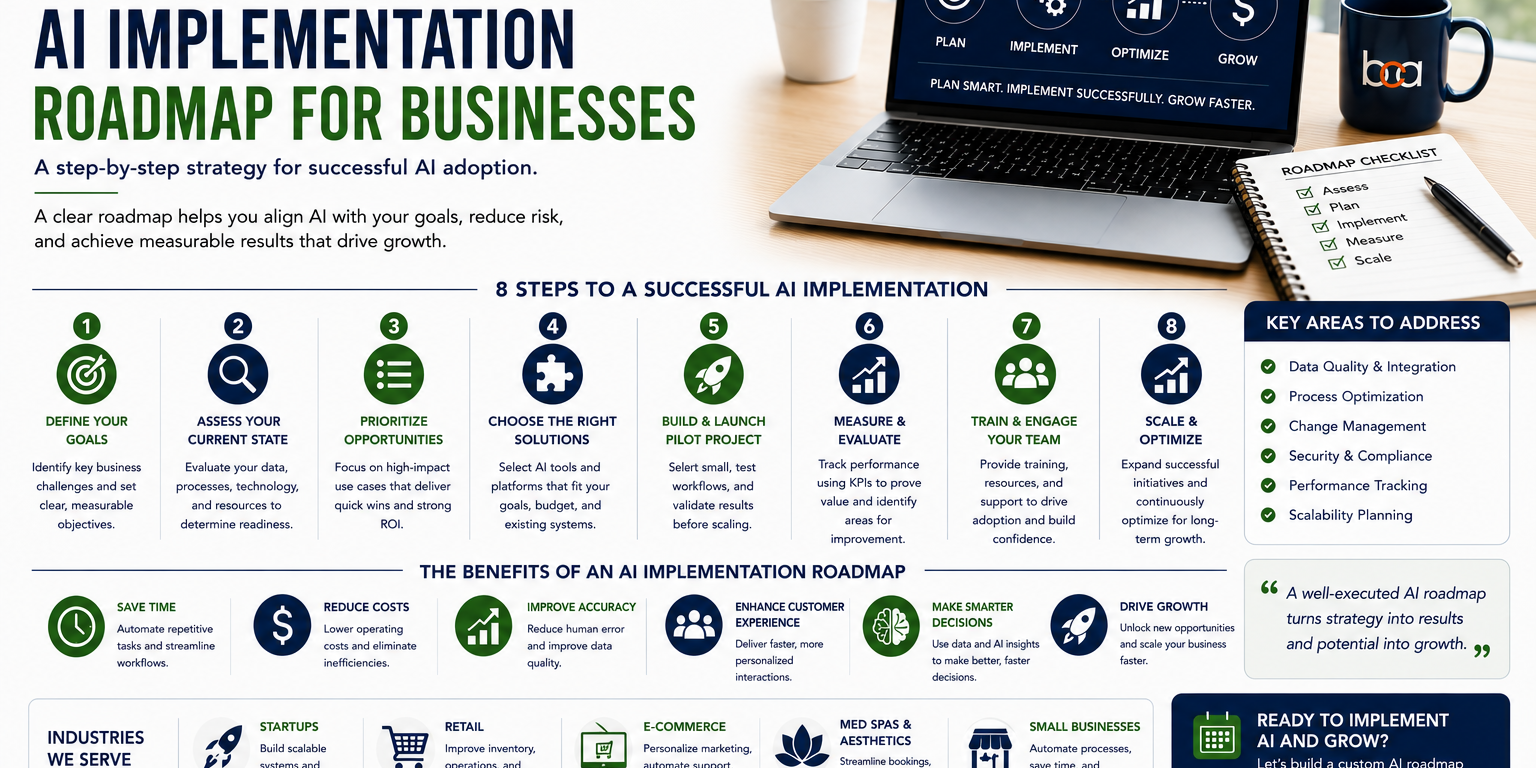
Step 1: Define Clear Business Objectives
Every successful AI initiative begins with a business problem rather than a technology solution.
Instead of asking:
“How can we use AI?”
Organizations should ask:
“What operational challenge creates the greatest financial impact?”
Examples include:
- Reducing administrative workloads.
- Improving customer response times.
- Increasing sales conversion rates.
- Eliminating repetitive manual tasks.
- Enhancing forecasting accuracy.
- Improving operational visibility.
When AI initiatives directly support measurable objectives, leadership can evaluate success using quantifiable business outcomes rather than subjective opinions.
Step 2: Assess Current Business Processes
Before implementing AI, businesses should thoroughly evaluate existing workflows.
Many organizations discover that inefficient processes simply become automated inefficiencies when AI is introduced without prior optimization.
A process assessment should evaluate:
- Current workflow efficiency.
- Manual data entry.
- Approval bottlenecks.
- Communication delays.
- Reporting limitations.
- Customer experience gaps.
This analysis identifies which processes should first be improved and which are ideal candidates for automation.
Step 3: Evaluate Organizational Readiness
Technology alone cannot transform an organization.
Leadership should evaluate several readiness factors before implementation.
Technology Infrastructure
Existing software platforms should integrate effectively with future AI solutions.
Questions include:
- Is customer data centralized?
- Are cloud systems already in place?
- Do departments share information efficiently?
- Can existing software communicate through APIs?
Data Quality
Artificial intelligence depends entirely on reliable information.
Organizations should review:
- Data accuracy.
- Duplicate records.
- Missing customer information.
- Reporting consistency.
- Security standards.
Poor data inevitably produces poor AI outcomes.
Employee Readiness
Successful implementation requires employee engagement rather than resistance.
Leadership should communicate:
- Why AI is being introduced.
- How daily work will improve.
- Which repetitive tasks will be eliminated.
- How employees will receive training.
Organizations that involve employees early often experience smoother adoption.
Step 4: Prioritize High-Impact Opportunities
Not every department requires AI immediately.
Businesses should focus first on initiatives that produce measurable value within several months.
Common early implementation opportunities include:
- Customer support automation.
- Sales lead qualification.
- Marketing content assistance.
- Internal knowledge management.
- Meeting summaries.
- Workflow approvals.
- Financial reporting.
- Document management.
Quick wins generate organizational confidence while providing valuable experience for future expansion.
Step 5: Select the Right AI Solutions
Choosing software simply because it includes artificial intelligence is rarely an effective strategy.
Instead, organizations should evaluate solutions based on several criteria.
Important considerations include:
- Ease of implementation.
- Integration capabilities.
- Security.
- Scalability.
- Vendor support.
- User experience.
- Reporting capabilities.
- Long-term cost.
The best solution is not necessarily the most advanced. It is the one that best supports existing business objectives.
Step 6: Launch a Pilot Program
Rather than deploying AI company-wide immediately, organizations should begin with a limited pilot.
Pilot implementations allow leadership to:
- Test workflows.
- Measure productivity improvements.
- Collect employee feedback.
- Resolve technical issues.
- Refine processes.
- Build internal success stories.
Once measurable improvements are demonstrated, expansion becomes significantly easier.
Step 7: Measure Performance
AI initiatives should always include clearly defined performance indicators.
Typical metrics include:
- Hours saved.
- Cost reduction.
- Revenue growth.
- Customer satisfaction.
- Response time.
- Employee productivity.
- Error reduction.
- Sales conversion improvements.
Without measurable performance, businesses cannot accurately evaluate return on investment.
Step 8: Scale Across the Organization
Once initial projects succeed, organizations can expand AI into additional departments.
A phased expansion often includes:
- Finance.
- Human resources.
- Marketing.
- Sales.
- Customer service.
- Operations.
- Executive reporting.
This structured approach reduces disruption while continuously improving organizational performance.
Common AI Implementation Challenges
Although every organization is unique, most businesses encounter similar obstacles during implementation.
These include:
- Employee resistance to change.
- Poor documentation.
- Inconsistent business processes.
- Data quality issues.
- Unrealistic expectations.
- Lack of executive sponsorship.
Addressing these challenges early significantly improves long-term success.
Best Practices for Long-Term AI Success
Organizations achieving the greatest return from AI typically follow several consistent practices.
They:
- Begin with clearly defined objectives.
- Improve processes before automating them.
- Invest in employee education.
- Measure every implementation.
- Expand gradually.
- Continuously optimize workflows.
- Align technology with business strategy.
AI should evolve alongside the business rather than becoming a one-time technology project. Considering an AI implementation roadmap for businesses is just good business.
How Business Consulting Agency Helps Businesses Grow
Artificial intelligence delivers its greatest value when it becomes part of a comprehensive business strategy rather than an isolated technology initiative.
Business Consulting Agency works with organizations to develop customized AI implementation roadmaps that align automation with operational goals, revenue growth, and long-term scalability. From evaluating existing workflows to identifying automation opportunities and guiding implementation, our consulting approach helps businesses reduce risk while accelerating measurable results.
Whether your organization is beginning its AI journey or expanding existing initiatives, a structured roadmap provides the clarity needed to make informed decisions and maximize return on investment.
Key Takeaways
Artificial intelligence is transforming how businesses operate, but successful implementation depends on careful planning rather than technology alone. A well-designed AI implementation roadmap helps organizations identify the right opportunities, prepare employees, optimize workflows, and measure meaningful business outcomes.
Companies that adopt AI strategically position themselves for greater operational efficiency, stronger customer experiences, and sustainable competitive advantages. By following a structured implementation process, businesses can reduce uncertainty while building a scalable foundation for future innovation.
Frequently Asked Questions
| Question | Answer |
|---|---|
| What is an AI implementation roadmap? | It is a structured plan that guides organizations through adopting artificial intelligence while aligning technology with business goals. |
| How long does AI implementation take? | Most initial projects can be planned and launched within several weeks to several months, depending on complexity and organizational readiness. |
| Should small businesses create an AI implementation roadmap? | Yes. Smaller organizations often benefit even more because a structured approach helps maximize limited resources and avoid costly mistakes. |
| What departments benefit most from AI? | Customer service, marketing, sales, operations, finance, and human resources frequently achieve significant productivity improvements through AI. |
| Why should businesses work with an AI implementation consultant? | An experienced consultant helps identify the highest-value opportunities, reduce implementation risks, improve adoption, and accelerate measurable business results. |