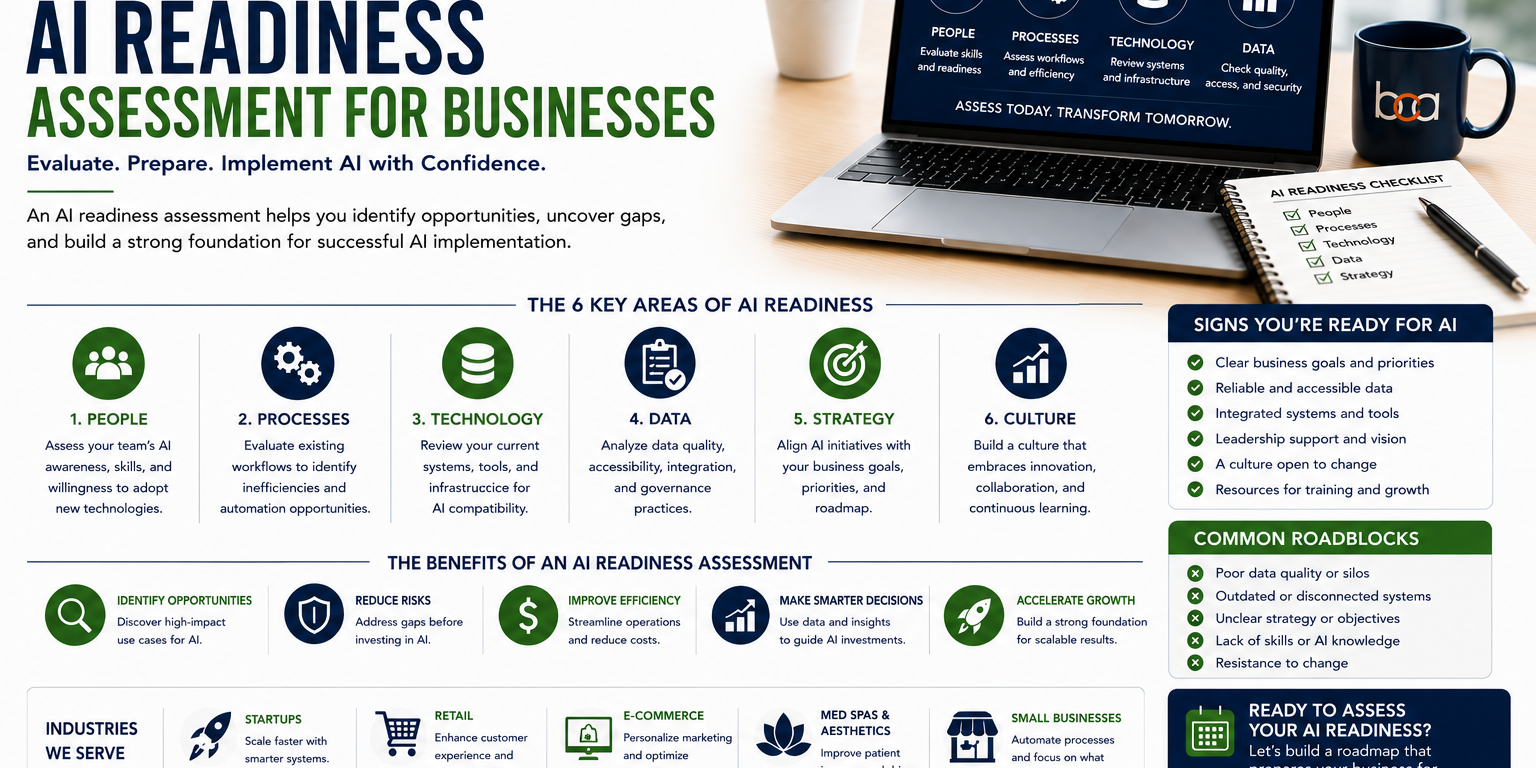
Artificial intelligence is no longer reserved for large enterprises with dedicated technology teams and multi-million-dollar budgets. Businesses of every size are adopting AI to automate repetitive tasks, improve customer experiences, streamline operations, and make faster, data-driven decisions. However, purchasing AI software is only one part of a successful implementation. Before investing in new technologies, organizations should determine whether they are truly prepared for the transition. An AI readiness assessment provides the foundation for successful adoption by evaluating your current business environment, identifying opportunities for improvement, and creating a practical roadmap for implementation.
Many organizations rush into AI initiatives because competitors are doing the same. Unfortunately, this often leads to disappointing results. Poor data quality, disconnected systems, inefficient workflows, and a lack of employee preparation can quickly derail even the most promising AI projects. Conducting an AI readiness assessment helps businesses avoid these common pitfalls while ensuring every investment supports measurable business goals.
What Is an AI Readiness Assessment?
An AI readiness assessment is a comprehensive evaluation that measures how prepared an organization is to adopt artificial intelligence. Rather than focusing only on technology, it examines the people, processes, systems, and data that support successful implementation.
The purpose of the assessment is to answer one important question:
Is your business ready to leverage AI effectively?
A complete assessment typically evaluates:
- Business objectives
- Existing workflows
- Technology infrastructure
- Data quality
- Employee readiness
- Leadership support
- Security and compliance
- Opportunities for automation
The results provide a clear understanding of your organization’s strengths, weaknesses, and priorities before investing in AI solutions.
Why Every Business Should Start with an Assessment
AI is most successful when it solves clearly defined business challenges. Organizations that skip the planning phase often implement software without understanding how it fits into their operations.
An AI readiness assessment reduces uncertainty by helping businesses:
- Identify high-impact automation opportunities
- Reduce implementation risks
- Improve technology investments
- Increase employee adoption
- Create measurable business outcomes
- Build a scalable AI strategy
Instead of reacting to technology trends, organizations develop a strategic plan that aligns AI initiatives with long-term business objectives.
The Four Pillars of AI Readiness
Successful AI implementation depends on more than purchasing the right software. Businesses should evaluate four essential areas before moving forward.
1. Business Processes
Artificial intelligence performs best when supporting efficient processes. If workflows are poorly designed, automation simply accelerates existing problems.
Review your operations by identifying:
- Manual data entry
- Repetitive administrative work
- Approval bottlenecks
- Customer service delays
- Communication inefficiencies
- Duplicate processes
Improving these workflows before implementation significantly increases AI’s effectiveness.
2. Technology Infrastructure
AI solutions rely on connected systems that can exchange information efficiently.
Your assessment should examine whether your business has:
- Modern CRM software
- Cloud-based applications
- Integrated business systems
- Secure infrastructure
- API connectivity
- Reliable reporting capabilities
Organizations with outdated or disconnected software may need infrastructure improvements before implementing AI.
3. Data Quality
Artificial intelligence depends entirely on data. Poor-quality information produces poor-quality results.
Evaluate whether your business data is:
- Accurate
- Consistent
- Current
- Organized
- Accessible
- Secure
Clean, reliable data allows AI systems to generate meaningful insights and automate tasks with confidence.
4. Organizational Readiness
Technology adoption ultimately depends on people.
Leadership should evaluate:
- Employee knowledge
- Change management processes
- Executive support
- Training requirements
- Internal communication
- Department collaboration
Businesses that prepare employees early typically experience higher adoption rates and stronger long-term success.
Signs Your Business Is Ready for AI
Many business owners wonder whether now is the right time to begin implementing AI. While every organization is different, several indicators suggest that your company is well-positioned for adoption.
You may be ready if your business:
- Performs repetitive manual tasks every day
- Uses cloud-based software
- Maintains organized customer data
- Has documented business processes
- Wants to improve operational efficiency
- Is focused on scalable growth
- Needs better reporting and business insights
- Has leadership committed to innovation
These characteristics often indicate that AI can provide measurable operational improvements.
Common Challenges Businesses Face
Even organizations with strong technology environments encounter obstacles during AI implementation.
Some of the most common challenges include:
- Legacy software that does not integrate
- Inconsistent business data
- Employee resistance to change
- Limited internal AI expertise
- Poor process documentation
- Unclear business priorities
- Unrealistic expectations
Identifying these issues during the assessment phase allows businesses to address them before implementation begins.
The Benefits of an AI Readiness Assessment
Conducting an AI readiness assessment offers far more than technical insights. It helps businesses make informed decisions that support long-term growth.
Organizations often experience benefits such as:
- Reduced implementation risk
- Better investment decisions
- Faster deployment
- Increased employee confidence
- Improved productivity
- Lower operating costs
- Higher return on investment
- Better customer experiences
Rather than implementing AI for the sake of innovation, businesses focus on initiatives that create measurable value.
Best Practices Before Implementing AI
A successful implementation begins with careful planning.
Before introducing AI into your organization, consider these best practices:
- Establish clear business objectives.
- Improve inefficient workflows.
- Clean and organize business data.
- Evaluate existing software integrations.
- Prioritize projects with the highest potential return.
- Prepare employees through education and communication.
- Start with a pilot project before scaling.
- Measure results continuously and refine your strategy.
Following these practices reduces risk while improving implementation success.
Developing an AI Roadmap
Once your assessment is complete, the next step is creating an implementation roadmap.
An effective roadmap should include:
- Business priorities
- AI opportunities
- Project timelines
- Technology requirements
- Budget estimates
- Employee training plans
- Performance metrics
- Long-term expansion goals
Rather than attempting to automate every department at once, organizations should focus on high-impact initiatives that deliver quick wins and build momentum for future projects.
How Business Consulting Agency Helps Businesses Grow
Artificial intelligence is most effective when it supports a well-defined business strategy. At Business Consulting Agency, we help organizations evaluate their AI readiness by examining operations, technology, workflows, and growth objectives. Our consultants identify automation opportunities, uncover operational inefficiencies, and develop customized AI implementation strategies that reduce risk while maximizing long-term value.
Whether your organization is exploring AI for the first time or preparing for a larger digital transformation initiative, our structured consulting approach provides the clarity and direction needed to make informed decisions with confidence.
Key Takeaways
Artificial intelligence has the potential to transform how businesses operate, but successful implementation begins long before new software is deployed. An AI readiness assessment helps organizations understand whether their people, processes, technology, and data are prepared to support meaningful AI adoption.
By evaluating your current business environment and creating a structured implementation roadmap, you can reduce risk, improve operational efficiency, and position your organization for long-term growth. Businesses that invest in preparation consistently achieve stronger results than those that adopt AI without a clear strategy.
Frequently Asked Questions
What is an AI readiness assessment?
An AI readiness assessment evaluates your organization’s people, processes, technology, and data to determine whether your business is prepared to successfully implement artificial intelligence.
Why is an AI readiness assessment important?
It helps identify implementation challenges, prioritize opportunities, reduce risks, and develop a strategic roadmap before investing in AI technologies.
How long does an AI readiness assessment take?
The timeframe depends on the size and complexity of the organization. Most assessments can be completed within a few days to several weeks.
What should businesses evaluate before implementing AI?
Businesses should review their business processes, technology infrastructure, data quality, employee readiness, leadership support, and overall business objectives.
Can small businesses benefit from an AI readiness assessment?
Absolutely. Small and mid-sized businesses often achieve the greatest return because an assessment helps them prioritize high-impact AI initiatives while avoiding unnecessary technology investments.