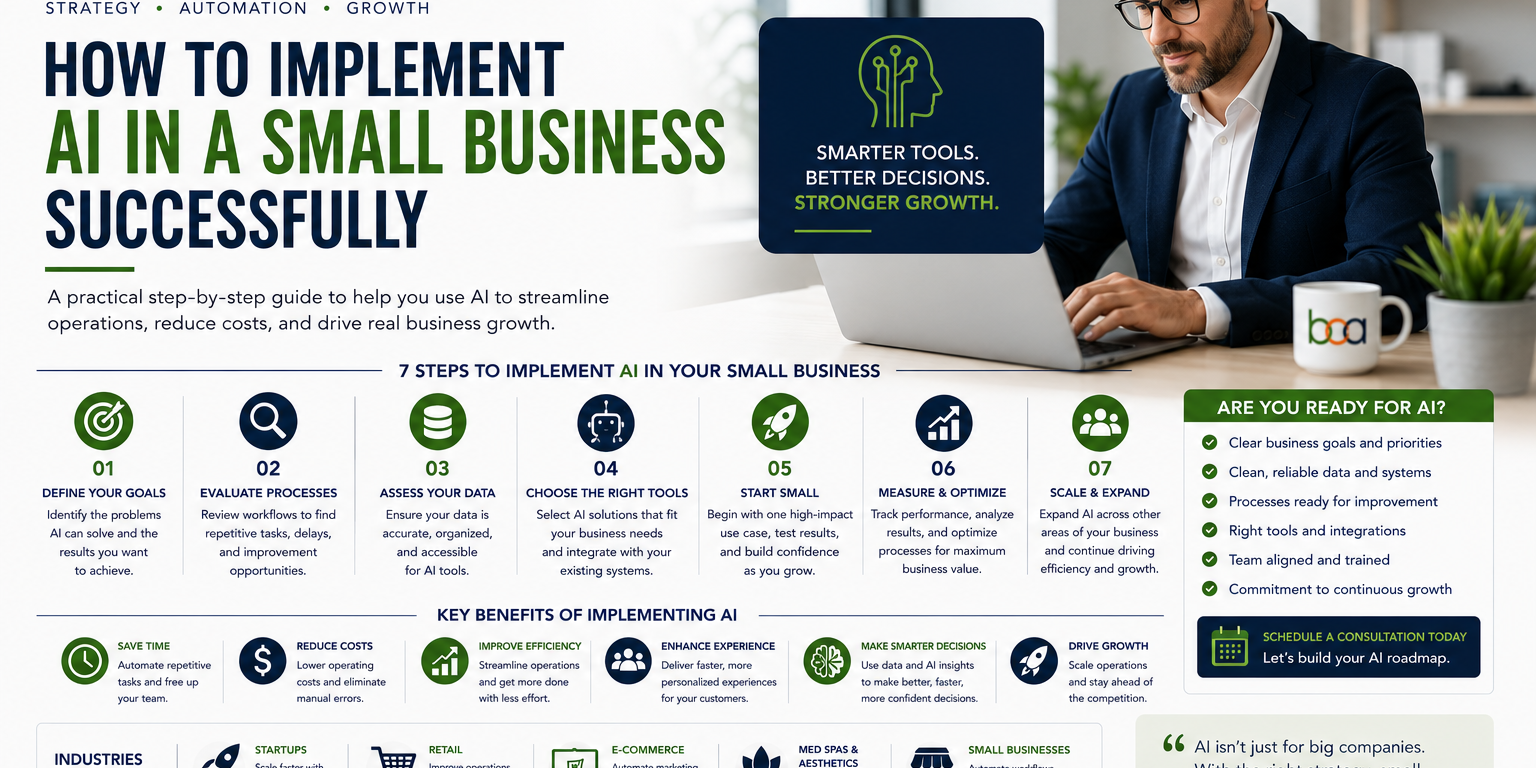
Artificial intelligence has become one of the most valuable technologies available to small businesses. What was once limited to large enterprises with significant technology budgets is now accessible to organizations of every size. From automating administrative work to improving customer service and streamlining operations, AI offers practical solutions that help businesses operate more efficiently and remain competitive. However, many business owners still ask the same question: how do you implement AI in a small business without disrupting daily operations or making expensive mistakes?
The answer begins with strategy rather than software. Successful AI adoption is not about purchasing the latest platform or automating every department overnight. It is about identifying the right opportunities, preparing your business, and implementing AI where it will deliver measurable value. Businesses that follow a structured approach are far more likely to achieve lasting results than those that adopt AI without a clear plan.
Why Small Businesses Should Invest in AI
Many business owners assume AI is only practical for large corporations. In reality, smaller organizations often benefit even more because automation allows them to accomplish more with limited staff and resources.
Implementing AI can help small businesses:
- Reduce repetitive manual work.
- Improve customer response times.
- Increase employee productivity.
- Lower operational costs.
- Generate better business insights.
- Scale operations more efficiently.
- Improve customer satisfaction.
- Support long-term business growth.
Instead of replacing employees, AI enables teams to focus on higher-value work that requires creativity, strategic thinking, and relationship building.
Step 1: Identify Your Business Goals
The first step in learning how to implement AI in a small business is defining exactly what you want to improve.
Rather than asking, “How can we use AI?” ask questions such as:
- Which tasks consume the most employee time?
- Where do delays occur?
- Which processes are repetitive?
- What prevents the business from scaling?
- Which customer experiences could be improved?
Answering these questions helps prioritize projects that deliver the greatest return on investment.
Step 2: Evaluate Existing Business Processes
Artificial intelligence works best when supporting efficient workflows. Automating broken processes simply allows mistakes to happen faster.
Before implementing AI, review your existing operations by identifying:
- Manual approvals.
- Repetitive administrative tasks.
- Duplicate data entry.
- Customer communication delays.
- Reporting inefficiencies.
- Bottlenecks between departments.
Improving these processes first creates a stronger foundation for automation.
Step 3: Assess Your Technology
Many AI tools integrate with existing business software. However, outdated systems or disconnected applications can create unnecessary challenges.
Evaluate whether your business currently uses:
- Cloud-based software.
- CRM platforms.
- Accounting systems.
- Marketing automation tools.
- Project management software.
- Collaboration platforms.
Businesses with modern, connected systems usually experience faster AI implementation.
Step 4: Organize Your Business Data
Artificial intelligence depends on reliable information. Before introducing AI, businesses should review the quality of their data.
Consider whether your information is:
- Accurate.
- Organized.
- Up to date.
- Secure.
- Consistent.
- Easily accessible.
Well-organized data allows AI systems to produce more accurate recommendations and automate tasks more effectively.
Step 5: Start Small
One of the biggest mistakes businesses make is attempting to automate everything at once.
Instead, begin with one or two high-impact projects that can demonstrate measurable improvements.
Good starting points include:
- Customer support.
- Appointment scheduling.
- Email management.
- Lead qualification.
- Internal documentation.
- Meeting summaries.
- Marketing content assistance.
- Sales follow-up.
Quick wins build confidence while allowing employees to become comfortable using AI.
Common AI Applications for Small Businesses
Artificial intelligence continues to expand across nearly every business function.
Popular applications include:
- Customer service chatbots.
- Sales automation.
- Marketing content creation.
- Predictive analytics.
- Inventory forecasting.
- Financial reporting.
- Workflow automation.
- Knowledge management.
Each implementation should support clearly defined business objectives rather than adopting technology simply because it is available.
Mistakes to Avoid
Understanding how to implement AI in a small business also means avoiding common implementation mistakes.
Businesses should avoid:
- Purchasing software without a strategy.
- Ignoring employee training.
- Automating inefficient workflows.
- Setting unrealistic expectations.
- Choosing too many projects simultaneously.
- Neglecting data quality.
- Failing to measure results.
A thoughtful implementation process almost always outperforms a rushed deployment.
Measuring Success
Every AI initiative should include measurable performance indicators.
Track metrics such as:
- Hours saved each week.
- Cost reductions.
- Customer response times.
- Employee productivity.
- Sales conversion rates.
- Customer satisfaction.
- Operational efficiency.
- Revenue growth.
Monitoring these metrics helps determine whether AI is delivering meaningful business value.
Why Strategy Matters More Than Technology
Technology evolves rapidly, but successful implementation depends on business strategy.
Organizations that understand how to implement AI in a small business focus on solving operational challenges before selecting software. This approach produces stronger long-term results while reducing unnecessary expenses.
Rather than viewing AI as a technology project, successful companies treat it as part of a broader business transformation strategy designed to improve efficiency, profitability, and scalability.
How Business Consulting Agency Helps Businesses Grow
Business Consulting Agency helps organizations implement artificial intelligence through practical, business-focused consulting. We work with companies to evaluate operational readiness, identify automation opportunities, develop implementation strategies, and integrate AI solutions that align with long-term business goals. Our consulting approach focuses on measurable outcomes, ensuring every AI initiative improves efficiency, supports growth, and delivers a meaningful return on investment.
Whether your organization is beginning its AI journey or expanding existing automation initiatives, our experienced consultants help you implement AI with confidence and clarity.
Key Takeaways
Learning how to implement AI in a small business begins with preparation rather than technology. Businesses that define clear goals, optimize existing processes, organize their data, and introduce AI strategically achieve stronger results than those that rush implementation.
As artificial intelligence continues to evolve, small businesses that embrace thoughtful adoption will be better positioned to improve productivity, reduce operational costs, and compete more effectively. By following a structured implementation strategy, organizations can transform AI into a valuable competitive advantage rather than simply another technology investment.
Frequently Asked Questions
How do you implement AI in a small business?
Begin by identifying business goals, evaluating current processes, organizing your data, selecting appropriate AI tools, and implementing solutions gradually while measuring results.
Is AI affordable for small businesses?
Yes. Many AI platforms offer affordable subscription pricing, allowing small businesses to automate operations without large upfront investments.
What is the first department that should use AI?
Customer service, sales, marketing, and administrative operations are often excellent starting points because they contain repetitive, time-consuming tasks.
How long does AI implementation take?
Simple AI solutions can often be implemented within weeks, while larger business transformation initiatives may take several months.
Should small businesses hire an AI consultant?
An experienced AI consultant can help identify the highest-value opportunities, avoid costly implementation mistakes, and develop a strategy that aligns AI investments with long-term business goals.