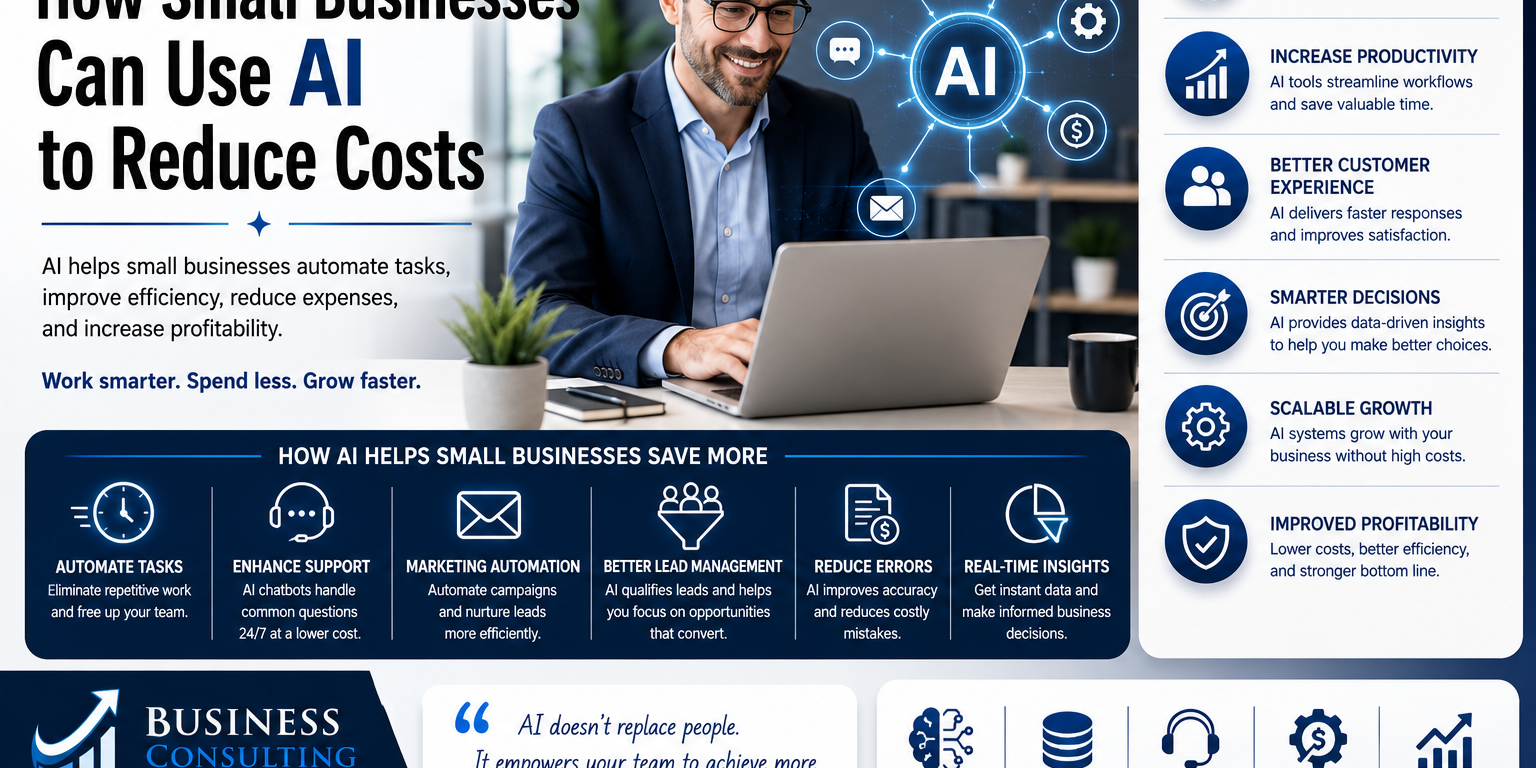
AI for small businesses is becoming one of the most effective ways to improve profitability without increasing overhead. Many organizations face rising labor costs, growing competition, and increasing customer expectations. Therefore, business owners are searching for smarter ways to operate. Fortunately, artificial intelligence offers practical solutions that help companies reduce expenses while improving efficiency. As a result, businesses can accomplish more without dramatically increasing resources.
Many organizations assume AI is only for large corporations. However, that assumption is no longer accurate. Today, affordable AI tools help companies automate tasks, streamline workflows, and improve customer experiences. Consequently, small businesses can compete more effectively than ever before. Furthermore, organizations that embrace automation often improve profitability faster than those relying solely on traditional processes.
Why AI for Small Businesses Continues to Grow
Business owners face constant pressure to improve efficiency. At the same time, customers expect faster responses and better service experiences. Therefore, many organizations are turning to AI-powered solutions.
Artificial intelligence helps companies automate repetitive activities while improving productivity. As a result, teams spend less time on routine work and more time on strategic initiatives. Furthermore, AI allows businesses to scale operations without significantly increasing costs.
Key reasons businesses are adopting AI include:
• Reducing operating expenses
• Increasing productivity
• Improving customer service
• Streamlining workflows
• Supporting business growth
• Improving decision-making
• Increasing profitability
These advantages create stronger and more scalable organizations.
Reduce Administrative Costs Through Automation
Administrative work consumes valuable employee time. However, many administrative activities follow predictable patterns. Therefore, they are ideal candidates for automation.
When repetitive tasks are automated, employees can focus on higher-value responsibilities. As a result, efficiency improves across multiple departments. Additionally, organizations often reduce labor costs while increasing productivity.
Common administrative activities that AI can automate include:
• Appointment scheduling
• Calendar management
• Data entry
• Invoice processing
• Document organization
• Email management
These improvements help businesses operate more efficiently.
Improve Customer Service Without Expanding Payroll
Customer service plays a critical role in business success. However, growing support teams can become expensive. Fortunately, AI allows organizations to improve customer experiences while controlling costs.
Many businesses now use AI-powered chat systems and automated communication tools. Consequently, customers receive faster responses. Meanwhile, support staff can focus on more complex requests.
Popular customer service applications include:
• AI chatbots
• Automated scheduling
• Instant lead responses
• FAQ automation
• Customer support workflows
• Lead qualification systems
These tools improve customer satisfaction while reducing support costs.
Use AI to Improve Marketing Performance
Marketing requires consistent effort. Nevertheless, many marketing activities are repetitive and time-consuming. Therefore, AI has become a valuable tool for modern marketing teams.
AI helps businesses create content, automate campaigns, and improve audience targeting. As a result, marketing becomes more efficient and scalable. Furthermore, organizations often generate stronger results without increasing budgets.
AI-powered marketing activities include:
• Content creation
• Email marketing
• Audience segmentation
• Campaign scheduling
• Social media management
• Lead nurturing
These systems help businesses improve marketing performance while reducing workloads.
Increase Sales Efficiency Through Automation
Sales teams frequently spend too much time on administrative tasks. Consequently, less time is available for revenue-generating activities. Fortunately, AI helps eliminate many of these inefficiencies.
When routine sales activities are automated, sales professionals can focus on building relationships and closing opportunities. As a result, productivity often increases significantly. Furthermore, automated systems help ensure that no lead is overlooked.
Important sales applications include:
• Lead scoring
• Automated follow-up
• CRM automation
• Sales forecasting
• Opportunity tracking
• Customer communication
These capabilities support stronger sales performance and revenue growth.
Automate Repetitive Business Processes
Many businesses still rely on manual workflows. Unfortunately, these processes often create delays, inconsistencies, and unnecessary costs. Therefore, workflow automation remains one of the most valuable AI opportunities available.
AI-powered systems can automate processes throughout the organization. Consequently, businesses improve efficiency while reducing operational complexity. Additionally, automation often improves accuracy and consistency.
Common workflow automation opportunities include:
• Employee onboarding
• Vendor management
• Purchase approvals
• Project tracking
• Internal reporting
• Customer follow-up
These improvements help organizations scale more effectively.
Improve Financial Visibility and Cost Control
Financial management becomes easier when business owners have access to better information. Therefore, many organizations now use AI to improve financial visibility.
AI can analyze large amounts of financial data quickly. As a result, business leaders gain insights that support smarter decisions. Furthermore, these systems often identify opportunities to reduce expenses.
Financial applications include:
• Expense monitoring
• Budget analysis
• Revenue forecasting
• Cash flow projections
• Vendor spending reviews
• Financial reporting
These tools support stronger financial management and profitability.
Strengthen Business Decision-Making
Successful businesses make decisions based on data rather than assumptions. Consequently, business intelligence tools continue to gain popularity.
AI helps organizations identify patterns, trends, and opportunities. As a result, leaders gain greater confidence in their decisions. Moreover, businesses can respond more quickly to changing market conditions.
Business intelligence benefits include:
• Faster reporting
• Trend analysis
• Customer insights
• Performance monitoring
• Market evaluation
• Growth forecasting
These capabilities support more strategic decision-making.
Reduce Customer Acquisition Costs
Acquiring customers can be expensive. However, AI helps organizations improve efficiency throughout the sales and marketing process.
When businesses target the right prospects, conversion rates often improve. Furthermore, automated nurturing systems keep leads engaged throughout the buying journey. Consequently, acquisition costs frequently decline.
AI-driven customer acquisition strategies include:
• Audience targeting
• Predictive analytics
• Lead qualification
• Automated nurturing
• Customer segmentation
• Conversion optimization
These strategies improve marketing efficiency and return on investment.
Build Scalable Business Systems
One of the greatest benefits of AI for small businesses is scalability. Traditionally, growth required additional staff and increased expenses. However, automation allows businesses to expand more efficiently.
When organizations implement scalable systems early, future growth becomes easier to manage. As a result, profitability often improves as operations expand. Furthermore, scalable systems help businesses maintain consistency during growth.
Examples of scalable AI systems include:
• Customer support automation
• Marketing automation
• Workflow automation
• Reporting automation
• CRM automation
• Business intelligence platforms
These systems support sustainable business growth.
Long-Term Benefits of AI Adoption
Many businesses initially adopt AI to reduce costs. However, the benefits often extend far beyond expense reduction. Consequently, organizations frequently discover additional opportunities for improvement.
As AI becomes integrated throughout operations, efficiency improves across multiple departments. Furthermore, better systems create stronger customer experiences. As a result, profitability often increases steadily over time.
Long-term benefits include:
• Lower operating costs
• Increased productivity
• Better customer experiences
• Stronger profitability
• Greater scalability
• Improved decision-making
• Faster growth
• Increased competitiveness
These advantages support long-term business success.
Key Takeaways
AI for small businesses provides practical opportunities to reduce costs, improve productivity, and strengthen profitability. Furthermore, modern AI tools are affordable, accessible, and increasingly easy to implement. Therefore, businesses of every size can benefit from automation and intelligent systems.
Core takeaways include:
• Automate repetitive tasks
• Improve customer service
• Increase sales efficiency
• Reduce operating costs
• Improve decision-making
• Build scalable systems
These strategies help organizations grow while improving profitability.
Q&A
| Question | Answer |
|---|---|
| What is AI for small businesses? | AI for small businesses refers to technology that automates tasks, improves efficiency, and supports growth. |
| Can AI reduce operating costs? | Yes. AI reduces manual work, improves productivity, and streamlines operations. |
| Which departments benefit most from AI? | Customer service, sales, marketing, administration, and operations often benefit significantly. |
| Is AI affordable for small businesses? | Yes. Many AI solutions offer affordable pricing designed for smaller organizations. |
| Does AI replace employees? | Most businesses use AI to improve employee productivity rather than replace workers. |
How Business Consulting Agency Helps Businesses Grow
Business Consulting Agency helps organizations implement AI solutions, automate workflows, modernize operations, and build scalable business systems. Furthermore, we help business owners identify inefficiencies, reduce costs, improve productivity, and strengthen profitability.
Whether a company needs workflow automation, marketing automation, CRM optimization, customer service improvements, or broader digital transformation initiatives, Business Consulting Agency provides practical solutions designed to generate measurable business results. Consequently, organizations become more efficient, more profitable, and better positioned for long-term growth.